
Stonkholders,
Nine days ago, management filed a brief explaining that the denominator had survived its first pressure test.
The market has since assigned that denominator a very different price.
That alone would not justify another filing. The repricing is more interesting because it arrived with three developments that change how StonkFun can be evaluated.
First, Pons has become a live comparable: a revenue-producing launch and trading system with token repurchases that has itself undergone a violent rerating at substantially greater scale.
Second, StonkFun's product surface has widened beyond the original stock-paired framing into markets paired against increasingly varied tokenized assets.
Third, the migration onto Raydium LaunchLab is becoming more than a routine integration. Custom quote support and rewards-related program work sit on top of an infrastructure whose standard quote assets are SOL, USDC and RAY.
The question is no longer simply whether StonkFun's mechanism works.
It is what the market is beginning to pay for the category — and what StonkFun would need to prove for that higher multiple to persist.
The denominator survived. The multiple did not.
Brief 009 was useful because it was filed after StonkFun's first meaningful drawdown. Trailing revenue had come off its peak, yet cumulative revenue and repurchases continued to rise.
The late-August picture is different.
Exhibit A · Since Brief 009
| Measure | Brief 009 · Aug. 21 | Snapshot · Aug. 30 | Change |
|---|---|---|---|
| $STONK market cap | $6.90m | ~$21.39m | +210% |
| Revenue · trailing 7d | $269,542 | $184,439 | −31.6% |
| Cumulative revenue (DeFiLlama) | $834,684 | $1,058,813 | +26.9% |
| Buyback expenditure · trailing 7d | $146,187 | $105,579 | −27.8% |
| Cumulative buyback expenditure | $435,568 | $564,185 | +29.5% |
| 7d buyback / protocol revenue | 54.2% | 57.2% | +3.0pp |
| MCap / annualized 7d revenue | 0.49× | 2.22× | +4.5× |
Market capitalization: DexScreener STONK/SOL pool, $21,385,466; CoinGecko cross-check $21,629,772 (2.25× on the same basis). Annualization: 7d revenue × 52.1429, identical to Brief 009's methodology.
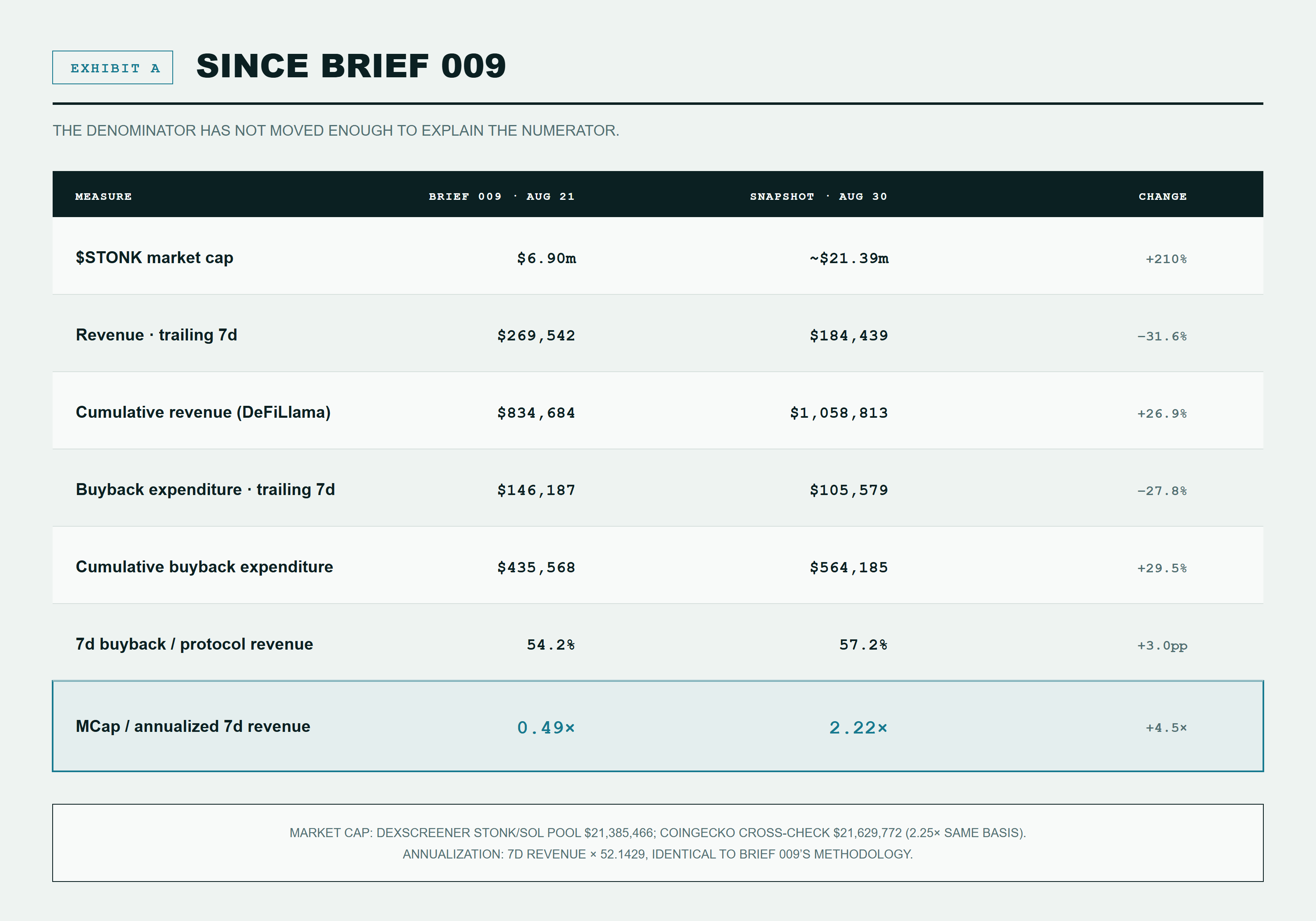
The most important line is not market capitalization.
It is revenue.
Trailing seven-day revenue is $184,439, below the Brief 009 level. Market capitalization is higher by roughly a factor of 3.1. The market has not merely capitalized a larger current cash-flow number. It has paid a higher price for each dollar of observed revenue.
That is a rerating.
There are many possible reasons: broader awareness, expectations of future growth, competitive comparisons, product developments, momentum, speculation. Public data cannot identify which buyer held which thesis, and management will not be conducting a séance on the order book.
What can be measured is the change in the multiple. The denominator has not moved enough to explain the numerator. Expectations have.
The market has found a comparable.
Peer analysis previously required awkward compromises. Pump.fun is vastly larger and operates a different model. Raydium is infrastructure. Conventional DEX comparisons say little about a launch system that also funds token repurchases.
Pons has made the problem easier.
Pons operates a launch and trading system on Robinhood Chain, spanning token creation, bonding-curve activity, post-graduation markets, protocol revenue and token repurchases.
It is not StonkFun on another chain. It is close enough to become useful.
Exhibit B · StonkFun and Pons (same window, 30 August 2026)
| Measure | StonkFun / $STONK | Pons / $PONS |
|---|---|---|
| Network | Solana | Robinhood Chain |
| Market capitalization | ~$21.39m | ~$266.5m |
| 7d protocol revenue (DeFiLlama) | $184,439 | V1 $383,360 + V2 $1,675,584 = $2,058,944 |
| Annualized 7d revenue | $9.62m | $107.4m |
| MCap / annualized 7d revenue | 2.22× | 2.48× |
| 30d protocol revenue (DeFiLlama) | $1,058,599 | V1 $1,917,899 + V2 $2,399,803 = $4,317,702 |
| 7d buyback / holder revenue | $105,579 | $506,780 (V1 only) |
| Buybacks / 7d revenue | 57.2% | 132% of V1 revenue (V1 only; see note) |
| 7d gross fees (separate metric, not revenue) | — | V1 $1,715,817 + V2 $10,073,107 = $11,788,924 |
| 7d DEX volume | — | ~$207.6m (estimated) |
PONS market cap $266.5m (DexScreener robinhood) / $265.9m (CoinGecko market_cap.usd). Revenue rows use DeFiLlama's dataType=dailyRevenue; the separate gross-fees row uses dataType=dailyFees— Pons's own adapter methodology defines revenue as only the protocol's retained share of swap fees plus launch fees, materially smaller than gross fees, so the two must not be conflated. PONS's V1 buyback ($506,780)exceeds V1's own trailing-7d revenue ($383,360); buyback execution and revenue accrual are not synced week-to-week, so this ratio is a timing artifact, not a literal same-week payout rate. PONS 7d DEX volume is estimated from CoinGecko market_chart total_volumes by sampling one rolling-24h reading per ~24h and summing — it is not a true interval sum. PONS V2 has no holders-revenue feed (DeFiLlama returns 400), so no combined buyback rate is computed.
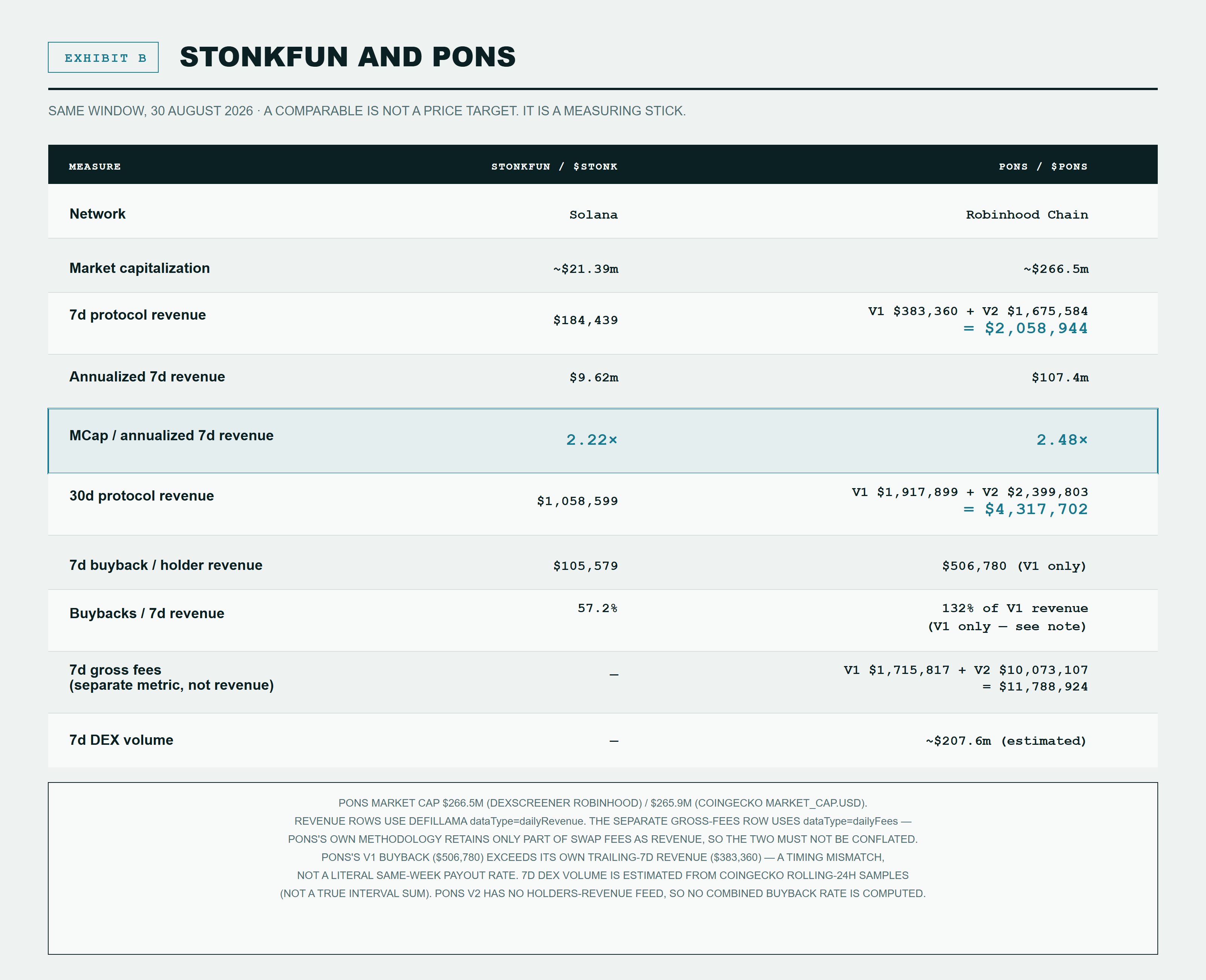
Two observations matter.
The first is scale. Pons is the larger operating system today, in revenue and in trading activity, by a wide margin.
The second is the current valuation relationship — and this is where the obvious approach is a trap. Pons's DeFiLlama adapters report both gross fees (all swap fees collected, plus launch fees) and protocol revenue (only the share the protocol actually retains); for Pons those two numbers differ by roughly 5-6×, unlike StonkFun, whose own methodology defines revenue as identical to fees. Measured on gross fees, Pons appears to trade at roughly 0.43× annualized — but that is not comparable to $STONK's revenue-based multiple, because it is not the same metric. Measured on the correct, identical basis — protocol revenue, both sides — $STONK trades at 2.22× and $PONS at 2.48×. The two systems are being priced within the same narrow band. The "STONK is obviously expensive next to a cheap comparable" argument does not survive using the same denominator on both sides.
That is analytically healthy. The comparison should not be used to manufacture a price target. It should be used to identify the operating gap — which, corrected, turns out to be a gap in scale rather than a gap in per-dollar-of-revenue pricing.
Pons may have helped the market learn how to price the category.
PONS itself has undergone a substantial repricing, roughly +617% over seven days per CoinGecko.
Earlier commentary presented PONS as unusually inexpensive relative to annualized revenue. The most widely circulated comparison used approximately 0.7× FDV to annualized thirty-day revenue.
That number must not be placed directly beside Brief 009's 0.49× figure. The windows differ — thirty-day versus seven-day annualization — and the valuation bases may differ as well.
The point is not that PONS and STONK experienced identical multiple expansion. It is that both moved from being valued as small, uncertain revenue streams toward valuations that embed more future expectation. Markets learn by analogy, and a successful comparable supplies a reference point.
PONS moving above $200 million while continuing to report substantial launchpad activity and repurchases may therefore matter to STONK even if no PONS buyer ever rotated a dollar into it.
It gives the market a number to argue with. A month ago, that number did not exist.
The opportunity set is no longer only stocks.
The original StonkFun differentiation was easy to describe: markets could be paired against tokenized equities and other non-standard assets instead of SOL or a stablecoin.
The product definition has widened. StonkFun now presents the concept as coins paired with anything, and the quote universe reflects it.
Publication exhibit · Market universe refresh (30 August 2026)
| Quote category | Listed pairs |
|---|---|
| xStock (tokenized equities) | 22 |
| PreStock (pre-IPO) | 6 |
| Currency | 5 |
| Collectibles | 2 |
| Backpack / Tessera / Leverage / SOL | 12 / 2 / 2 / 1 |
| Custom mints | 279 |
| Total | 331 |
Source: StonkFun first-party /api/public/v1/pairs. Categories are reported separately and are not collapsed into a single market-share statistic.
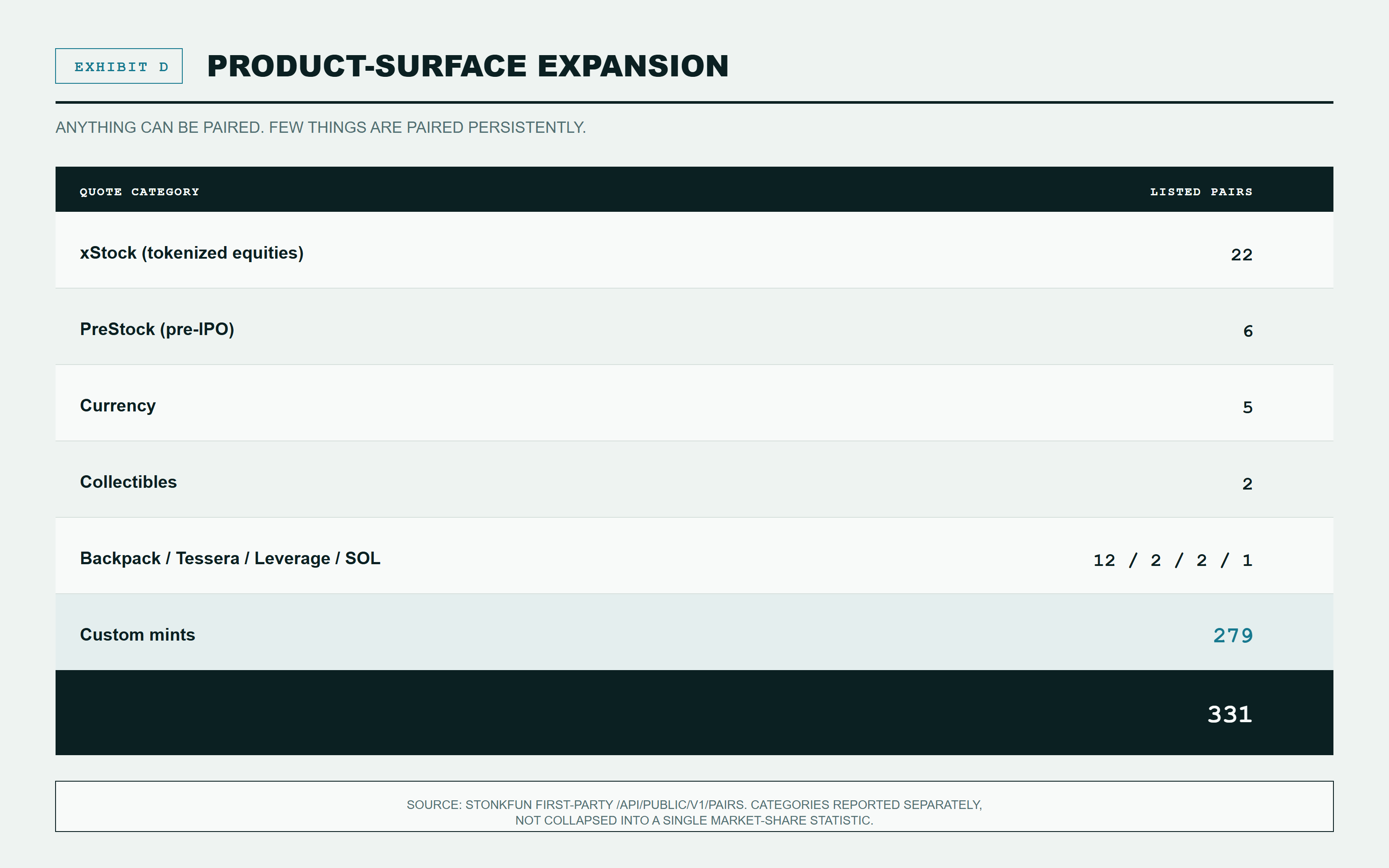
A stock-paired memecoin is a niche. A generalized market-creation system in which almost any tokenized asset can become the denominator of a new market is closer to an infrastructure proposition.
Permissionless systems can generate enormous inventory and very little durable activity. The important metric is not how many things can theoretically be paired. It is how many pairs people continue to trade.
The ecosystem has begun noticing the experiment.
There has also been a change in where the model is discussed.
StonkFun reported that its concept was discussed on stage at Solana Summit (Belgrade, 26–27 August 2026), with a Titan Exchange executive and a Solana Foundation representative talking about the platform.
The wording is exact because the claim is exact: the platform reported an on-stage mention. That is evidence of ecosystem attention.
It is not evidence of Solana Foundation endorsement, investment, sponsorship or a partnership.
The significance is distribution. A mechanism that was effectively unknown weeks earlier has become legible enough to enter broader ecosystem conversations about what can be built on Solana. Attention is not revenue. It can become distribution, and distribution matters more if the underlying system becomes easier to scale.
LaunchLab changes the throughput of the machine.
The most important operating development since Brief 009 may not yet appear in the revenue figures.
StonkFun is completing its migration onto Raydium LaunchLab. StonkFun states the integration will allow instant deployments and lower deploy costs, and is waiting on aggregators, terminals, launchers and a program update to handle rewards distributions.
Exhibit E · LaunchLab architecture
| Stage | Standard LaunchLab | StonkFun-specific / custom |
|---|---|---|
| 1. Launch | Permissionless token launch against a bonding curve; platform PDAs; configurable fee splits | Custom quote assets as launch pairs (beyond SOL/USDC/RAY) |
| 2. Bonding-curve trading | Constant-product, linear or fixed-price curves; quote vault; graduation threshold | Custom-quote bonding curves; rewards distributions handled by program update |
| 3. Graduation | CPMM-only since 17 Aug 2026; creator LP locked with platform share | Custom migration logic for non-standard quote assets |
| 4. Routed liquidity + economics | Raydium CPMM pool; platform/creator/burn fee scales; SOL/USDC/RAY quotes | STONK buyback capture from quote revenue; aggregator/terminal/launcher compatibility |
Standard features per Raydium LaunchLab documentation and the 17 August 2026 changelog (CPMM-only graduation; SOL/USDC/RAY as supported bonding-curve quote assets). Raydium added Token-2022 quote-mint support on 24 August 2026, which enables non-standard quote mints with transfer fees.
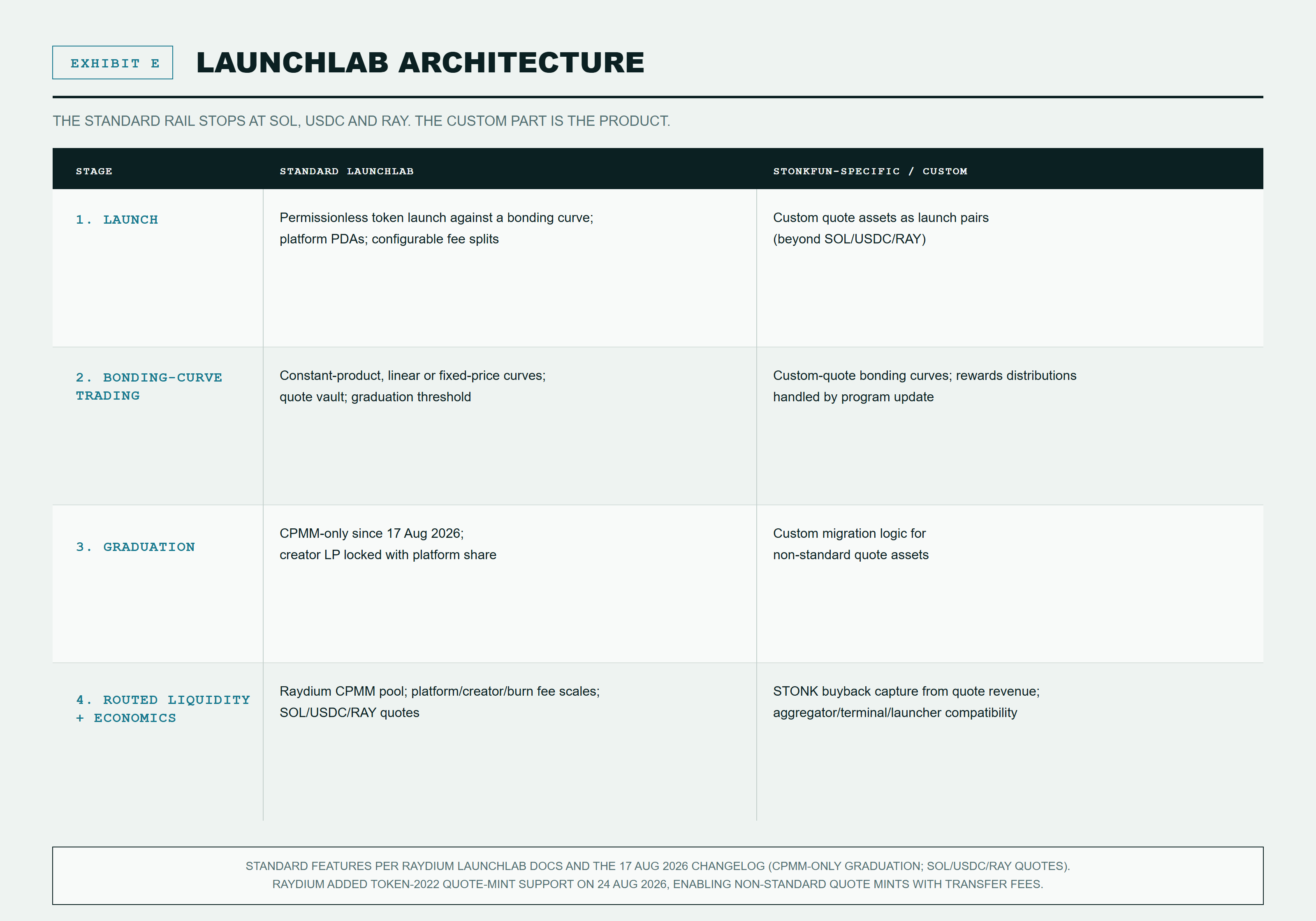
The direct deployment-cost reduction is substantial. It is probably not the most important part.
The original architecture imposed friction on how many markets could economically be created. LaunchLab changes that. The potential path is: cheaper deployment → more creators → more experiments → more successful graduations → more liquidity → more routed trading; and, provided StonkFun continues capturing economics from the result, more trading → more revenue → greater capacity for $STONK repurchases.
That final arrow must be measured, not assumed.
The pre-migration DeFiLlama series reflects the existing fee path. The post-migration system introduces bonding-curve markets and CPMM graduation. Pre- and post-migration revenue should not be treated as one uninterrupted economic series until the new fee path is verified. The migration creates a hypothesis. It has not yet produced the result.
This is becoming more than an ordinary integration.
There is a second reason LaunchLab matters.
StonkFun's differentiated product requires functionality a conventional SOL-quoted launch does not. The central requirement is custom quote assets. Without them, LaunchLab provides an effective token-launch mechanism but not StonkFun's core market concept.
StonkFun states its integration includes a program update to handle rewards distributions and compatibility work across aggregators, terminals and launchers.
The exact ownership of each engineering task should be verified before publication. The broader pattern is nevertheless meaningful: functionality needed by StonkFun's unusual market structure — Token-2022 quote mints, custom quotes, rewards program work — is being incorporated into the infrastructure around LaunchLab.
This does not establish a formal strategic partnership, exclusivity, sponsorship or endorsement. No first-party source says any of those things.
It is evidence of something more concrete: engineering attention and aligned incentives.
For StonkFun, Raydium supplies established liquidity infrastructure, market formation, graduation and access to Solana routing. For Raydium, StonkFun potentially supplies a new class of markets. The relationship can be mutually useful without either party issuing a press release announcing that it is mutually useful.
For $STONK, the implication is not that Raydium will make the token appreciate. The implication is that StonkFun may not need to solve every infrastructure problem required to scale its model independently. That changes the execution problem.
Pons represents scale. LaunchLab represents a path toward it.
At present, Pons is substantially larger. That is the correct starting point.
A simplistic comparison would ask: if PONS is worth more than $200 million, why isn't STONK?
The Research Department declines.
The better question is: what operating gap would StonkFun have to close before convergence became economically defensible?
Exhibit C · The operating gap (30 August 2026)
| Measure | StonkFun | Pons | Multiple |
|---|---|---|---|
| 7d protocol revenue | $184,439 | $2,058,944 | 11.2× |
| Annualized 7d revenue | $9.62m | $107.4m | 11.2× |
| 30d protocol revenue | $1,058,599 | $4,317,702 | 4.1× |
| Market capitalization | ~$21.39m | ~$266.5m | 12.5× |
| 7d gross fees (separate metric) | $184,439 | $11,788,924 | 63.9× |
| 7d DEX volume | — | ~$207.6m (estimated) | — |
Purpose: measure what StonkFun would need to close. It is not an inferred valuation target. Revenue rows use dataType=dailyRevenue; the gross-fees row is a separate metric (dataType=dailyFees) kept for context and must not be read as a fourth revenue multiple — StonkFun's own fees equal its revenue by definition, so its fees-row figure is unchanged from its revenue-row figure.
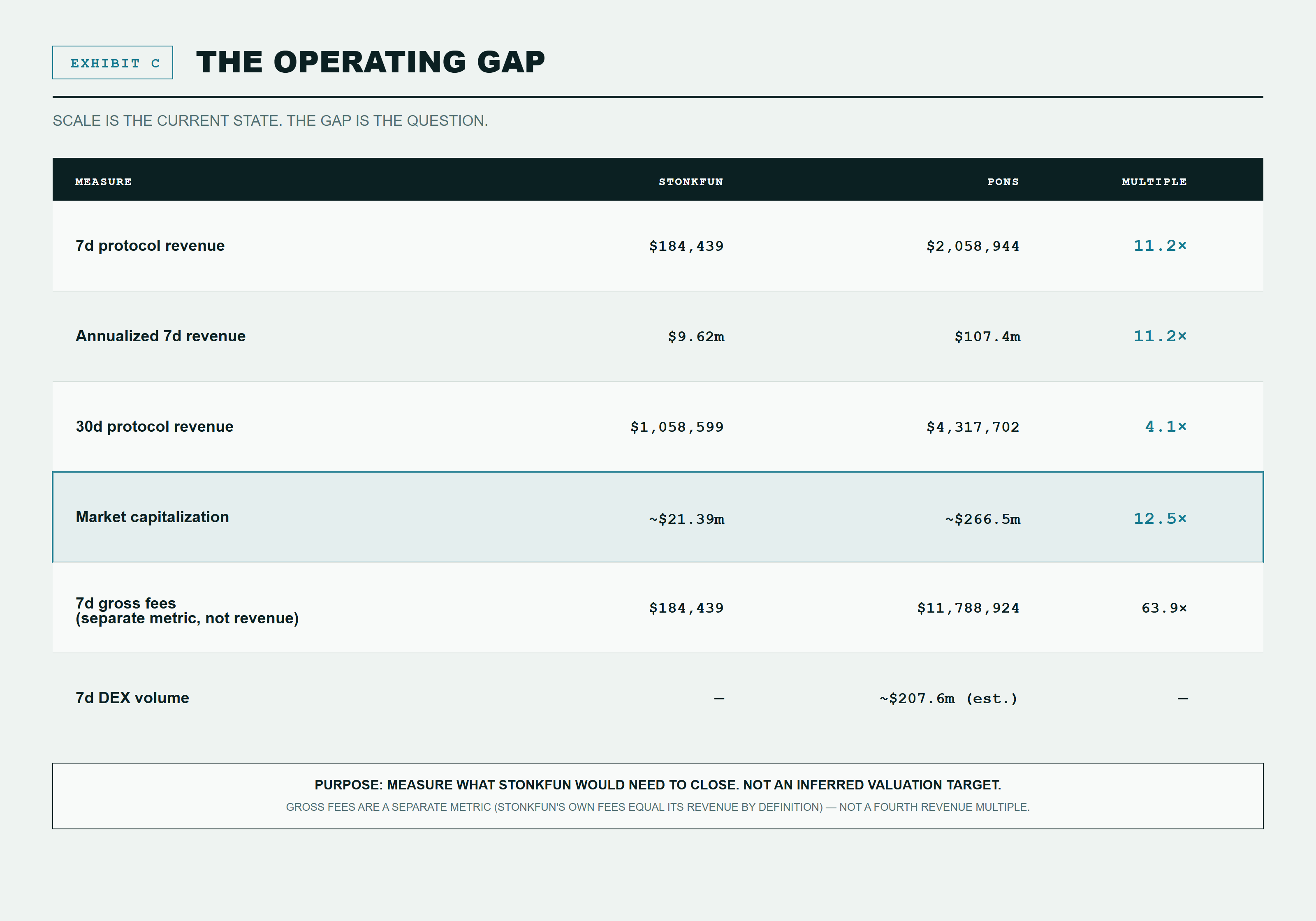
The revenue gap is smaller than the fee-based comparison alone would suggest, and it moves by window: on the trailing seven days Pons's protocol revenue is running at roughly 11× StonkFun's; on the trailing thirty days the gap narrows to roughly 4×, which mostly reflects how recently Pons's revenue accelerated rather than a stable ratio. The market-capitalization gap (~12.5×) sits closer to the 7d revenue gap than the 30d one. None of the three multiples should be treated as the "true" gap — they describe the same two systems from different windows, and the honest reading is that the operating gap is real, sizeable and not yet settled into one number.
That gap can be measured. Revenue needs to grow. Market formation needs to become easier. Successful launches need to graduate. New quote categories need sustained trading rather than announcement-day activity. Routing needs to work reliably. The platform must keep capturing economics from the resulting trading, and those economics must keep reaching $STONK through observable repurchases.
LaunchLab addresses several constraints in that chain. It does not answer whether durable demand appears on the other side. That is the experiment now beginning.
One accounting warning before management becomes excited.
The current revenue series may be incomplete at the margin for certain unusual quote assets if the underlying pricing cannot reliably value them.
That matters. If some protocol revenue is omitted because a quote asset cannot be priced, the reported revenue denominator is understated, and an understated denominator makes the observed revenue multiple look higher.
Two concrete observations:
- StonkFun's own volume coverage reports 2,236 unpriced pool-days, with coverage ending 28 August 2026.
- StonkFun's API documents that ledger rows carrying no USD price count as zero, and its first-party total revenue ($1,189,785) sits above DeFiLlama's cumulative figure ($1,058,813).
The final publication pass must therefore verify whether any known adapter or pricing issue remains unresolved and quantify the impact. Management prefers its favorable numbers without assistance from missing data.
What would validate the new multiple.
A rerating creates a higher standard. LaunchLab gives us specific metrics with which to test it.
Exhibit F · Post-LaunchLab scorecard
| Metric | What to watch |
|---|---|
| Deployment elasticity | Do lower deploy costs materially increase launches? |
| Graduation rate | Do more launches develop enough demand to graduate? |
| Post-graduation persistence | Do CPMM markets keep trading after initial attention fades? |
| Quote-asset breadth | Do multiple categories sustain durable markets? |
| Routing quality | Do execution and liquidity problems on exotic pairs improve? |
| Protocol capture | How much gross trading becomes StonkFun revenue under the new architecture? |
| $STONK capture | What portion of revenue becomes observable buyback expenditure? |
| Relative scale | Does the economic gap with Pons narrow? |
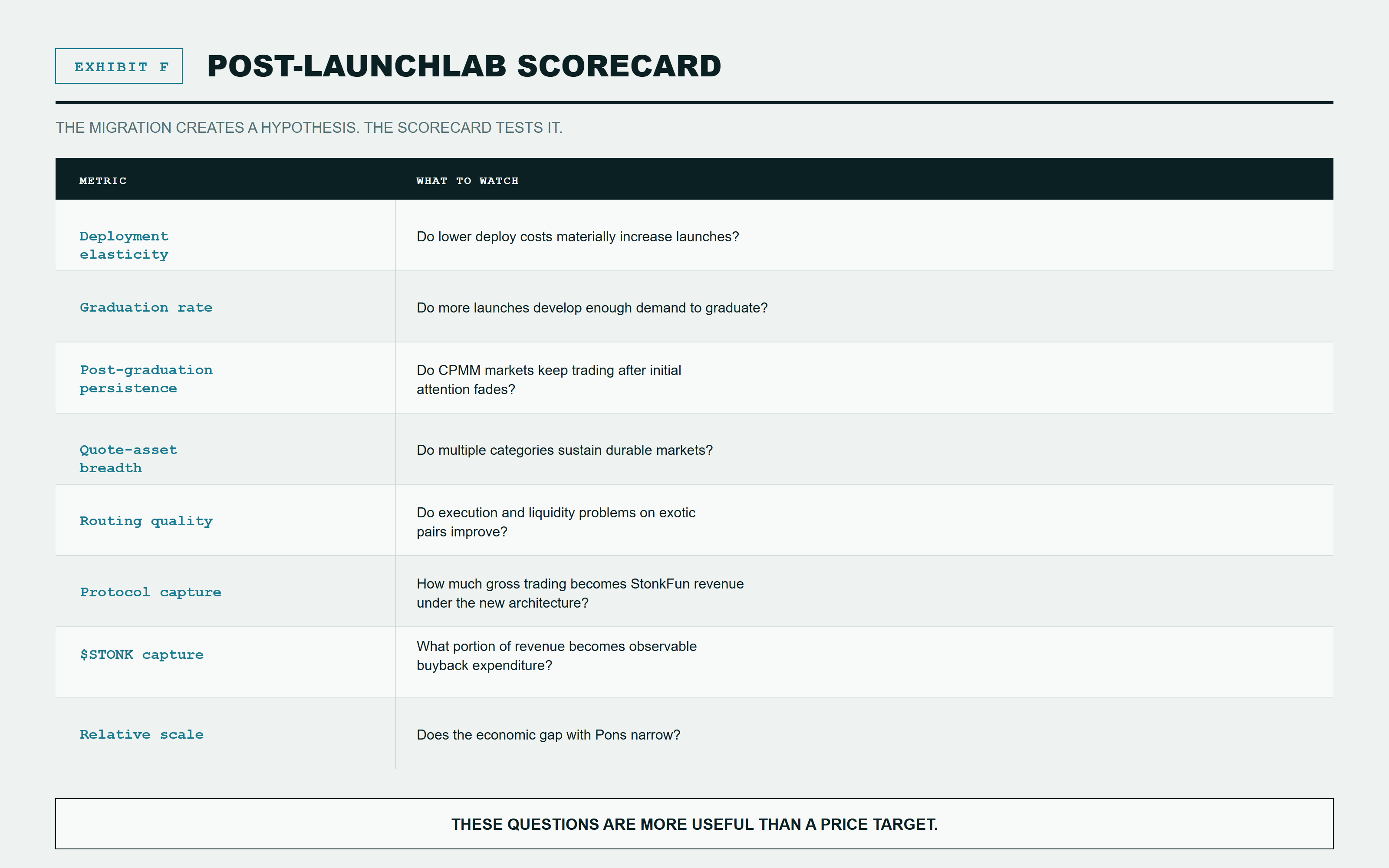
These questions are more useful than a price target. They allow the market's current assumptions to be tested.
The Chairman's view
Brief 009 concluded that the denominator had survived its first pressure test.
The subsequent period produced a different test. The market began paying more for it.
That development would be less interesting if StonkFun were alone. It is not. Pons has demonstrated what a revenue-generating launch system with token repurchases can look like at substantially greater scale, and its token has undergone its own major repricing.
Pons does not establish fair value for STONK. It establishes something that did not previously exist.
A comparable.
Measured correctly — protocol revenue against protocol revenue, not revenue against gross fees — that comparable currently prices $STONK and $PONS within the same narrow band, roughly 2.2×–2.5× annualized seven-day revenue. The market has not obviously mispriced one relative to the other. What it has priced very differently is scale: Pons generates something like four to eleven times StonkFun's revenue, depending on the window, and carries a market capitalization about twelve times larger. That is a gap in what each system has built and captured, not a gap in how each dollar of revenue is valued.
At the same time, StonkFun is moving toward a permissionless LaunchLab architecture, reducing deployment friction and expanding the range of possible quote assets. Raydium's infrastructure is increasingly accommodating the use cases that make StonkFun different.
That does not guarantee success. It changes what success would require.
A month ago, the largest question was whether the mechanism actually worked. Brief 007 established that it did. Brief 009 established that it kept working under less favorable conditions.
The next question is whether the mechanism can support materially more activity.
For the first time, the market appears willing to pay in advance for part of that answer.
Management has recorded the advance. The operating department still owes us the answer.
Sources
- Chairman's Brief 009 — The Denominator Has Been Tested ↗
- DeFiLlama — StonkFun protocol revenue ↗
- DeFiLlama — StonkFun buyback (holders) revenue ↗
- DexScreener — STONK/SOL token-pairs endpoint ↗
- CoinGecko — STONK market data ↗
- DexScreener — PONS/Robinhood Chain search ↗
- CoinGecko — PONS market data ↗
- DeFiLlama — Pons V1 protocol revenue ↗
- DeFiLlama — Pons V2 protocol revenue ↗
- DeFiLlama — Pons V1 buyback (holders) revenue ↗
- DeFiLlama — Pons V2 holders revenue (unavailable, HTTP 400) ↗
- CoinGecko — PONS market chart (volume) ↗
- StonkFun — first-party pairs registry ↗
- StonkFun — first-party volume API ↗
- StonkFun — first-party revenue API ↗
- StonkFun (X) — Solana Summit on-stage report ↗
- Raydium — LaunchLab documentation ↗
- Raydium — LaunchLab CPMM-only changelog, 17 August 2026 ↗
- Raydium — LaunchLab Token-2022 quote-mint changelog, 24 August 2026 ↗
- StonkFun (X) — LaunchLab integration status ↗
- DeFiLlama — Pons V1 gross fees (separate metric, not revenue) ↗
- DeFiLlama — Pons V2 gross fees (separate metric, not revenue) ↗
Stonks on Stonk is an independent editorial and meme project. This filing is commentary, not financial advice. Market data are volatile and all observations are timestamped snapshots. No STONK price target is implied, and no convergence with PONS market capitalization is asserted.