
Stonkholders,
The Chairman's correspondence is back in circulation. There is a fair amount to catch up on.
Last week we were looking at a market in which lenders were still prepared to lend, but at prices that made the business plans less comfortable. Monday brought some relief: the S&P 500 was up 1.05% and the Nasdaq 1.62% at 11:22 a.m. in New York, with the ten-year Treasury yield back below 5%. Bitcoin was around $85,800 in our earlier afternoon snapshot.
The Fed has actually raised rates since we last wrote. So this recovery needs a better explanation than the usual expectation of cheaper money. The most immediate one starts with oil. The buying in AI has resumed too. Bitcoin's part in this recovery raises a further question: are investors hedging against trouble with money, or simply becoming less worried about owning risk?
What Has Changed in Oil
The supply scare in Letter 008 concerned Saudi Arabia's East-West pipeline, which carries crude to the Red Sea and provides an alternative to the Strait of Hormuz. The damage raised the prospect of a prolonged loss of export capacity. That is the backdrop to the subsequent fall in prices.
By Thursday, Saudi Arabia was offering additional cargoes to Asian refiners through ship-to-ship transfers off Oman. There were also reports of efforts to restore part of the pipeline's capacity. Those arrangements could offset some of the disruption, although the repair timetable remained uncertain.
Monday's selling also reflected renewed efforts to arrange US–Iran talks and expectations that more Saudi supply could reach the market. Traders were revising the size and duration of the shortage they had feared. The reports do not establish that repairs are complete or that shipping has returned to normal.
That distinction matters for equities. Oil falling because supply may recover is a different proposition from oil falling because customers cannot afford it. A smaller supply shock offers some relief to margins and household spending without requiring a recession to do the work. It may also reduce the amount of further tightening investors think will be needed to contain inflation. The immediate equity benefit is relief from a cost shock that had been getting worse.
There is an awkward detail for anyone ready to close the energy file. US diesel averaged $6.51 a gallon on Monday, according to AAA figures reported by the Wall Street Journal. Reuters separately reported record diesel prices in several markets, with refinery outages and disrupted trade routes continuing to restrict supply.
Our freight concern therefore survives the better crude quotation. Refiners still have to turn the oil into the right product and get it to the customer. The useful confirmation would be cheaper finished fuel and easier delivery, alongside the improvement in crude. For now, the market has marked down part of the supply risk; the haulage bill has not followed.
The AI Spending Continues
Technology has its own reason to recover. Reuters linked Monday's buying to evidence of continuing AI investment. Anthropic and Accenture each committed at least $1 billion over five years to model evaluation on Friday. That is one example: work on assessing models can itself attract spending, rather than simply delay commercial activity.
SoftBank supplied a financing update on Monday, launching a roughly $11 billion bond offering to help fund its OpenAI investment and replace a $10 billion bridge facility. Pricing is expected on 24 September. Refinancing the bridge should not be counted as a second investment of the same amount.
These developments complicate the idea that a more cautious discussion of AI capabilities must bring the investment cycle to a halt. They do not settle the return on that investment. SoftBank still has to price its bonds, and the companies receiving the capital still have to earn enough from it.
That is where this letter meets the last one. Friday's high-yield index effective yield was 7.52%, with a credit spread of 268 basis points. The first is an index measure of the total yield, the second a spread measure; neither is a quotation available to every borrower. The financing market remains open at a considerable cost.
Bitcoin's Recovery Deserves a Closer Look
Our afternoon snapshot put Bitcoin at $85,817. A nearby CoinGlass observation showed a gain of roughly 9.5% over seven days. That is enough of a move to revisit the asset, even if the explanation takes longer to establish.
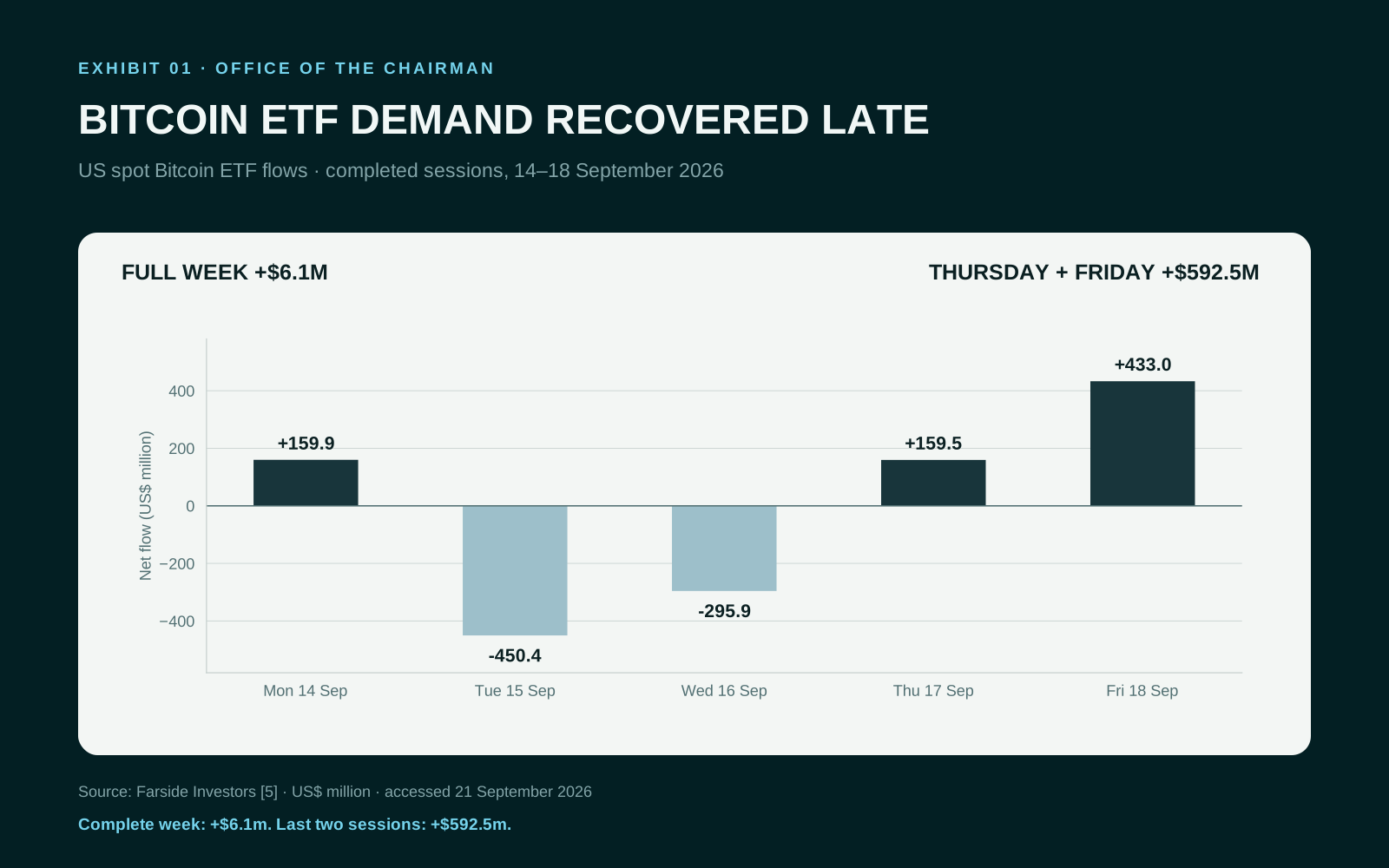
The ETF figures are encouraging at the end of the week, less impressive over the whole of it. Farside's data show $592.5 million of inflows on Thursday and Friday. After the earlier withdrawals, however, the five completed sessions netted just $6.1 million. The preceding week had lost $462.7 million.
That is a recovery in demand from a weak starting point. It would become much more persuasive after several complete weeks of inflows. Choosing the strongest two days would make the argument easier, but leave out most of the week.
Short covering has also contributed, according to Investor's Business Daily. Positions that have become too expensive to maintain can generate a great deal of buying very quickly. Whether those purchases are followed by voluntary allocations is the next question. The broker closing a short has no particular obligation to share the buyer's eventual macro thesis.
For the moment, the price trend has improved more clearly than the evidence about who intends to hold it.
Is This a Debasement Trade?
It could develop into one. We are not there on the evidence in this letter.
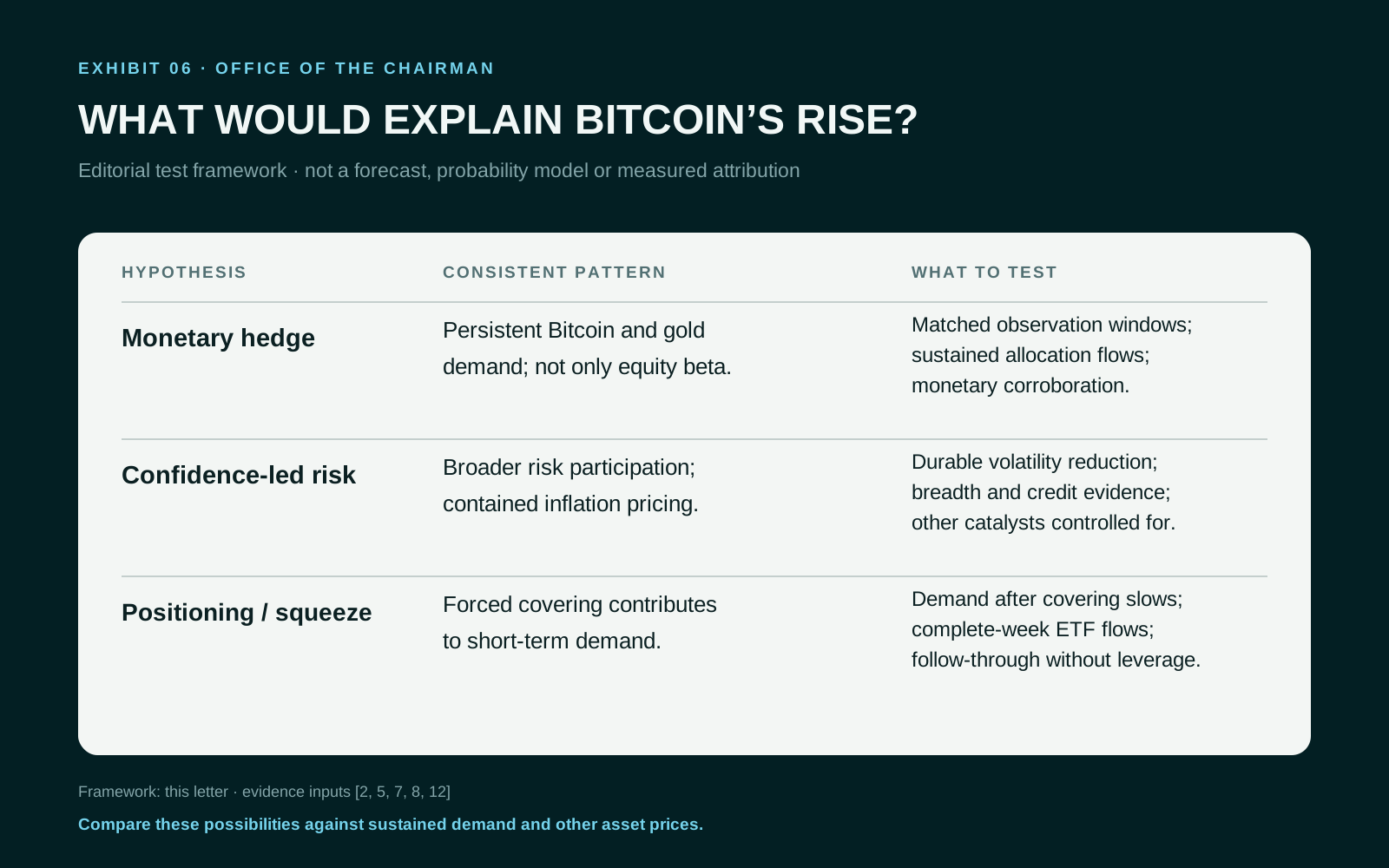
The debasement argument is that investors want protection from an erosion of money's purchasing power. Bitcoin's limited supply gives its buyers a way to express that concern. But a rising Bitcoin price can also reflect a simpler willingness to take risk, especially when technology shares are recovering at the same time.
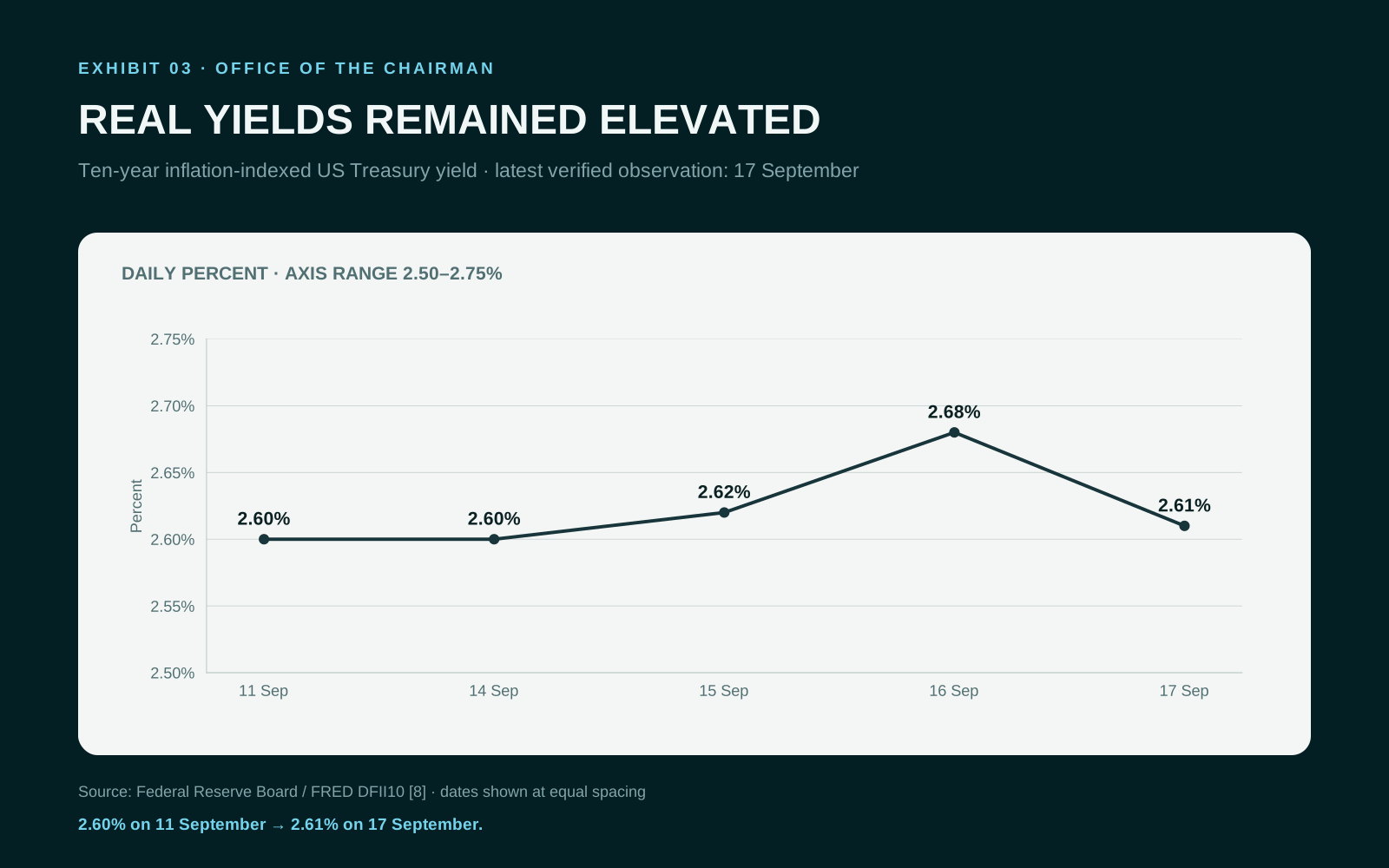
The bond market provides a useful check. Ten-year breakeven inflation fell from 2.38% on 15 September to 2.33% on Friday. The ten-year real Treasury yield was 2.61% on 17 September, little changed from 2.60% on 11 September. These are dated observations with different endpoints. Neither shows the kind of sustained decline in real returns or rise in inflation compensation that would make the monetary-hedge explanation more compelling.
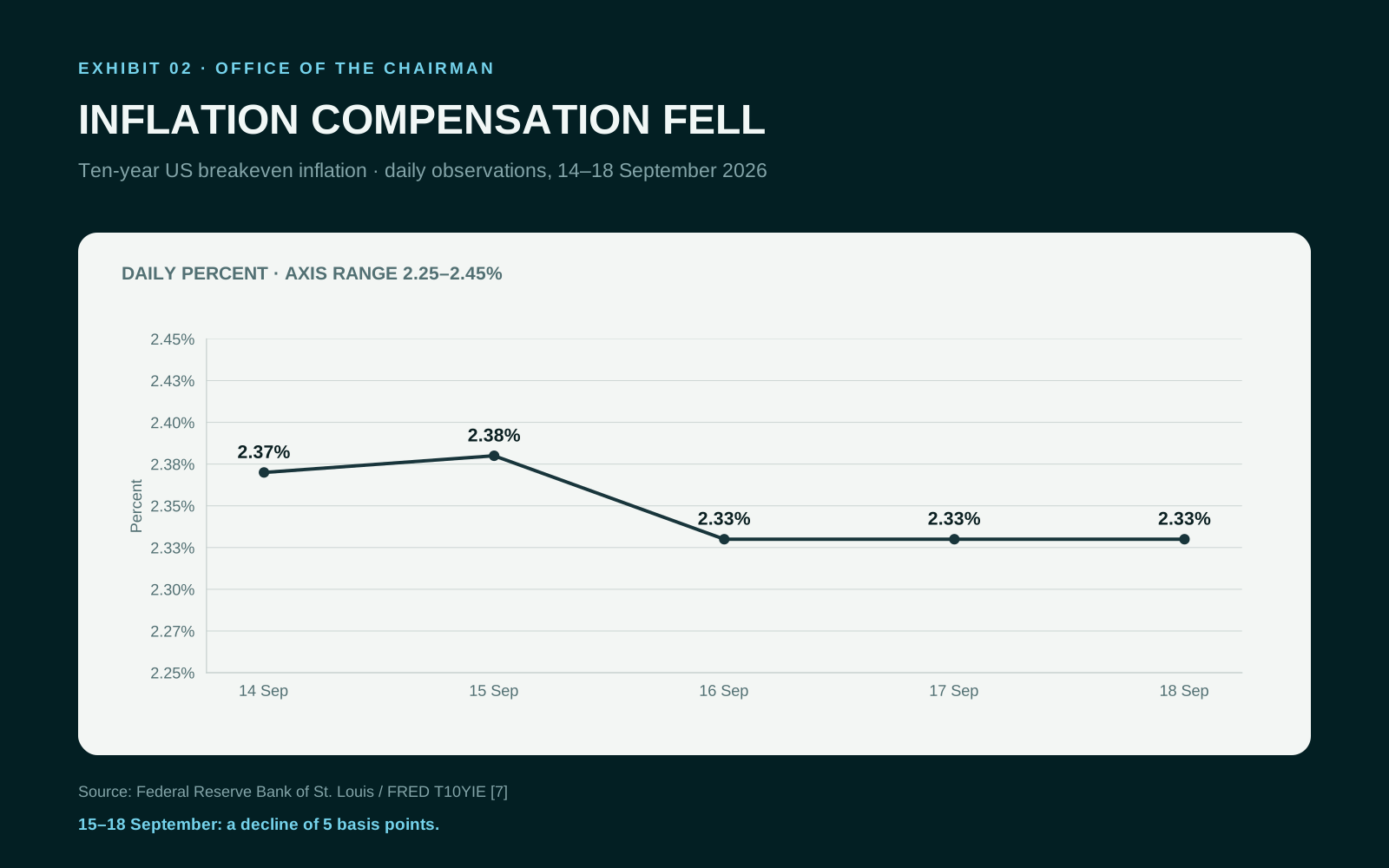
Breakevens also contain liquidity and risk-premium effects; they are not a direct survey of expected inflation. And protection against monetary erosion need not begin with a collapse in the dollar against other currencies. The dollar could outperform other fiat currencies while all of them lost purchasing power.
Still, an explanation needs some evidence beyond being possible. We would look for Bitcoin and gold attracting durable demand over the same period, including sessions when equities are less helpful. Continued ETF allocations would add weight. A rally that depends heavily on technology sentiment and forced covering would leave us with a narrower conclusion.
The distinction is important because the Fed offers a different possible reason to own risk.
The Fed's Room to Act
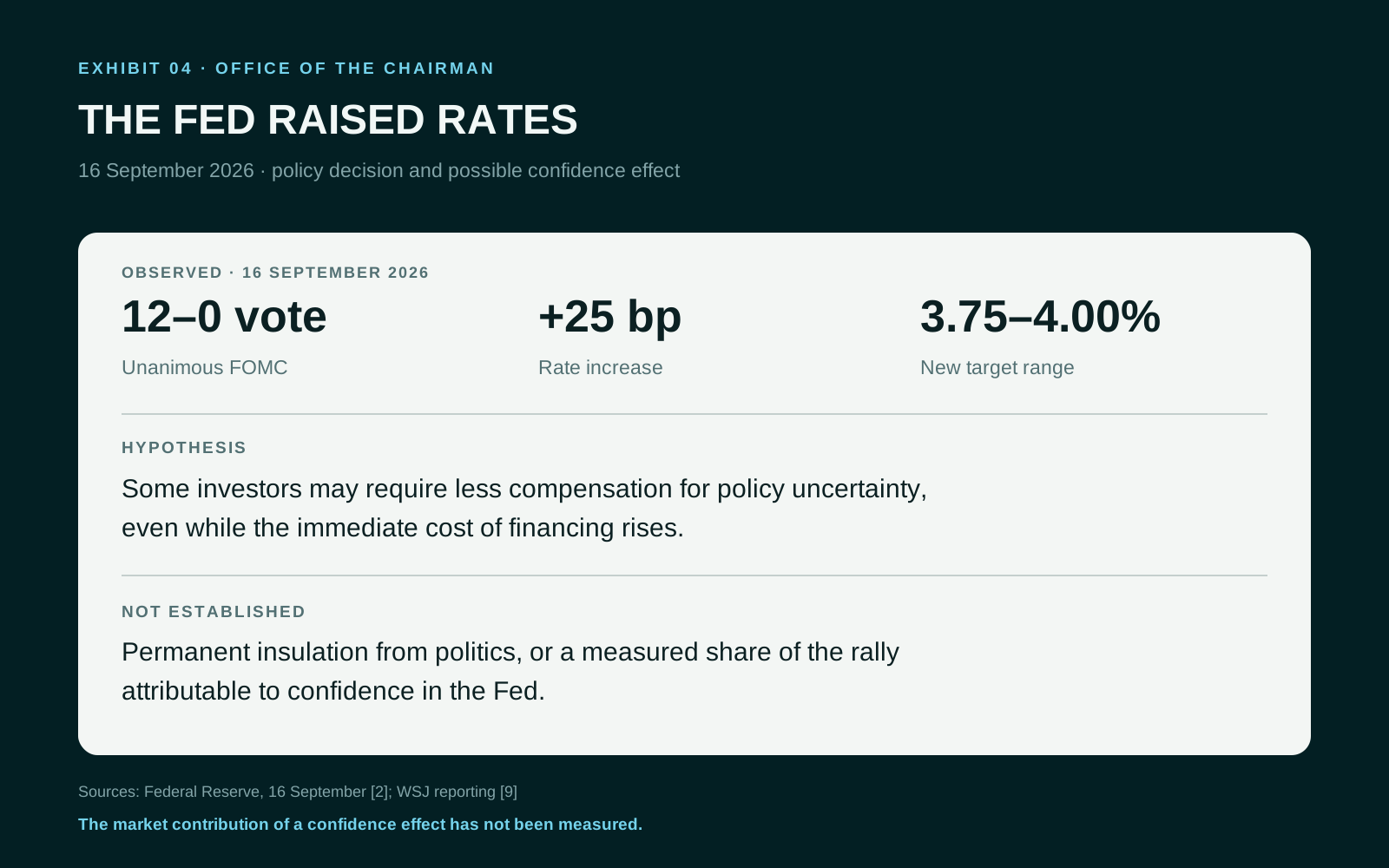
On 16 September the FOMC voted 12–0 to raise its target range by a quarter point to 3.75–4.00%, citing its inflation objective. That supplies an observation relevant to the independence question: the committee carried out a tightening decision despite the president's earlier public preference for lower rates.
The Wall Street Journal reported that Trump continued to support Warsh after the increase. It also reported Trump's account of a call before the decision, in which he said he had advised Warsh to vote with the committee. The episode therefore should not be presented as proof that political contact has ceased. What happened is narrower: the committee increased rates and the president stood by its chairman.
For an investor worried that inflation would be tolerated to avoid a political disagreement, that could be reassuring. The investor might demand less compensation for that particular risk, even while facing a higher short-term interest rate. There is room for both effects in the same valuation.
We have not isolated that confidence effect in market prices. Oil, earnings expectations and positioning were changing too. But it belongs in the discussion, particularly for Bitcoin: a recovery in confidence about monetary management could support a volatile asset without its buyers having lost confidence in money.
What the Midterms Might Change
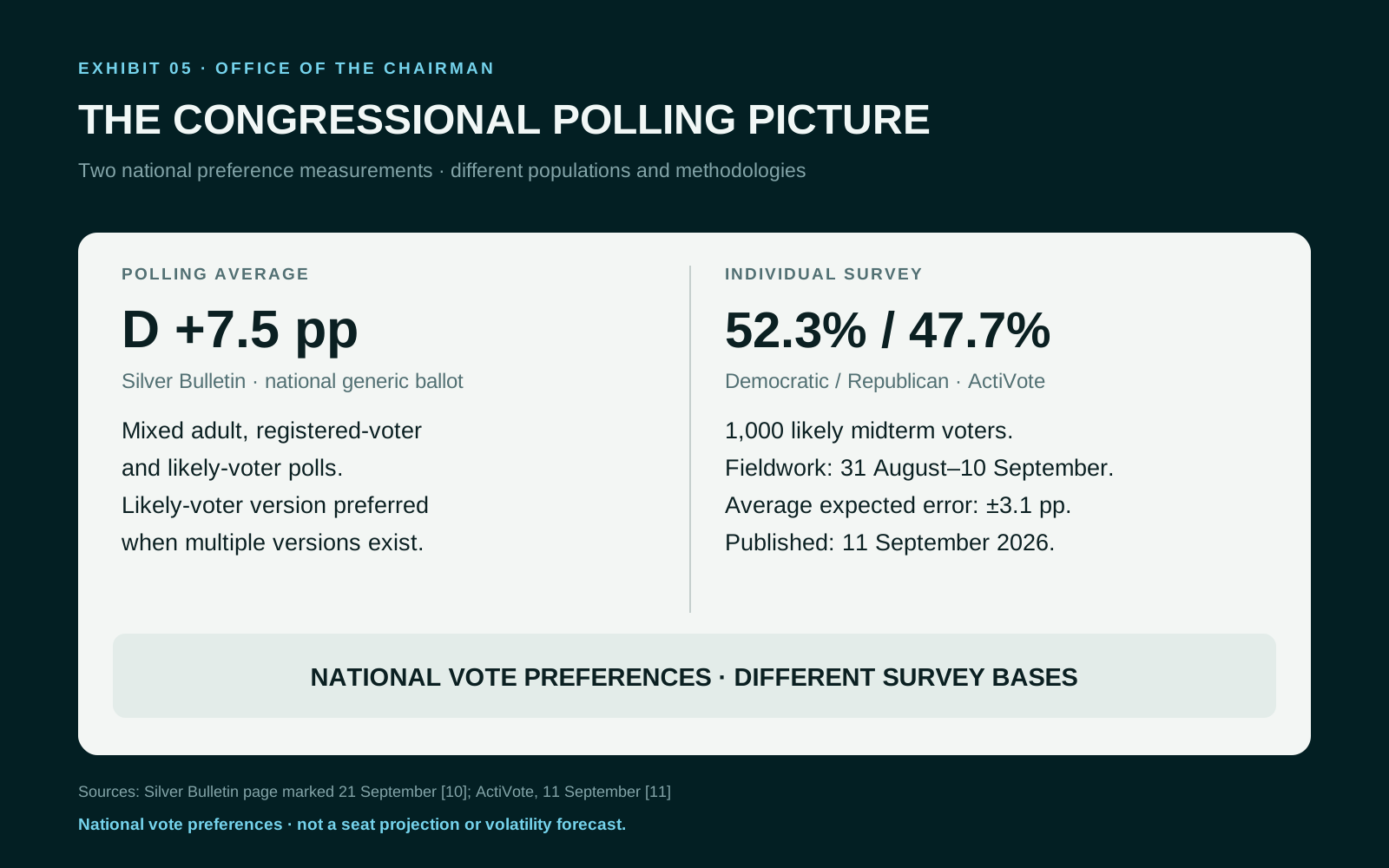
The congressional polls introduce another possible constraint on policy. Silver Bulletin's national generic-ballot average, on a page marked updated 21 September, shows a 7.5-point Democratic lead. Its default series mixes adult, registered-voter and likely-voter surveys. ActiVote's separate survey of 1,000 likely midterm voters, conducted 31 August–10 September, measured 52.3% Democratic and 47.7% Republican support, with reported average expected error of ±3.1 points.
State Street's Michael Arone set out the investment argument in August: divided government can restrict sweeping legislative changes, leaving businesses with fewer policy surprises to price. An investor concerned about abrupt changes in legislation could see value in that constraint. It is a scenario about the scope for policy changes, not a claim that one party mechanically produces better market returns.
The constraint would depend on the chamber and the issue. The Senate confirms presidential nominees; the House does not. Funding negotiations could become more difficult, and executive and foreign-policy decisions would remain sources of uncertainty. Congressional checks might limit one kind of disruption while creating more negotiation over another.
There is no basis here for treating a polling lead as two years of lower volatility. Nor have we established that the latest surveys caused this rally. The gridlock argument was circulating before Monday, while oil and AI supplied much more immediate news. We would give the polling interpretation more weight only with evidence that changed expectations about policy were being reflected in prices.
Through the Rest of the Week
For oil, we need to see whether the export workarounds and repairs deliver the expected supply, and whether diesel and freight costs begin to ease. Those developments would address the problem set out in Letter 008 more directly than another fall in the crude screen price.
For Bitcoin, the useful test is demand after the covering slows. A complete week of ETF inflows would be a better starting point than another large intraday percentage. For the broader recovery, we would also look for participation beyond the largest technology names and for financing costs to improve enough to matter to borrowers.
EC-009 remains open. Its twenty-session window runs from 15 September to 13 October, excluding the 12 October bond-market holiday. The condition is breached if the high-yield index closes at or below 7.20% for five consecutive qualifying sessions. All four observations from 15–18 September were above that level, leaving sixteen scheduled sessions at Friday's close. A missing observation counts for neither side, resets the run and does not extend the window. This is an incomplete test, not a completed pass. Previously recorded breaches remain breached.
SoftBank's expected pricing on Thursday will provide one live test of the terms on offer. Further ahead, the BEA has August PCE inflation scheduled for 30 September, alongside the third estimate of second-quarter GDP.
Our reading is that the recovery has several credible supports without yet requiring a broad debasement thesis. Oil supply expectations have improved, AI spending is continuing, and Bitcoin has recovered sharply from its recent levels. The Fed-confidence and congressional-constraint arguments are worth watching, but neither has been established as the cause of the move.
There is enough here to take the recovery seriously. We would be more comfortable once some of the expected relief arrives in the form of lower costs, delivered supply and buyers who stay.
— The Chairman
Methodology and Disclosure
Published 21 September 2026. Reuters equity observations are intraday at 11:22 ET / 16:22 BST, replacing the earlier draft's 10:24 ET snapshot. The retained Bitcoin quote was collected at approximately 16:02 BST; CoinGlass supplied a separately timed seven-day comparison. ETF calculations use completed sessions through 18 September, excluding the unfinished Monday row. Breakevens run through 18 September; the real-yield chart ends on 17 September. Credit observations are 18 September closes. Oil and diesel reporting was checked through the Reuters update published at 16:02 UTC / 17:02 BST on 21 September; repair expectations are not treated as completed repairs. Source-specific dates are retained rather than presented as a simultaneous snapshot. This is market commentary, not a price target or personalised investment recommendation. The hero is an AI-generated editorial illustration. A single pre-publication check used an information cutoff of 18:35 BST / 13:35 ET on 21 September. No newer price or completed-session observation was adopted; the supplied snapshots and chart endpoints remain unchanged. The EC-009 count was corrected against the published 15 September start.
Supplemental exhibits · Fed, polling and possible mechanisms
Source notes
- 01Stonks on Stonk, Chairman's Letter 008, “Capital Is Available. See Attached Rates.” Published 14 September 2026; revised after the US open. Used for narrative continuity and the existing EC-009 rule, not as independent verification of external facts. ↗
- 02Federal Reserve, FOMC statement, 16 September 2026. Unanimous 12–0 decision; target range raised by 25 basis points to 3.75–4.00%; stated 2% inflation objective. ↗
- 03Reuters, “Wall St rises on AI gains as oil slides, Treasury yields retreat,” 21 September 2026. Updated snapshot at 11:22 a.m. ET: S&P 500 +1.05%, Nasdaq +1.62%, ten-year Treasury yield below 5%. Intraday, not closes. ↗
- 04BTC quote snapshot collected through the market-data tool at approximately 16:02 BST on 21 September 2026: $85,817; raw fields retained in data/quote-snapshot.json. CoinGlass's separately timed BTC page provided the approximately 9.5% seven-day comparison; it is not the source of the exact $85,817 quote. ↗
- 05Farside Investors, US spot Bitcoin ETF daily flows, accessed 21 September 2026. Daily units US$ million. Week 14–18 September: +159.9, −450.4, −295.9, +159.5, +433.0; net +6.1. Week 8–11 September: −46.6, −120.2, −282.7, −13.2; net −462.7. Totals calculated for this letter. ↗
- 06Investor's Business Daily, “Bitcoin Surges. Coinbase Wins Target Hike. These Crypto Stocks Break Out.” 21 September 2026. Used only for the report that short squeezing and ETF buying contributed; rolling liquidation totals are deliberately not repeated. ↗
- 07Federal Reserve Bank of St. Louis, FRED series T10YIE, accessed 21 September 2026. Daily ten-year breakeven inflation: 2.37% on 14 September, 2.38% on 15 September, 2.33% on 16, 17 and 18 September. ↗
- 08Federal Reserve Board via FRED, DFII10, accessed 21 September 2026. Ten-year inflation-indexed constant-maturity Treasury yield: 2.60% on 11 and 14 September, 2.62% on 15 September, 2.68% on 16 September, 2.61% on 17 September. Latest verified observation is 17 September, not 18 September. ↗
- 09Nick Timiraos and Brian Schwartz, The Wall Street Journal, “How Warsh Raised Rates Without Drawing Trump’s Ire,” 17 September 2026. Reports continued presidential support and Trump’s account of a pre-decision call. Evidence about one episode, not permanent insulation from political influence. ↗
- 10Silver Bulletin, generic congressional ballot page, marked updated 21 September 2026. Default national average displayed as D+7.5; mixed survey populations. The page also contains an older contributor timestamp, so this letter does not claim a new one-day polling change. No seat forecast or likely-voter-adjusted forecast is reproduced. ↗
- 11ActiVote, national generic congressional ballot survey, published 11 September 2026. Fieldwork 31 August–10 September; 1,000 likely midterm voters; 52.3% Democratic, 47.7% Republican; average expected error ±3.1 percentage points. ↗
- 12Michael W. Arone, State Street Investment Management, “The midterm paradox: Voters want change, markets prefer gridlock,” 26 August 2026. Cited for the attributed gridlock mechanism only, not the article's election forecasts. ↗
- 13US Senate, “About Nominations,” accessed 21 September 2026. Institutional source for the Senate's confirmation role. ↗
- 14Chatham House, “What the US midterms could mean for Trump's power,” September 2026. Used for its analysis of congressional funding and nomination leverage and limits on control of executive and foreign-policy action; no election prediction or evaluative political characterisation adopted. ↗
- 15ICE Data Indices via FRED, US High Yield Index Effective Yield, BAMLH0A0HYM2EY. 14–18 September closing observations: 7.48%, 7.55%, 7.53%, 7.46%, 7.52%. Accessed 21 September; updated at 9:17 a.m. CDT. ↗
- 16ICE Data Indices via FRED, US High Yield Index Option-Adjusted Spread, BAMLH0A0HYM2. 18 September: 2.68 percentage points, equivalent to 268 basis points. Accessed 21 September. ↗
- 17Reuters, “SoftBank launches $11 billion bonds to fund OpenAI investment,” 21 September 2026. Launched offering, expected pricing 24 September; replacement of the $10 billion bridge facility is not additional investment of the same amount. ↗
- 18US Bureau of Economic Analysis, release schedule, accessed 21 September 2026. August Personal Income and Outlays and the third estimate of second-quarter GDP scheduled for 30 September. ↗
- 19Reuters, “Oil falls 1% as investors watch Middle East supply disruptions,” 17 September 2026. Saudi cargo offers through ship-to-ship transfers off Oman and reported efforts toward partial pipeline restoration; repair timetable uncertain. ↗
- 20The Wall Street Journal, “Oil Futures Extend Decline on Easing Supply Concerns,” 21 September 2026, 09:39 ET; accompanying diesel update at 11:03 GMT. Supply-restoration and diplomatic expectations; AAA-reported national diesel average $6.51 per gallon. ↗
- 21Anadolu Agency, “Oil falls more than 2% as US-Iran diplomacy gains momentum,” 21 September 2026. Diplomatic efforts and Saudi flow expectations eased part of the supply concern; ongoing disruptions remain. ↗
- 22Reuters, “Global diesel prices hit record highs, further rises possible,” 21 September 2026. Refined-product shortages, refinery outages and disruption to trade routes; crude and delivered fuel conditions are distinct. ↗
- 23Reuters, “Anthropic, Accenture to invest $2 billion in AI model evaluation as safety concerns rise,” 18 September 2026. Each company committed at least $1 billion over five years. Friday announcement, not a newly announced Monday commitment. ↗
Market levels reflect the cited publication cutoff. Commentary only; not financial advice.