
Stonkholders,
Two traders on this floor closed positions this week.
The first held an asset that had not moved in six weeks. He closed it because nothing was happening. The second held an asset that had risen thirty percent. He closed it because something was.
They consider themselves opposites. The floor considers the first impatient and the second disciplined. Both were managing a feeling and filing it as a process.
This Brief concerns the second man, whose error is better disguised, better rewarded and considerably more expensive. He will not be corrected by anyone, because his position was profitable and the record will show that he made money. The record is not being asked the right question.
Management wishes to be precise about the objection. There is nothing wrong with selling an asset that has risen. Assets that have risen are sold every day for entirely respectable reasons. The objection is to selling an asset because it has risen, and then entering a different reason in the minutes.
A gain is a fact about the past. It is not an instruction about the future.
The vocabulary of the floor
No trader on this desk reports being frightened of surrendering a gain. The floor has developed alternative language.
He is taking some off. He is de-risking. He is letting the market pay him.
The word disciplined performs most of the work. The same trader was not described as disciplined three weeks earlier, when the position was flat and he was adding to it precisely because the position was flat. The behaviour has not been corrected in the interval. It has been renamed.
The most durable formulation is that nobody ever went broke taking profits. Management accepts the claim exactly as stated. Nobody goes broke. They go nowhere.
The floor already understands that activity carries friction. What it understands less well is that this particular activity is not distributed randomly across the book. It falls almost entirely on one side. Across 66,465 households at a discount broker between 1991 and 1996, the most active fifth by portfolio turnover earned 11.4 percent annually against a market return of 17.9 percent, while the least active fifth earned 18.5 percent. Trading being expensive is the familiar half of that finding. The expensive trading being concentrated in the positions that were working is the half that costs money.
A book of small realised gains cannot finance the losses that eventually arrive at full size. The trader who reliably books twelve percent and reliably absorbs thirty has constructed an orderly decline with excellent documentation.
Consistency in the wrong direction is still consistency. The floor has been grading it as process.
The inversion
Traders close winners early and hold losers late. The tendency was named the disposition effect in 1985 and measured directly in 1998 against the records of 10,000 brokerage accounts, where investors realised gains far more readily than losses — a preference explained by neither rebalancing, nor transaction costs, nor subsequent performance.
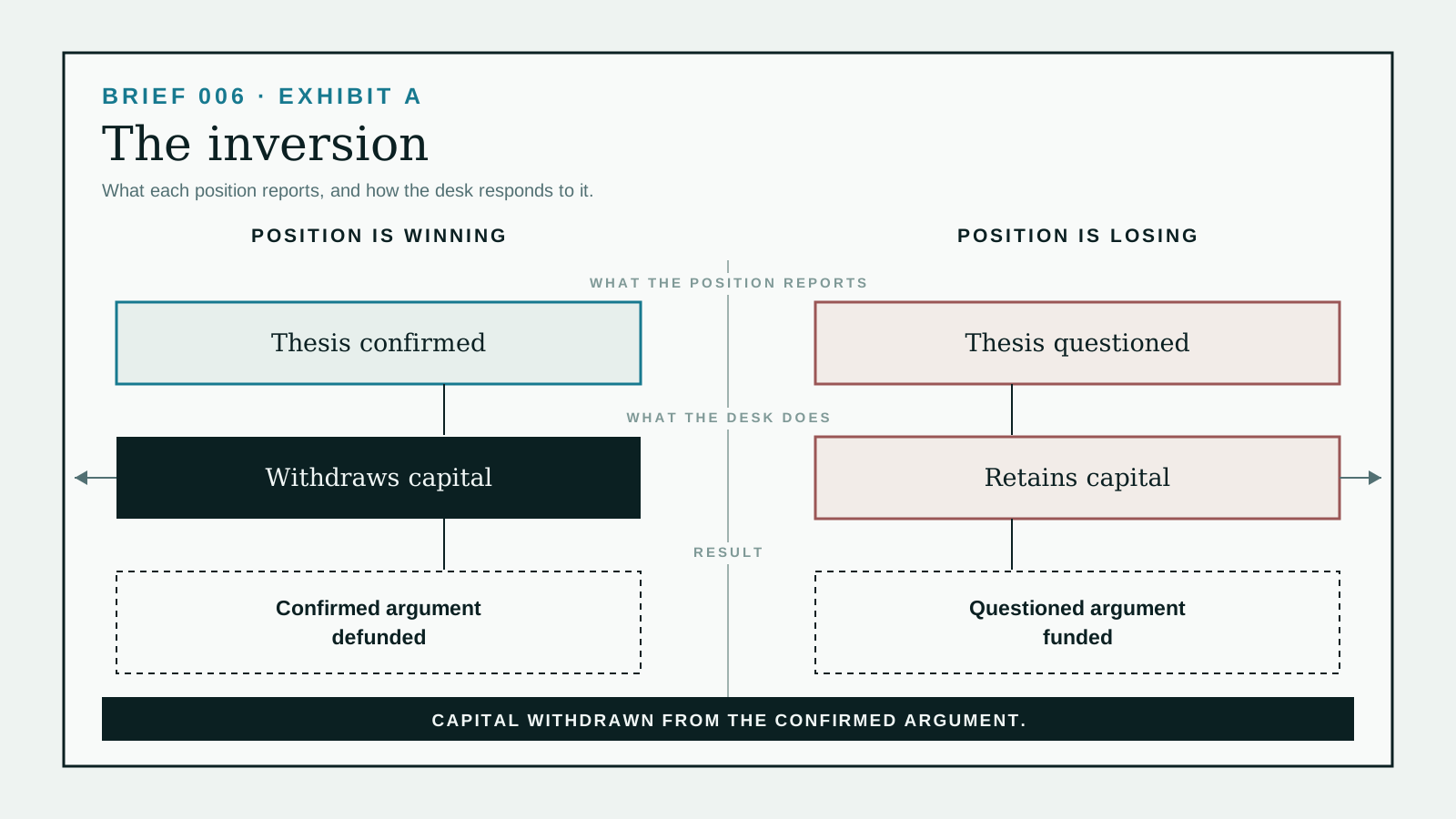
Consider what each position is reporting.
The winner is the position in which the thesis is being confirmed. The loser is the position in which the thesis is being questioned. The desk responds by withdrawing capital from the argument that is working and leaving it in the argument that is not.
The measured cost of this arrangement is 3.4 percentage points, being the margin by which the winners those investors sold outperformed the losers they retained over the following twelve months.
Performed in that order, this is an error. Described as taking profits and giving the other one more time, it becomes a strategy, and the description is what ends up in the review.
The desk is not allocating capital by conviction. It is allocating capital by which position is currently more comfortable to look at.
The entry price is not information
Every terminal on this floor displays the trader's average cost for each position. It has damaged more sound holdings this year than any macroeconomic event.
The mechanism is not mysterious. Outcomes are evaluated as gains and losses measured against a reference point rather than against total wealth, producing caution above that point and appetite below it. The reference point here is not the account balance. It is narrower and more arbitrary than that: whatever price this particular position happened to be opened at, on whatever morning the trader happened to act.
That number is a clerical artefact. It has been promoted to a decision variable.
The position does not know what you paid. The market holds no view on your entry. An asset thirty percent above your average and an asset thirty percent below it are, with respect to what happens next, the same asset facing the same conditions. Two traders holding identical exposure at identical prices will reach opposite conclusions because they opened on different Tuesdays.
Cost basis has exactly one defensible use, which is the calculation of tax. Every other function it is asked to perform, it performs badly.
The part of the trade that has already occurred is not evidence about the part that has not.
Exhibit B: the trimmed position
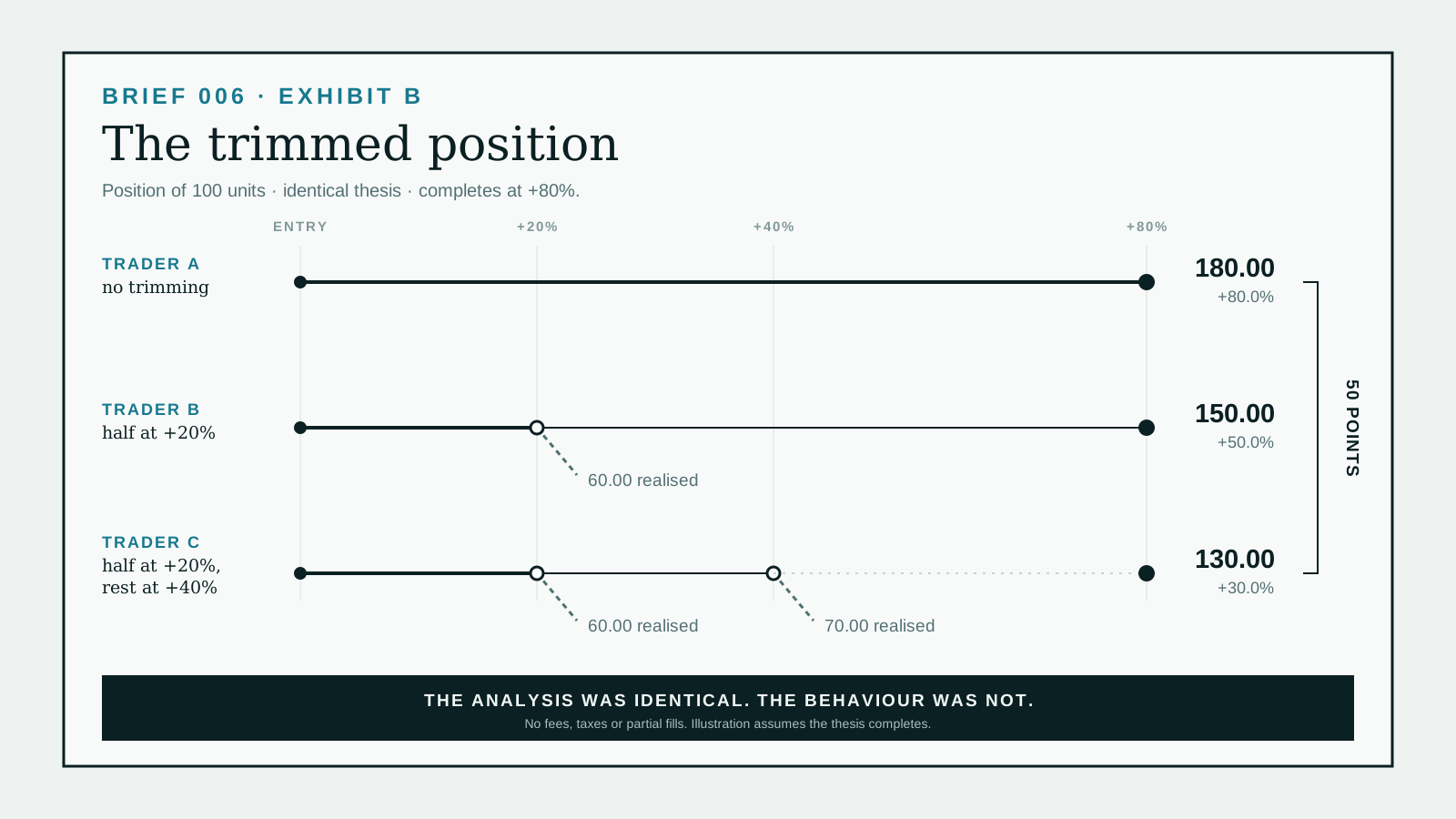
Consider a deliberately simplified position of 100 units.
The thesis is correct and eventually completes with the asset 80 percent higher. The analysis is identical in every case below. The only variable is the trader's exit behaviour on the way there. There are no fees, taxes or partial fills.
Trader A holds the position until the thesis completes.
Trader B sells half at +20 percent, because a gain has appeared and half seems prudent, and holds the remainder to completion.
Trader C sells half at +20 percent and the remainder at +40 percent, on the basis that two disciplined exits are better than one.
| Exit behaviour | Realised early | Held to completion | Total | Return |
|---|---|---|---|---|
| A — no trimming | — | 180.00 | 180.00 | +80.0% |
| B — half at +20% | 60.00 | 90.00 | 150.00 | +50.0% |
| C — half at +20%, rest at +40% | 60.00 | 70.00 | 130.00 | +30.0% |
Each trader was correct about the asset. Each held it through the period in which the thesis was proven. The 50-point spread between A and C was not produced by analysis, information or risk management. It was produced entirely by discomfort arriving at different times.
The arithmetic of repair is worth stating explicitly. To match Trader A, Trader B must now earn 30 units on the 60 he withdrew — a further 50 percent, from a new position, selected under time pressure, in an asset he has not yet analysed.
He did not reduce risk. He exchanged a thesis he had already validated for one he has not yet written.
Management notes that the illustration assumes the thesis completes, and that this assumption is performing considerable work. In the cases where the position fails at +20 percent instead of continuing to +80, Trader C is the one who looks disciplined and Trader A is the one explaining himself to the committee. The exhibit does not demonstrate that trimming is wrong. It demonstrates that trimming performed without reference to the thesis produces a return determined by the trader's tolerance rather than by his analysis — and tolerance is not a strategy in either direction.
A thought exercise for the shareholder
- At +20 percent, what proportion of the position would you sell?
- At −20 percent, what proportion of the same position would you sell?
- What changed in the thesis between those two questions?
- If the answer is nothing, which of the two decisions was about the asset?
- Would you buy this position today at its current price, knowing what you now know?
- If yes, on what basis are you selling it?
There may be a defensible answer. Concentration limits are real, liquidity is real, and a position that has doubled may genuinely exceed its mandate.
The exercise requires only that the reason be stated before the sale rather than after it.
What completion looks like
Management has now twice referred to a thesis being complete without defining the term. The omission is common on this floor, and the vacuum is precisely what profit-taking fills.
A thesis is complete when the reason for owning the asset has occurred. There are three ordinary forms.
The event happened
The catalyst arrived, the refinancing closed, the product shipped, the policy changed. The position was held in anticipation of something specific and that something is now behind it.
The gap closed
The asset was owned because it was priced incorrectly against a stated benchmark. It is no longer priced incorrectly. The argument was resolved by the market rather than abandoned by the holder.
The capital has a better use
Not a more exciting use. A better one, at comparable risk, assessed against this position on its current merits rather than against the fact that this position is up.
None of the three is a price. All of them can occur while the position shows a loss, and none occurs merely because the position shows a gain.
Completion and profit are unrelated conditions that happen to be displayed on the same screen.
Reduction, and what it conceals
Management does not object to reducing a position. Reducing a position is frequently correct. Management objects to reducing a position without entering the reason into the record.
One clarification is required before that test can be applied, because the argument so far invites a cruder reading than it deserves. Nothing in this Brief requires a position to be held whole or sold whole. An exit is not a single decision taken once at a single price. It is a schedule of conditional reductions, most of which never execute.
A position of any size should carry, at entry, more than one stated outcome: the conditions under which the thesis is confirmed and the position may be held or increased; the conditions under which it has partially completed and exposure may be reduced; and the zone in which it is no longer supported and the position should not exist at all. These are not price targets in the retail sense. They are the points at which the evidence changes state, and the price is only where that change happens to be observed.
The threshold is supposed to move
A position that fails to reach its first objective has reported something. Demand did not appear where the thesis said demand would appear. That is not a neutral event to be waited through. It is partial disconfirmation, and it legitimately shifts both the invalidation zone and the appropriate exposure.
The trader who holds the full position from that point all the way back to his original stop, on the grounds that he does not sell into weakness, is not demonstrating conviction. He is declining to read a result. A thesis that has been partly disproven should be funded partly.
The distinction, then, is not between a threshold that moves and one that stays fixed. Thresholds move. Thresholds that cannot move belong to a trader who has stopped updating.
The distinction is between a threshold that moves because the structure changed and a threshold that moves because the trader would like to feel better.
One question separates them.
If the position fails to reach the first objective within the expected window, reduce by a third and reset invalidation to the prior structural level is a rule. It can be written in advance, it survives contact with an uncomfortable morning, and it issues the same instruction regardless of who is watching. It stopped working, so I got out is not a rule. It is a description of a feeling, composed afterwards, and available to justify any action at all.
Two reductions can therefore appear identical on the ticket and differ entirely in character. The first executes a conditional schedule the trader wrote while nothing was at stake. The second is reverse-engineered from wherever the price happens to be sitting when he looks at it.
Thresholds are permitted to move with the evidence. They are not permitted to move with the trader.
The round trip
Management anticipates the objection. It is the strongest one available and it deserves a direct answer.
A trader who never books a gain will eventually watch a position rise thirty percent, return to its entry price and continue below it. The gain was real while it existed. It is not real now. Being told that an exit is a decision about the argument is of limited comfort to a man who has just carried a position all the way up and all the way back down.
The objection is legitimate. The conclusion usually drawn from it is not.
A round trip is almost never caused by a failure to take profit. It is caused by the absence of any exit condition whatsoever. The trader who surrenders an entire advance did not hold a definition of completion, did not state an invalidation, and was therefore relying on the price to tell him when to act. The price eventually did. It simply told him late, and at a level he did not choose.
Profit-taking does not remedy this. It is the same condition at an earlier hour. In both cases the price is making the decision. The only question is whether it makes it on the way up or on the way down.
The remedy is governance written before the position moves: a completion condition stated at entry, an invalidation stated at entry, and — where concentration genuinely warrants it — a scheduled reduction expressed as a rule the trader wrote while nothing was at stake, then executed whether or not it feels necessary on the day. Management has no objection to a position being trimmed at a predetermined level. Management objects to the level being determined at the moment of discomfort and subsequently described as though it had always existed.
A rule written in advance decides the round trip. A rule written during one merely regrets it.
The scratch
Management enters one qualification, because there is a round trip that is not a failure and the floor files it incorrectly with great consistency.
A position advances. A pre-stated rule moves the exit to the entry price. The advance does not hold, the position is closed at entry, and the trader records the episode as having given back thirty percent.
He has done no such thing. The plan contemplated this outcome, specified the level at which the exit would move, and then produced exactly the result it described. The correct entry in the record is a scratch: capital committed, thesis tested, thesis unconfirmed, position closed at no cost beyond friction. A process reaching one of its intended terminals is working.
The thirty percent he believes he lost was never his. It was a mark on a screen, available to a seller of a smaller size, at a moment he had already decided not to act on.
Management notes that the rule is not free and should not be applied reflexively. Moving an exit to entry converts a position with room to breathe into one that ordinary noise can close, and a trader who does it automatically on every advance will scratch a great many theses that were never disproven. It is a legitimate instrument with a real cost, and the condition that triggers it deserves the same care as the condition that opened the position.
A round trip the strategy specified is not a round trip. It is a scratch, and it should be filed as one.
The high-water mark
The more expensive damage arrives afterwards.
A trader who has given back a large gain acquires a number he will not put down: the highest price the position reached. He grades himself against it, describes the episode as a loss of that amount, and resolves never to permit it again. Every subsequent position is then trimmed early on the authority of a single memory.
The peak is not information.
It belongs to the same family as the entry price, arriving from the opposite direction: a figure the trader did not choose, could not have known at the time, and in most cases could not have transacted in size at even if he had. A high print describes one trade at one moment, executed by somebody smaller and faster, and it says nothing whatsoever about the exit that was actually available to the whole position.
The entry price records what you paid. The peak records what you might have received. Neither describes the asset, and a trader who has replaced the first with the second has changed which arbitrary number chairs the committee.
The review after a round trip therefore contains one question. Was the thesis invalidated somewhere on the way down, and did the trader fail to act on it? If so, the failure was in execution, and the invalidation rule requires enforcement rather than revision. If the thesis remained intact throughout and only the price moved, nothing has been discovered, and the memory of the peak does not constitute a mandate to trim the next position early.
A round trip is an argument for defining the exit. It is not an argument for accepting the first one offered.
Why the Firm prefers it
The floor is not solely responsible for this.
An unrealised gain is a figure on a screen. A realised gain is an entry in the record. It can be reported, discussed at committee and attributed to the individual who produced it. It survives the quarter. It cannot be withdrawn by Tuesday.
Nobody instructed the floor to prefer realised gains. No policy was issued and no memorandum exists. The reporting system simply notices one kind of outcome and not the other, and behaviour follows attention with great reliability and no announcement.
Institutions therefore develop a structural preference for booked gains and then describe that preference as risk discipline, because risk discipline is a better heading than the desk would like something to show. The trader closing a position before lunch is not only managing his own discomfort. He is producing an artefact for a system that measures artefacts.
Management has reviewed the arrangement and finds it operationally convenient.
A firm that measures only what has been booked will eventually be run by people who book things.
Management's disposal doctrine
This Brief does not propose that positions be held indefinitely. Trimming is often right, and concentration left to grow without limit will eventually run the book rather than the other way around.
Management proposes a separation of powers.
The thesisDetermines whether the position should exist.
The mandateDetermines the maximum size at which it may exist, set in advance and without reference to any particular price.
The evidenceDetermines whether the thesis has been invalidated or completed.
The priceDetermines none of the above. It prompts review. It does not conclude it.
Recent price movement may inform an exit. It may not authorise one on its own.
Where the asset has risen, allow the position to remain until the thesis is resolved rather than until the trader is comfortable. A mandate that requires reduction should be executed on the schedule the mandate specified, not the one the chart suggested. Absent either condition, the correct action is to leave the position alone, which will feel like negligence and is not.
This approach will occasionally result in a gain being surrendered, a position retracing most of its advance, and a shareholder observing that the profit was available and was not taken. Those outcomes are visible and irritating.
The alternative costs are less visible: the thesis abandoned at the first sign of success, the capital rotated into an unexamined replacement, and the long record of correct analyses that were never permitted to finish.
Re-entering the position
An exit is frequently treated as a permanent ruling on an asset, rather than a decision about a particular position at a particular size. This produces two errors that look opposite and are not.
The first refuses to buy the name back at all. The position was sold at a profit and the file was closed; buying it again reads, to the trader, as admitting the sale was premature. The asset is placed on an informal exclusion list — not because the thesis is invalid, but because re-entering would require narrating a change of mind in public.
The second waits for the price to fall back to the level at which it was sold, on the theory that paying more than that number would be undisciplined. This is the entry-price error, arriving from the exit side. The price at which a position happened to be closed carries no more information about the asset's future than the price at which it happened to be opened. It is not a floor, a bargain, or a test of virtue. It is the level at which a different exposure was appropriate, given the evidence available at the time.
Management proposes the same standard for re-entry as for the original position: does the thesis exist, is it consistent with the evidence obtained since the exit, and does the current price offer an attractive way to hold it. The prior exit is one data point in that evidence, no more privileged than any other closing price on the chart. It does not require defending, and it does not require avoiding.
A thesis correctly exited on completion, and subsequently supported by a new development, is not the same trade resumed. It is a new decision that happens to involve a name already known to the desk. It should be sized, and defended, exactly as if the position had never been held before.
Selling a position does not disqualify you from owning it again. It only obliges you to explain why, this time, on terms that do not reference the last ticket.
A note to the stonkholders
The culture of $STONKS has considerable tolerance for conviction on the way in. It has less practice at conviction on the way out.
There will be positions that retrace after we decline to trim them. There will be gains that evaporate and would have been perfectly real had anyone booked them. No framework eliminates that outcome without also eliminating the outcome in which a correct thesis is permitted to run to its conclusion.
The objective is not to hold everything forever. It is to ensure that when a position is closed, the reason can be stated in a sentence that does not contain the words up or down.
A gain may be pleasant. A gain may be prudent to realise. A gain may be entirely irrelevant to the question of whether the reason for owning the asset still stands.
Only the last of those is an investment consideration, and it is the only one the screen does not display.
Management is prepared to be uncomfortable. The evidence is authorised to end the discomfort. The price is not.
Source note
- 1. Barber & Odean — Trading Is Hazardous to Your Wealth (2000) ↗
- 2. Shefrin & Statman — The Disposition to Sell Winners Too Early and Ride Losers Too Long (1985) ↗
- 3. Odean — Are Investors Reluctant to Realize Their Losses? (1998) ↗
- 4. Kahneman & Tversky — Prospect Theory: An Analysis of Decision under Risk (1979) ↗
Stonks On Stonk is an editorial and meme project. This Brief is cultural commentary, not financial advice.