
Stonkholders,
Across the firm, management has observed that traders are generally willing to wait for a thesis to play out, provided it begins playing out immediately.
The thesis is written. The evidence is assembled. The position—or deliberate lack of one—is approved. Then the market continues in the opposite direction.
Nothing fundamental has changed. The original risks remain. The expected mechanism remains plausible. Only the price has declined to cooperate on the preferred timetable.
This is often enough to trigger an unscheduled investment committee.
The trader does not initially say the thesis is wrong. The language is more administrative. Perhaps the market is looking through the weakness. Perhaps positioning matters more than fundamentals. Perhaps the rally itself is evidence of resilience. Perhaps it is better to participate now and become cautious later.
The conclusion usually arrives before the analysis: capital should be put back to work.
By the time the trader buys near the level they had previously considered excessive, the decision is described as adaptation. In many cases, no material premise has been updated. The discomfort simply lasted longer than the mandate could tolerate.
The thesis was not invalidated. The trader's patience was.
A thesis and a timetable are not the same instrument
Every market thesis contains at least two judgments.
The first concerns mechanism: what is happening, why it matters and how it should eventually affect prices.
The second concerns timing: when the market will recognise it.
Traders are usually more rigorous about the first. They can describe employment, earnings, liquidity, valuation, positioning or policy transmission in detail. The timetable is often supported by less. A few weeks becomes a few months because that feels like a serious forecasting horizon. A quarter-end, central-bank meeting or earnings season is recruited to give uncertainty a calendar invitation.
When the date passes and the mechanism has not yet appeared in price, the two judgments are collapsed into one. A timing error is treated as a thesis error.
That conclusion may be correct. A thesis that cannot explain why its expected transmission keeps failing deserves scrutiny. Delay can contain information. Markets may be discounting conditions the trader has missed, or the mechanism may be too weak to matter.
“Not yet” and “not true” remain different findings.
| Question | What is being tested? | Evidence that should change the answer |
|---|---|---|
| Is the thesis still valid? | The causal mechanism | Changed fundamentals, policy, earnings or liquidity |
| Is the timetable still credible? | The expected speed of transmission | Delayed pass-through, new catalysts or a missing catalyst |
| Is the position still appropriate? | Portfolio construction | Carry, volatility, liquidity, sizing and capacity to wait |
A timetable can be wrong while the thesis remains intact. A thesis can be right while the position is badly designed. A position can be sensible even when the eventual forecast proves wrong.
These are not semantic distinctions. They determine which part of the decision needs repair.
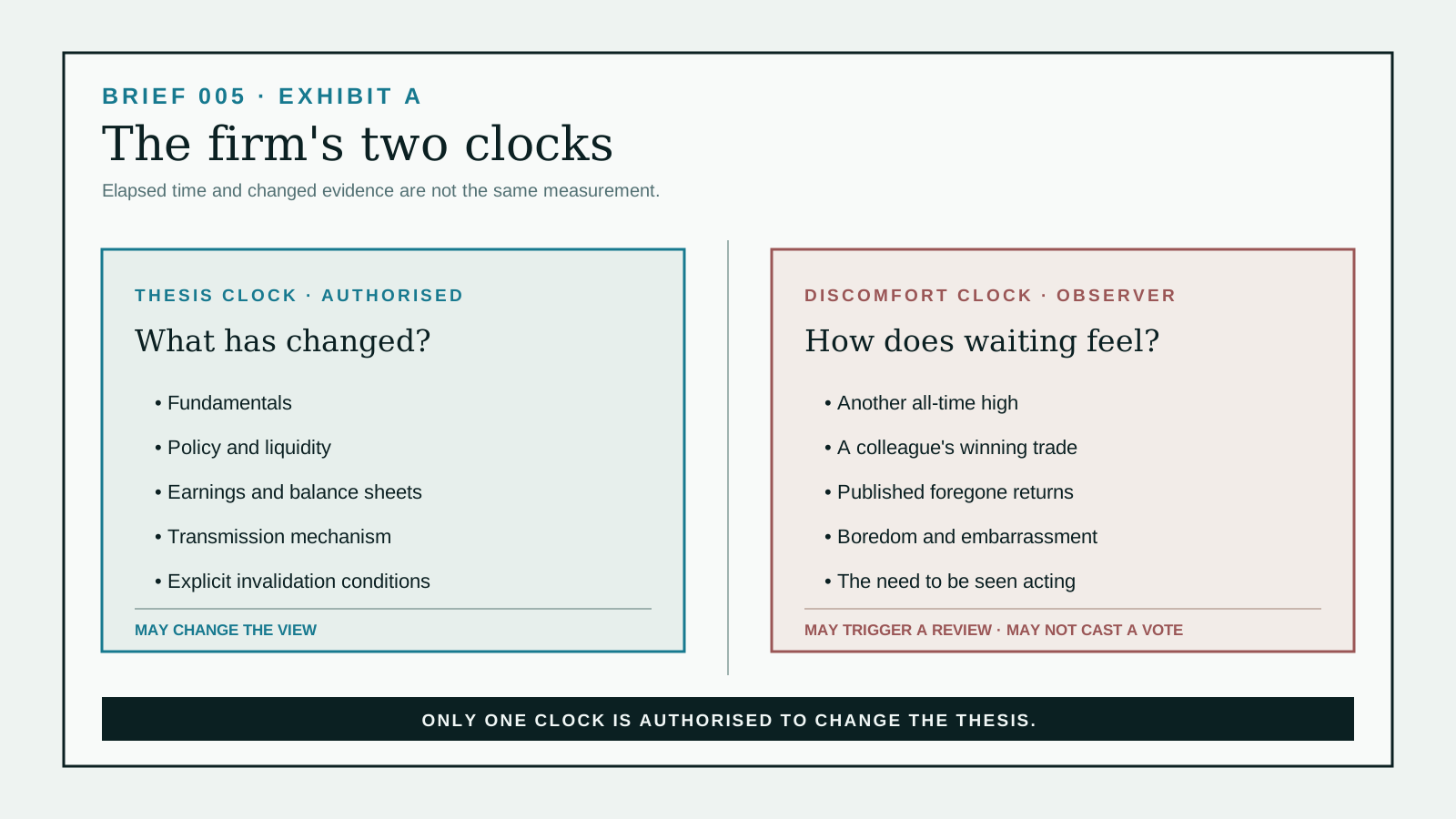
The firm's two clocks
Once a trader steps aside, two clocks begin running.
The first is the thesis clock. It measures whether the mechanism is strengthening, weakening or failing to transmit.
The second is the discomfort clock. It measures how long the trader has watched other people make money.
Only one of these clocks is supposed to control the decision.
In practice, the discomfort clock is easier to read. It updates every day. A rising index supplies a closing mark. A colleague's profitable trade supplies a comparison. Financial media provides a list of everything the cautious trader should apparently have owned. The cost of waiting is published in real time.
No equivalent ticker records the benefit. Capital preserved by avoiding an eventual drawdown produces no celebratory screenshot. Flexibility retained for a better entry is equally quiet. From the outside, a thesis under review looks remarkably similar to a person doing nothing.
This asymmetry makes patience professionally awkward. Action generates evidence of work. Waiting generates questions.
Research on action bias illustrates the broader instinct. In one study of elite football penalties, goalkeepers overwhelmingly chose to dive even though remaining in the centre produced better average outcomes in the sample. The authors argued that action was the norm and therefore felt less regrettable, even when inaction could have been more effective.
A penalty study cannot manage a portfolio. The institutional pressure is still familiar: being wrong while active can feel more defensible than being right while still.
The firm should be careful about promoting visibility to competence.
Opportunity cost is real
There is a respectable objection to patience.
Cash can become an expensive refuge. Markets can remain overvalued longer than expected. Strong businesses can continue compounding while the cautious observer waits for an entry that never arrives. A trader can turn every rally into further proof of irrationality and spend years protecting capital from gains.
Management accepts the charge.
Patience is not free. It incurs opportunity cost, inflation, reinvestment risk and the possibility that the market has understood the situation better than the trader. The longer a thesis fails to transmit, the greater the obligation to investigate why.
Opportunity cost does not answer the investment question by itself.
The fact that an asset has risen while it was not owned establishes that money could have been made. It does not establish that the original entry standard was wrong, that the future expected return remains attractive, or that buying now is superior to the available alternatives.
The market is particularly skilled at turning missed returns into a demand for immediate participation. A position rejected at 100 feels safer at 120 because the rise appears to confirm its quality. The prospective return may now be lower. The downside may be larger. None of this prevents the trader from feeling that the decision has become more responsible.
The trade is no longer being purchased solely for its expected return.
It is also being purchased to end the experience of not owning it.
Opportunity cost belongs in the investment case. It should not become the investment case.
Price is evidence, not management
Price matters.
A persistent rally can reflect stronger fundamentals, easier financial conditions, improving liquidity, superior earnings or information not yet incorporated into the trader's framework. Ignoring it would simply refuse available evidence.
Price continuing upward, however, does not by itself identify which explanation is correct.
The firm has observed a recurring substitution. The trader begins with a causal thesis. When the market disagrees, price gradually replaces causality:
It keeps going up, therefore something must be better, therefore the original risks matter less, therefore participation is now prudent.
The reasoning is circular, but the chart is persuasive.
A stronger review asks what the price movement is telling us that can be independently examined.
- Have growth or earnings expectations materially improved?
- Has the underlying balance sheet strengthened?
- Have policy or liquidity conditions changed?
- Has an identified risk been resolved, or merely ignored?
- Has the expected payoff improved—or only the fear of missing it?
- Would the trade be attractive today if the recent rally were hidden?
If the answers reveal structural strengthening or a genuine shift in fundamentals, the thesis may be invalidated. Management should update it without ceremony. A thesis is an analytical instrument, not a family heirloom.
If the only new evidence is that price continued upward, review is warranted. Capitulation is not yet required.
Patience and stubbornness use the same chair
The strongest criticism of patience is that it can become indistinguishable from stubbornness.
Both can look calm. Both can use long time horizons. Both can describe volatility as noise. Both can claim that the market will eventually understand.
The difference is governance.
Patience preserves the original standard for changing one's mind. Stubbornness changes that standard whenever the evidence approaches it.
Patience says: These developments would weaken or overturn the thesis.
Stubbornness says: Those developments were never important anyway.
This risk is not confined to traders who remain cautious. The same behaviour appears in positions already owned. Experimental work on escalation of commitment has shown that decision-makers may commit additional resources after negative outcomes, particularly when they feel personally responsible for the original decision. In markets, this can mean adding to a losing position, extending the horizon or moving the invalidation point so the thesis is never formally allowed to fail.
Waiting outside a trade can produce the mirror image. The trader may keep predicting an imminent correction, move each failed catalyst forward and describe every additional rally as a larger future opportunity.
Management does not consider either behaviour patient.
Patience requires the possibility of surrender.
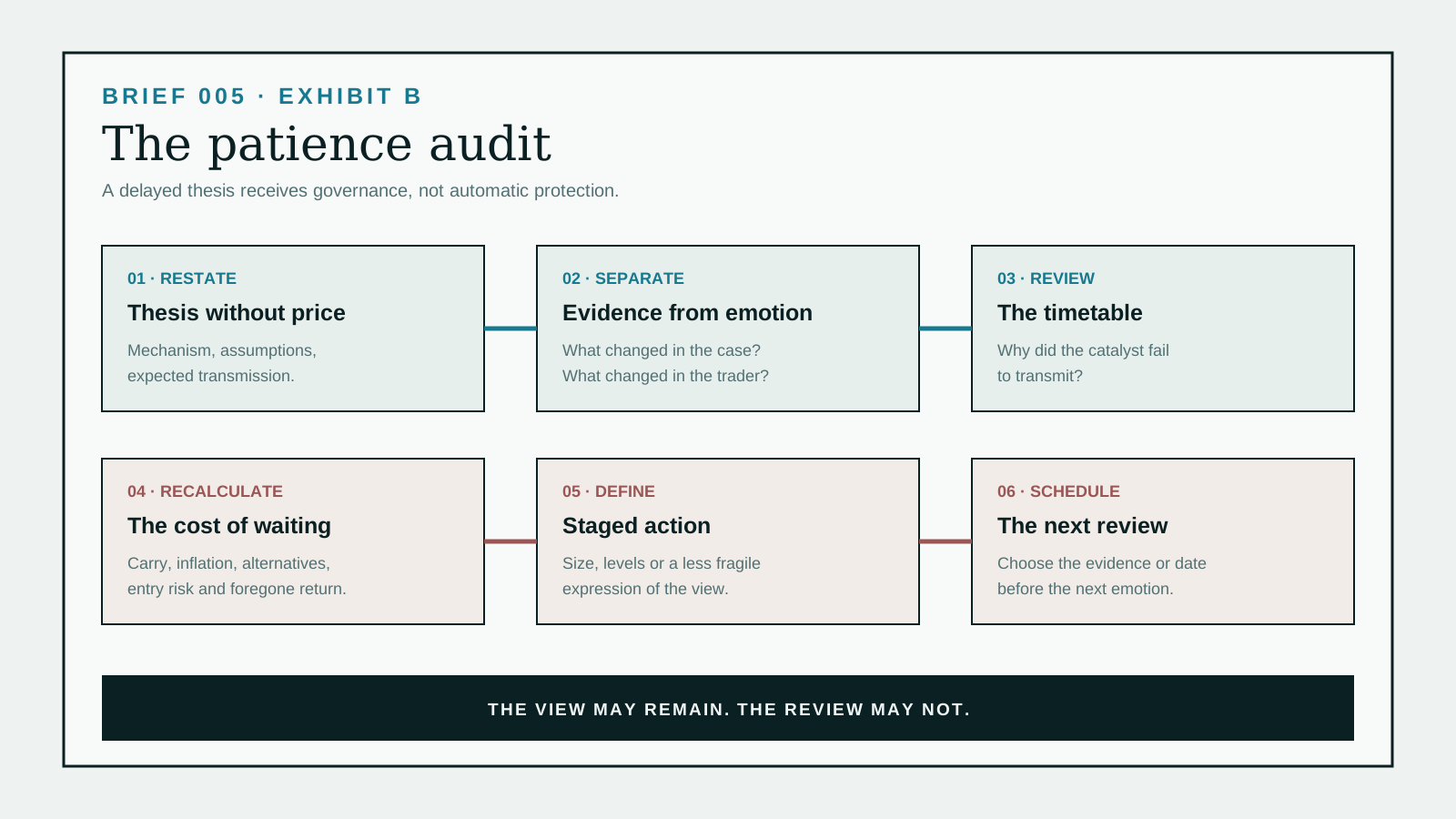
The patience audit
The firm therefore proposes a review process for any thesis that has remained unresolved longer than expected.
Restate the thesis
Describe the mechanism without relying on the claim that price is too high, too low or due.
Separate invalidation
Record what changed in the evidence separately from what changed in the trader's emotional experience.
Review the timetable
Explain why transmission failed and whether another force offset or disproved the expected catalyst.
Recalculate waiting
Include carry, inflation, foregone returns, alternatives and the probability the desired entry never appears.
Define staged action
Consider smaller initial size, predetermined levels or a less fragile expression of the thesis.
Set the next review
Choose the evidence or date before the next emotional emergency committee convenes.
The audit prevents boredom, embarrassment and price momentum from rewriting the view without entering the minutes.
Cash requires a mandate
It is fashionable to say that cash is a position.
Sometimes it is. Sometimes it is the absence of a decision with better branding.
Cash becomes a position when the holder can explain:
- what risk it is intended to avoid;
- what return or flexibility it is expected to provide;
- what evidence would justify deployment;
- whether deployment will be staged or immediate; and
- what would prove that remaining in cash was the wrong allocation.
Without those conditions, cash can become an indefinite waiting room. The trader remains cautious because caution has become part of the identity, while every missed rally makes changing course feel more humiliating.
Compulsory deployment would solve the wrong problem. Cash requires an explicit mandate.
Management has seen traders abandon a thesis at the point of maximum emotional pressure, not maximum analytical change. They wait through the uncertainty, watch the market move without them and finally buy when the social cost of caution exceeds the perceived financial risk.
This often feels like relief. The relief is emotional; it adds nothing to the expected return.
A note to the stonkholders
The culture of $STONKS has room for conviction. It should also have room for a thesis that requires time, a review that changes management's mind and a position size that remains zero while the evidence is incomplete.
Patience does not mean predicting the same outcome forever. It means refusing to replace a causal judgment with an emotional deadline.
The market may continue higher. The correction may never arrive. The cautious trader may eventually discover that the firm's capital would have been better deployed elsewhere. Those are legitimate outcomes and they belong in the review.
What does not belong in the review is the idea that a thesis becomes false merely because other people made money before it resolved.
Markets are under no obligation to validate sound reasoning promptly. They are equally under no obligation to validate it eventually.
The firm must remain patient and revisable. It may change its mind when the evidence earns that authority. The latest price does not receive it automatically.
Management is prepared to wait. The evidence is authorised to interrupt.
Source note
Stonks On Stonk is an editorial and meme project. This Brief is cultural commentary, not financial advice.