
Stonkholders,
The market has a habit of allowing the most recent trade to chair the next investment committee.
A large win arrives. The account is larger. The trader sizes positions as a fraction of the total pot, so the next position becomes larger too. The arithmetic appears disciplined. The emotional conclusion arrives unnoticed: I have more capital because I am now a better trader.
A loss produces the opposite distortion. The account is smaller, but the desired outcome becomes larger. The next trade is no longer asked only to make money. It is asked to repair the previous one, restore confidence and return the portfolio to the balance it recently displayed.
In both cases, the last result acquires authority over the next decision.
Anyone who has spent enough time around a trading floor has seen both versions. After a large win, size increases because the pot can support it. After a loss, size increases because the pot must be repaired. Both decisions arrive dressed as conviction. Neither necessarily reflects an improvement in the underlying process.
The last trade may change the size of the bankroll. It should not automatically change the authority we have to size the next one.
The account grew. The edge may not have.
There is nothing irrational about allowing position size to grow with capital.
If a trader consistently risks a fixed fraction of the portfolio, a larger account will produce a larger nominal position. This is not recklessness. It is arithmetic. Compounding would be a disappointing business model if every gain had to be removed from future productive use.
The danger begins when three separate things are treated as one:
- The account is larger.
- The trader feels more confident.
- The trader has become more skilful.
Only the first is established by the balance on the screen.
A profitable outcome may reflect skill. It may also reflect a favourable market, an unusually forgiving entry, excessive risk that happened to work, or a thesis that was correct for reasons the trader did not understand. One result cannot reliably distinguish among them.
Yet a large win changes behaviour quickly. The next setup looks cleaner. Objections become less persuasive. Positions that once felt substantial begin to look conservative. Capital acquired through one successful decision is mentally redesignated as evidence that future decisions deserve more freedom.
The trader says they are sizing from the new bankroll.
Sometimes they are sizing from the new self-image.
Management therefore distinguishes between three forms of scaling.
Mechanical scaling
The bankroll changes and a pre-existing risk rule produces a proportionate change in nominal exposure.
Emotional scaling
Recent profit increases the percentage at risk, lowers the standard for entry or expands the number of positions taken.
Earned scaling
A record of repeated decisions shows that a particular setup, market and execution style can support greater discretion.
The first is arithmetic. The second is momentum wearing a tie. The third takes time.
The recovery trade
Losses interfere with sizing differently.
After a loss, the trader is no longer operating from the same reference point. The previous account balance remains visible in memory. Recovering it begins to feel less like making a return and more like restoring property that already belongs to the shareholder.
This is how the market turns an arbitrary historical number into an urgent corporate target.
The next trade is asked to do too much. It must be profitable, immediate and large enough to matter. A normal opportunity appears inadequate because a normal gain will not repair the damage quickly. The position becomes larger. The entry arrives earlier. The thesis becomes more flexible. The need to recover is presented as conviction in the new setup.
On the floor, revenge trading rarely introduces itself by name. It sounds more respectable: repair the loss, recover the balance, find the next clean setup and prove that the previous outcome changed nothing.
It has already changed the person making the next decision.
A cooling-off period can create distance between the loss and the next deployment of capital. Its purpose is not ceremonial restraint. Time alone does not improve a thesis, and revenge trading does not become prudent merely because it waited until after lunch.
The pause exists to restore independence between two decisions.
Before the next trade, management should be able to ask:
- Would I take this trade if the previous loss had never happened?
- Is the position sized from the capital I have, or from the amount I want to recover?
- Can I state the setup, invalidation and intended exit before entering?
- Am I choosing this opportunity, or choosing the feeling of being back in action?
- Is the additional size supported by evidence, or by urgency?
If the previous trade is required to explain the next one, the portfolio may still be settling an old account.
Exhibit A: The second trade
Consider a deliberately simplified account with 100 units of capital.
Management's baseline rule permits 10% of the current account to be lost on a trade. For the purposes of the illustration, a winning trade adds the chosen risk fraction to the account and a losing trade subtracts it. There are no fees, taxes, slippage or partial outcomes. The purpose is not to model a real strategy. It is to isolate what happens when the last result changes the size of the next decision.
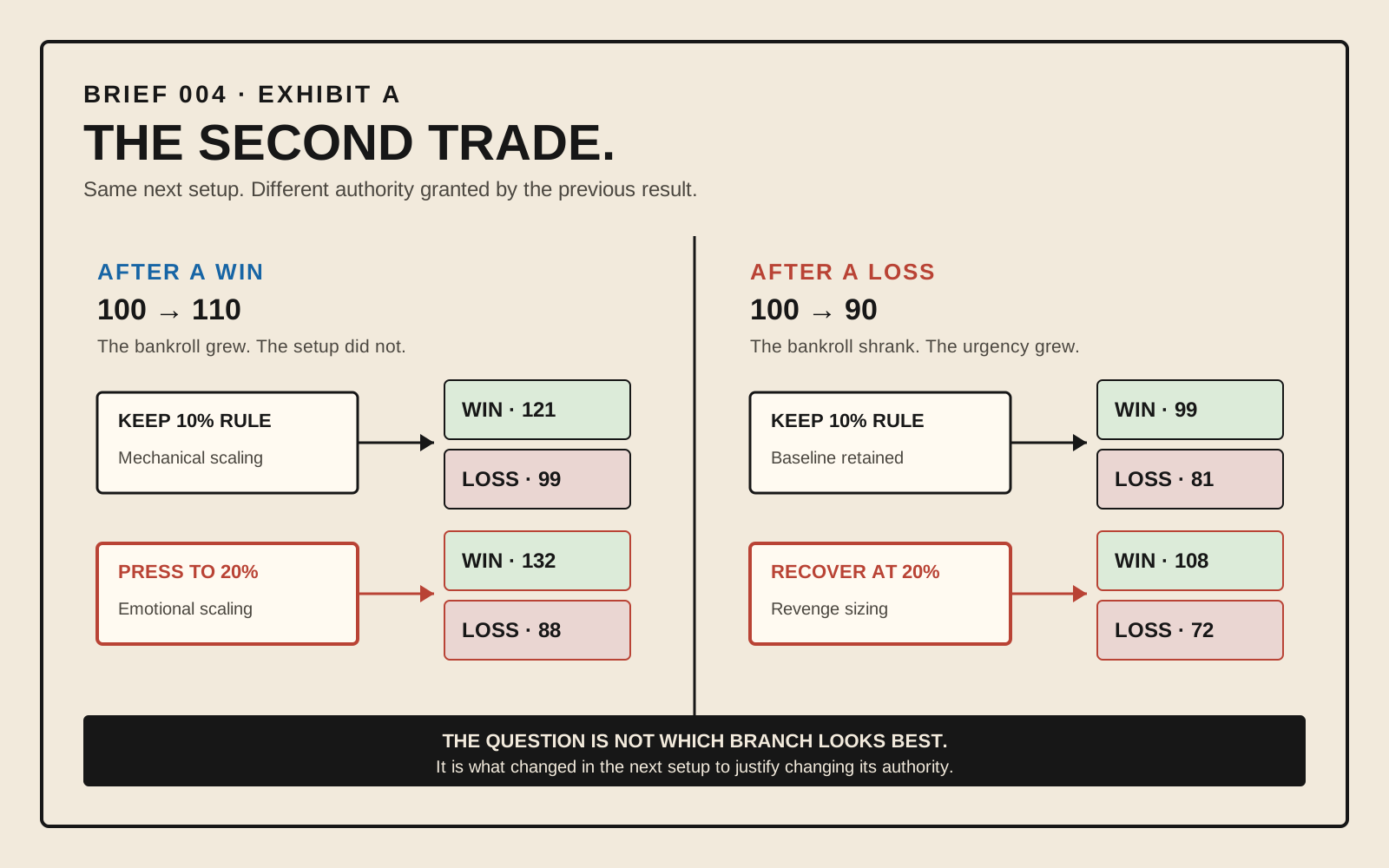
The first trade wins. The account rises from 100 to 110.
The trader can keep the 10% rule for the next trade, or interpret the win as permission to increase risk to 20%.
| Decision after the first win | If the next trade wins | If the next trade loses |
|---|---|---|
| Keep risk at 10% | 121.00 | 99.00 |
| Increase risk to 20% | 132.00 | 88.00 |
The larger position makes the attractive outcome substantially more attractive. It also allows one loss to remove the entire first gain and a further 12 units of the original capital.
Now reverse the first result.
The account falls from 100 to 90. The trader can keep the 10% rule, or double risk to 20% in an attempt to recover more quickly.
| Decision after the first loss | If the next trade wins | If the next trade loses | Gain required to return to 100 |
|---|---|---|---|
| Keep risk at 10% | 99.00 | 81.00 | 23.46% |
| Increase risk to 20% | 108.00 | 72.00 | 38.89% |
This table explains why revenge sizing is persuasive.
If the enlarged recovery trade wins, the account does not merely recover. It reaches 108. The original loss is erased and the decision to increase size appears to have been vindicated.
If it loses, the account falls to 72. Returning to 100 then requires a gain of 38.89%, compared with 23.46% if the baseline rule had been maintained.
The recovery trade offers emotional closure on the favourable branch and a materially more difficult recovery on the unfavourable one. Arithmetic cannot tell us which branch will occur. It can show exactly how much additional authority was granted to the second trade.
A thought exercise for the shareholder
- After the account rises to 110, what percentage would you risk on the next trade?
- After the account falls to 90, what percentage would you risk on the same next trade?
- Which number did you notice first: 132, 108, 88 or 72?
- What changed in the quality of the next setup between the two scenarios?
- If the setup, liquidity, invalidation and expected payoff are identical, what evidence justifies giving it different size?
- If the correct answer is not to take the second trade, would you record that as a successful decision?
There may be a defensible answer. The first outcome may reveal useful information about the strategy, and the account balance genuinely changes the amount of capital available. The exercise does not demand identical nominal exposure under all conditions.
It demands that the difference be explained.
If the only explanation is that the trader feels more capable after the win or more urgent after the loss, the previous trade is sizing the next one.
Every position has two sizes
Position sizing is usually discussed as a financial control. It is also behavioural infrastructure.
Every position has a financial size and a psychological size.
The financial size is visible: capital deployed, percentage at risk, expected volatility, liquidity and maximum acceptable loss.
The psychological size appears later. It is measured in sleep interrupted, plans abandoned, charts refreshed, moods altered and rules renegotiated while the position moves.
The same financial exposure can be psychologically small to one trader and unmanageably large to another. This is not a moral distinction. Temperament, experience, time horizon, liquidity and personal circumstances all change the amount of volatility a person can observe without becoming part of it.
A position becomes psychologically oversized when ordinary movement changes the quality of the person evaluating it.
At that point, the trader may still be within a numerical loss limit while already operating outside their decision-making capacity. The position has acquired the ability to shorten time horizons, manufacture urgency and convert every new candle into apparent information.
Reducing size in those circumstances is not necessarily a loss of conviction. It can be the action that makes conviction capable of rational review.
Management cannot eliminate volatility. It can decline to let volatility appoint a new portfolio manager after every candle.
The invisible return of doing nothing
Markets are highly efficient at publishing the profits we missed.
The token that rises after we declined to buy it remains visible. The screenshot circulates. The entry appears obvious in retrospect. The untaken trade is entered into the emotional accounts as a loss, despite no capital having left the portfolio.
The losing trade we considered and rejected receives no equivalent publicity.
There is no chart of the capital preserved by avoiding a poor setup. No notification announces that inadequate liquidity, unclear invalidation or emotional urgency would have produced a loss. A trade not taken leaves no heroic evidence of the damage it did not cause.
But abstention has an economic value.
Every trade not taken surrenders potential upside. It also avoids a potential loss, preserves attention and leaves capital available for a better-aligned opportunity. The decision cannot be judged only by whether the asset later rose or fell.
A trade that rallies after being rejected may still have been outside the trader's edge, impossible to size responsibly or unsupported by the information available at the time. A trade that collapses after being rejected does not automatically prove wisdom either. Fear can be rewarded by accident just as recklessness can.
Poker makes the danger of becoming results-oriented unusually clear. The underlying error is known as outcome bias: allowing the eventual result to alter the assessment of a decision that was made with the same information. A player can make the mathematically correct decision and lose the hand, or make a poor decision and win because the cards cooperate. The discipline is to review the choice against the probabilities and information available when it was made—not the story completed afterward.
Trading offers fewer clean probabilities, which makes the same discipline harder and more important. A weak thesis can make money. A well-constructed trade can lose. A rejected trade can rally. The result belongs in the record, but it cannot be allowed to rewrite the quality of the original decision. Otherwise luck is promoted to skill, discipline is demoted to failure, and the behaviour most likely to survive over time is abandoned after whichever outcome happened last.
This is how pattern drift begins. A poor decision wins, so the exception becomes a new permission. A sound decision loses, so the rule is weakened or discarded. Size, entry standards and exit discipline then move a little after each result until the trader is following a strategy that was never consciously chosen.
One outcome may justify review. It should rarely be allowed to rewrite operating policy.
That distinction should change what gets celebrated.
Most trading scorecards reserve praise for profitable positions. A buy that works is remembered. A sell that prevents further damage may be remembered. A candidate examined and correctly rejected usually leaves no mark at all. The record therefore over-rewards visible action and under-records judgment that points away from it.
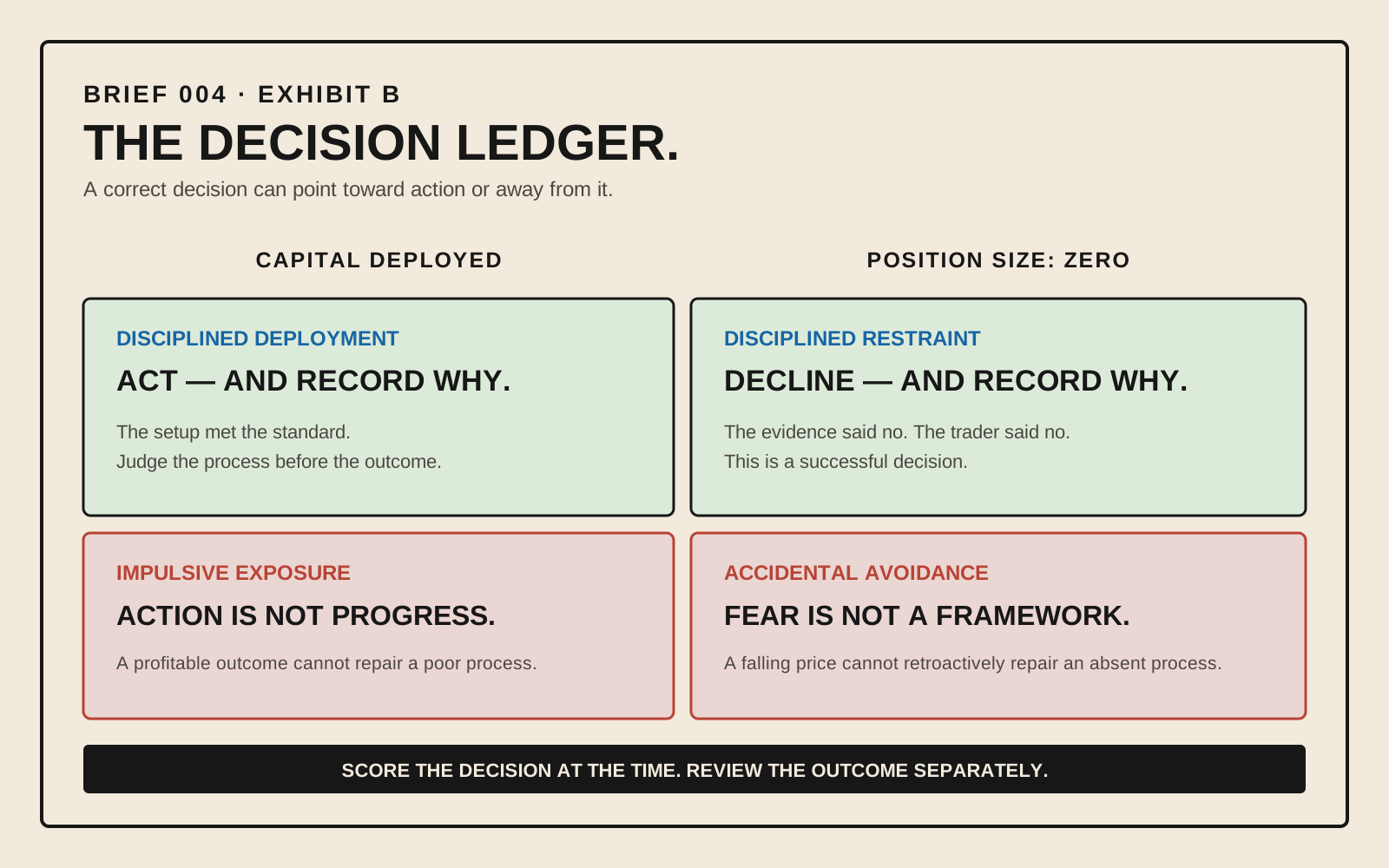
A sound decision deserves credit regardless of its direction. Buying, selling, reducing and declining to participate are all capital-allocation decisions. If the evidence said no and the trader said no, the process worked. The fact that no position appeared on the account does not make the decision less real.
That credit must remain conditional. Avoidance without analysis is not discipline, and a falling price does not retroactively improve a poor process. The achievement is making the decision that the evidence supported at the time, then remaining willing to repeat that process even when the market later supplies an irritating counterfactual.
The decision journal should therefore contain more than entries and exits. It should also record serious candidates rejected, the reason for rejection, and whether that reason would still be valid if the same setup appeared again. Otherwise the losses avoided by inaction remain economically useful and behaviourally invisible.
This distinction matters most after a loss. The desire to recover makes inactivity feel expensive. Every rising chart becomes money left on the table. The trader begins to believe that remaining still is another form of losing. Inactivity carries an opportunity cost, but it does not remove capital from the account.
Sometimes the correct position size is zero. Reaching zero for the right reason is a completed decision, not a failure to make one.
Markets publish the profits we missed. They do not issue statements for the losses we avoided. Management is nevertheless required to account for both.
Discretion must be earned, not inherited
A fully mechanical system is not the only respectable way to trade.
Experience matters. Context matters. Some opportunities are genuinely better than others, and a trader who has developed an edge should retain the ability to act with greater conviction when the conditions justify it.
Discretion should exist. The issue is who authorised it.
Too often, discretion is treated as an entitlement inherited when the account is opened. The trader may increase size because the setup feels exceptional, ignore a rule because the market looks different this time, or extend an invalidation because experience supposedly detects something the original plan did not.
Occasionally the override is correct. Discretionary judgment should still become more valuable as evidence accumulates, not merely more available as confidence rises.
Discretion is earned by discovering, over repeated decisions:
- which setups the trader actually understands;
- which market conditions support those setups;
- how execution changes under pressure;
- where confidence has historically exceeded competence;
- how losses affect the next decision; and
- when the trader is least qualified to override their own rules.
This is a voyage of discovery, not a credential issued at incorporation.
The practical objective is bounded discretion: establish the baseline mechanically, allow judgment to operate within defined limits, and expand those limits only when the record supports it.
One large win does not earn permanent latitude. One painful loss does not revoke all judgment. A sequence of well-documented decisions is more informative than either.
The account balance measures capital. It does not confer authority.
Build the behaviour before increasing the size
Repeatability does not require every trade to look the same. It requires the same questions to govern trades that claim to belong to the same setup.
A useful operating pattern can be built in six steps.
This is how trading behaviour becomes repeatable without becoming rigid. The rules establish a normal operating range. Evidence earns exceptions. The journal makes both visible. Review determines whether the exception deserves to become part of the rule.
Discretion remains available, but it leaves an audit trail.
Management's sizing doctrine
This Brief does not propose that every position be identical, every setup be treated as ordinary or every decision be surrendered to a formula.
Management proposes a separation of powers.
The bankrolldetermines what can be lost.
The setupdetermines whether capital should be deployed—including whether the correct deployment is none.
The evidencedetermines whether the setup deserves more or less than the baseline.
The trader's psychological statedetermines whether discretion is presently fit for office.
Recent P&L may inform these decisions. It may not chair all four departments.
After a win, allow the arithmetic to compound without assuming skill compounded at the same rate.
After a loss, allow the bankroll to shrink without demanding that the next trade restore the previous balance.
After either, require the next opportunity to stand on its own.
This approach will occasionally result in a profitable trade being missed, a winning streak not being pressed to its theoretical maximum, or a recovery taking longer than the shareholder would prefer. Those outcomes are visible and irritating.
The alternative costs are less visible: the oversized follow-up trade, the recovery attempt that deepens the drawdown, and the deteriorating judgment produced when every position carries more emotional work than the trader can perform.
Capital preservation is not merely the preservation of money. It is the preservation of the ability to make the next independent decision.
A note to the stonkholders
The culture of $STONKS may celebrate conviction. It should not confuse conviction with the permanent obligation to be fully deployed.
There will be trades that escape without us. There will be positions we size too cautiously and opportunities whose quality becomes obvious only after the market has removed the ambiguity. No governance framework can eliminate regret without also eliminating judgment.
The objective is not to avoid every missed gain or every realised loss. It is to prevent the most recent outcome from rewriting the rules before the next decision arrives, and to give correct restraint the same procedural credit as correct action.
A win may increase the capital available for deployment.
A loss may justify a smaller nominal position.
Neither result, by itself, determines whether the trader's edge has strengthened, whether discretion should expand or whether the next trade deserves to exist at all.
Capital may compound automatically. Judgment does not.
Management therefore permits the bankroll to grow faster than its confidence, discretion to grow slower than both, and the correct position to remain zero until the evidence recommends otherwise.
Source note
Stonks On Stonk is an editorial and meme project. This Brief is cultural commentary, not financial advice.