
Stonkholders,
Management has reviewed several positions recently described by their owners as battle-tested.
All of them are up.
This has complicated the review.
The positions have survived favourable liquidity, rising attention, expanding volume and, in several cases, the sustained cooperation of the market. Their owners have interpreted this survival as evidence of durability.
Management considers the conclusion premature.
A mechanism observed under favourable conditions has demonstrated that it can work under favourable conditions. This is useful information. It is not the same information as what happens when one of those conditions disappears.
The distinction matters because markets are unusually generous during periods in which everything required by a thesis is simultaneously available.
Liquidity conceals financing dependence.
Rising volume conceals weak unit economics.
Momentum conceals poor retention.
Multiple expansion conceals mediocre earnings.
A rising asset conceals almost everything.
None of these observations means the underlying thesis is false. It means the thesis has so far been examined by circumstances unusually interested in helping it pass.
Prosperity verifies the mechanism. Adversity identifies the dependency.
The firm would like to know the dependency.
The conditions that made you right
Every successful position develops an origin story.
The product was superior.
The valuation was wrong.
The market misunderstood the catalyst.
The protocol had better economics.
The company executed.
The trader had edge.
Some of these explanations will be correct.
The difficulty is that favourable markets allow several explanations to remain correct at the same time.
Suppose an asset rises while its underlying business grows, liquidity expands, industry volumes increase and its valuation multiple rerates.
The shareholder has made money.
What has been learned?
Less than the shareholder thinks.
The return contains at least four possible contributors: operating performance, market growth, financial conditions and valuation. Until those variables separate, the shareholder cannot know how much of the result belongs to each.
This problem appears everywhere.
A trader who performs during a broad rally may possess genuine security-selection skill. They may also own securities.
A business growing fifty percent while its category grows seventy percent is growing impressively and losing ground.
A protocol generating record fees during record speculative volume has demonstrated the ability to monetise activity. It has not yet demonstrated the ability to retain activity.
A leveraged balance sheet that refinances easily while credit is abundant has demonstrated access to abundant credit.
The mistake is not enjoying favourable conditions.
The mistake is recording their contribution as personal achievement.
Management has reviewed the attribution methodology and found it generous.
Exhibit A · The attribution problem
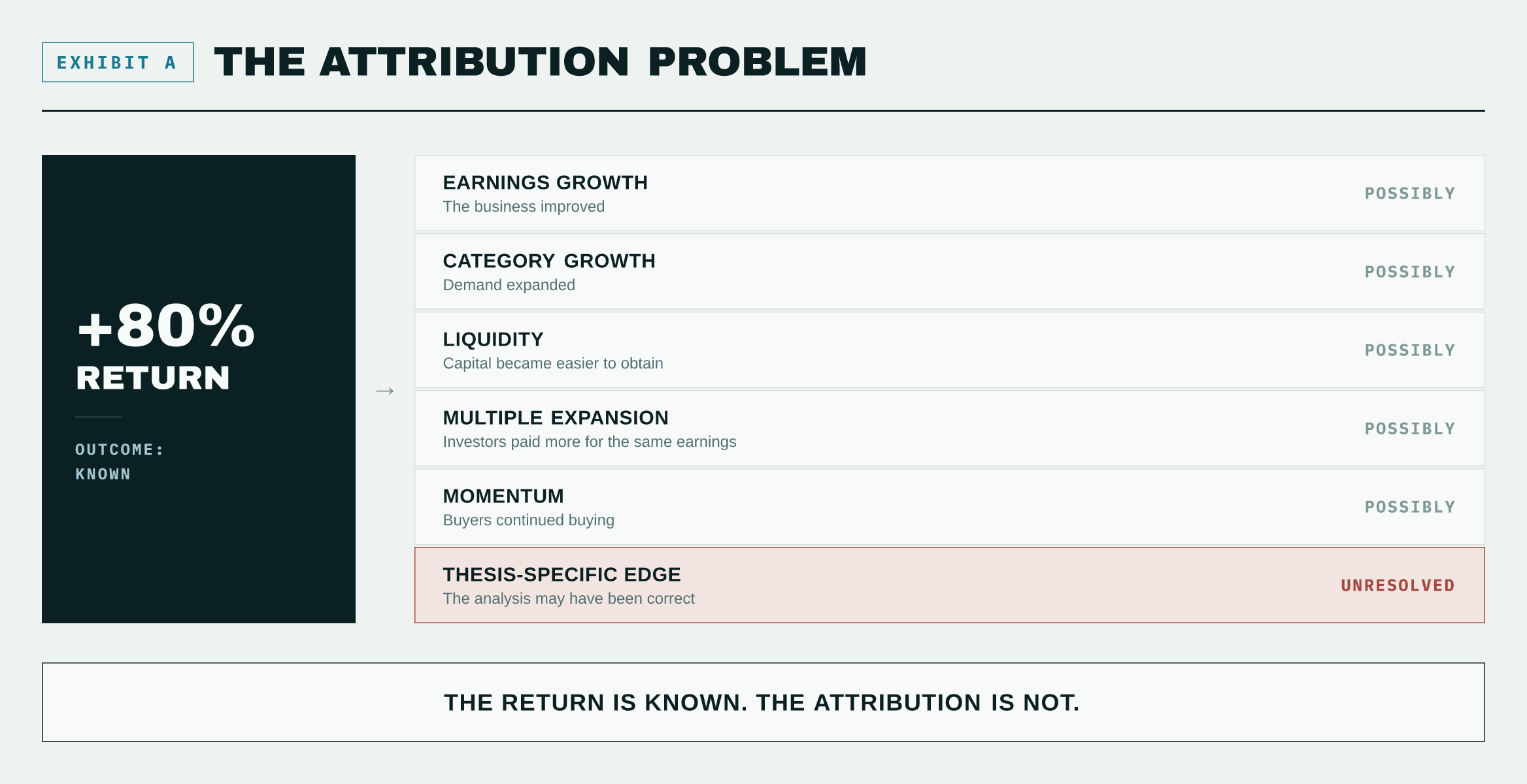
Consider a position that rises 80 percent.
The investment committee records: RETURN: +80%.
The useful question is what produced it.
A return is an outcome.
Attribution is an investigation.
The firm has occasionally confused the first with completion of the second.
Being right does not yet tell you what you were right about.
The first thing to break
A useful thesis should contain something that is expected to deteriorate when conditions turn against it.
This sounds undesirable.
It is not.
It is how the mechanism becomes observable.
If trading volume falls by half, fee revenue should fall. The question is by how much.
If financing conditions tighten, a leveraged company should face higher costs. The question is whether those costs inconvenience the business or impair it.
If consumer demand weakens, revenue should slow. The question is whether margins survive.
If attention leaves a speculative market, activity should decline. The question is what activity remains when attention is no longer subsidising it.
The investor who cannot identify what should weaken under stress has not described resilience.
They have described invulnerability.
Management has encountered very few invulnerable businesses and considerably more invulnerable presentations.
The objective is therefore not to predict the exact drawdown.
It is to predict the sequence.
What should weaken first?
What should remain intact?
What would deteriorate faster than expected?
And what deterioration would tell us that we misunderstood the mechanism entirely?
These questions belong in the file before the answers become visible.
The stress register
Management proposes that every material thesis maintain a stress register.
Not a price target.
Not a collection of historical crashes.
A list of dependencies and the observations that would distinguish ordinary stress from structural failure.
Demand stress
Condition: Activity falls materially.
Expected: Revenue declines with activity.
Review: Does revenue fall proportionately, less than proportionately, or substantially faster?
Failure: The economics require permanently exceptional activity.
Competitive stress
Condition: A credible alternative appears.
Expected: Some users, volume or pricing power migrate.
Review: What remains without novelty or exclusivity?
Failure: The proposition survives only in the absence of alternatives.
Liquidity stress
Condition: Capital becomes more expensive or less available.
Expected: Valuations compress and marginal activity declines.
Review: Can the underlying mechanism continue without multiple expansion or cheap financing?
Failure: Financing was the business model.
Attention stress
Condition: The narrative moves elsewhere.
Expected: Speculative activity declines.
Review: Which users, holders or customers remain when participation stops being socially rewarded?
Failure: Attention and demand were the same variable.
Price stress
Condition: The asset falls materially.
Expected: Shareholders become unhappy.
Review: Has anything in the mechanism changed?
Failure: None, unless price itself is part of the mechanism.
The final category requires particular attention.
The firm has historically devoted disproportionate resources to it.
Price stress is not always thesis stress
An asset falls forty percent.
Something has happened.
Management agrees.
The question is where.
If the business continues generating the same cash flow, the balance sheet remains intact, customers remain, the catalyst remains available and the expected economics are unchanged, then much of the observed stress may reside in the market price.
That matters. A forty-percent drawdown is not imaginary merely because the thesis survives. It changes portfolio concentration, liquidity, financing capacity, volatility and the opportunity cost of continuing to hold the position.
But it does not automatically change the underlying argument.
The reverse is more dangerous.
An asset can remain flat while its thesis deteriorates underneath it.
Revenue quality weakens.
Customer acquisition becomes more expensive.
Competitors take share.
Management changes the accounting.
Debt accumulates.
The catalyst passes without effect.
The price, meanwhile, declines to participate in the analysis.
A trader who uses price as the primary stress indicator will therefore occasionally become extremely concerned about a healthy thesis and remarkably relaxed about a failing one.
The chart is where stress becomes visible. It is not necessarily where stress occurred.
This is why the firm cannot outsource risk management to the colour red.
The Department of Historical Stress Testing
The firm's stress-testing department has reviewed the matter.
Its current methodology is to identify the largest adverse event experienced by a position, reproduce that event in a spreadsheet, and confirm that the position survived it.
The department has therefore established, with considerable confidence, that every surviving position would have survived the conditions it has already survived.
Management thanks the department for its work.
Historical stress tests are useful. They reveal sensitivity to events that actually occurred.
They become less useful when the past event is treated as the boundary of what may occur.
The next stress rarely arrives with the administrative courtesy of resembling the previous one exactly.
A portfolio designed to survive the last inflation shock may fail during a liquidity shock.
A business prepared for falling demand may be unprepared for rising funding costs.
A protocol that survives declining token prices may fail when volume migrates.
A trader who survived one drawdown may discover that the next one attacks a different part of the thesis.
The relevant exercise is therefore not merely:
What happened last time?
It is:
What must remain true for this position to work?
Once stated, those conditions can be attacked individually.
This is less comforting than replaying history.
It is also closer to risk management.
Exhibit B · The pre-mortem
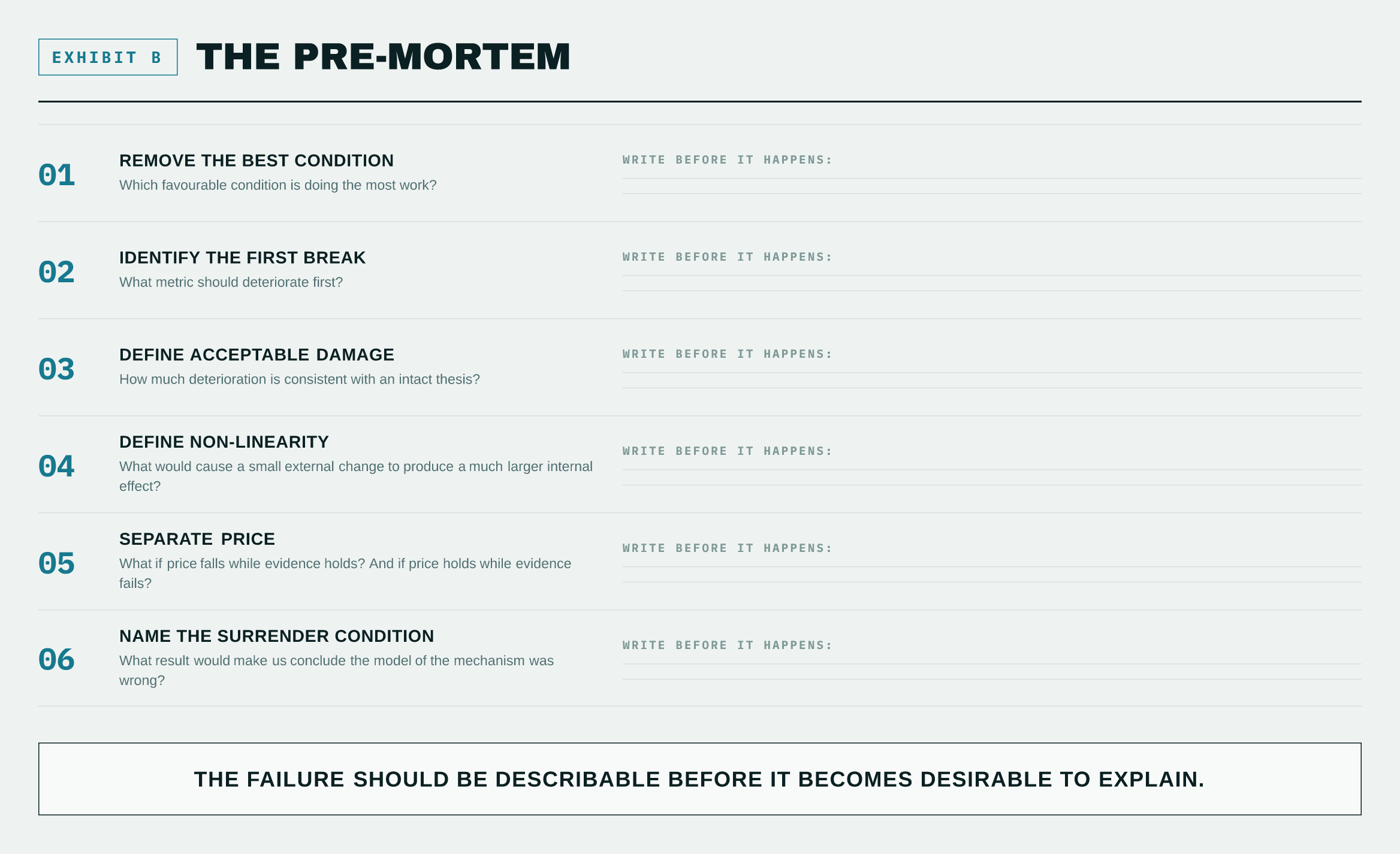
Before conditions deteriorate, management asks the owner of a position to imagine that the thesis has failed.
Not that the price is down.
That the thesis itself has failed.
The task is to explain why.
01 · Remove the best condition
Which favourable condition is currently doing the most work?
Volume? Liquidity? Pricing? Attention? Financing? Market share?
Remove it.
02 · Identify the first break
What metric should deteriorate first?
Write it down before it does.
03 · Define acceptable damage
How much deterioration is consistent with an intact thesis?
A stress test with no tolerance range is merely an alarm.
04 · Define non-linearity
What would cause a small external change to produce a much larger internal effect?
This is where hidden leverage usually lives.
05 · Separate price
Assume the asset falls fifty percent while the operating evidence remains unchanged.
What action does the thesis require?
Then assume the price is unchanged while the operating evidence deteriorates materially.
Ask again.
06 · Name the surrender condition
What result would make management conclude that the original model of the mechanism was wrong?
Not temporarily uncomfortable.
Wrong.
THE FAILURE SHOULD BE DESCRIBABLE BEFORE IT BECOMES DESIRABLE TO EXPLAIN.
Resilience has a denominator
Growth rates receive most of the firm's attention.
Management would like to introduce the denominator.
A business growing twenty percent in a market growing five is doing something different from a business growing twenty percent in a market growing forty.
A protocol retaining half its activity while category volume falls seventy percent is reporting something different from one whose activity falls ninety.
A company maintaining margins while input costs rise has demonstrated something that record margins during falling input costs could not demonstrate.
The absolute result may look worse.
The information contained in it may be better.
This is one reason the first difficult period in a young business can be analytically valuable.
The headline numbers deteriorate.
The dependencies become visible.
What remains after the favourable conditions are removed is closer to what the investor actually owns.
Resilience is not measured by whether a number falls. It is measured by what survives the reason it fell.
The test has arrived
Management had expected that eventually conditions would become less cooperative.
Eventually has proved efficient.
Prices across the ecosystem have fallen. Attention has become less generous. Positions that looked considerably easier to own several days ago now require their owners to remember why they owned them.
The firm does not propose to explain every movement after it has occurred.
There will always be a sufficiently persuasive story available.
What matters for this Brief is simpler.
Conditions are worse.
The test therefore becomes observable.
This is precisely the moment at which price should become less interesting than everything around it.
Is activity disappearing with price?
Are participants disappearing with attention?
Are builders still building?
Are products still being shipped?
Are markets still functioning?
Are mechanisms operating as designed?
Are communities becoming quieter, or actually leaving?
And when the easiest money and newest attention have moved elsewhere, is there still something here that people consider worth building around?
Those questions will not all be answered this week.
They have only just become worth asking.
Exhibit C · What remains?
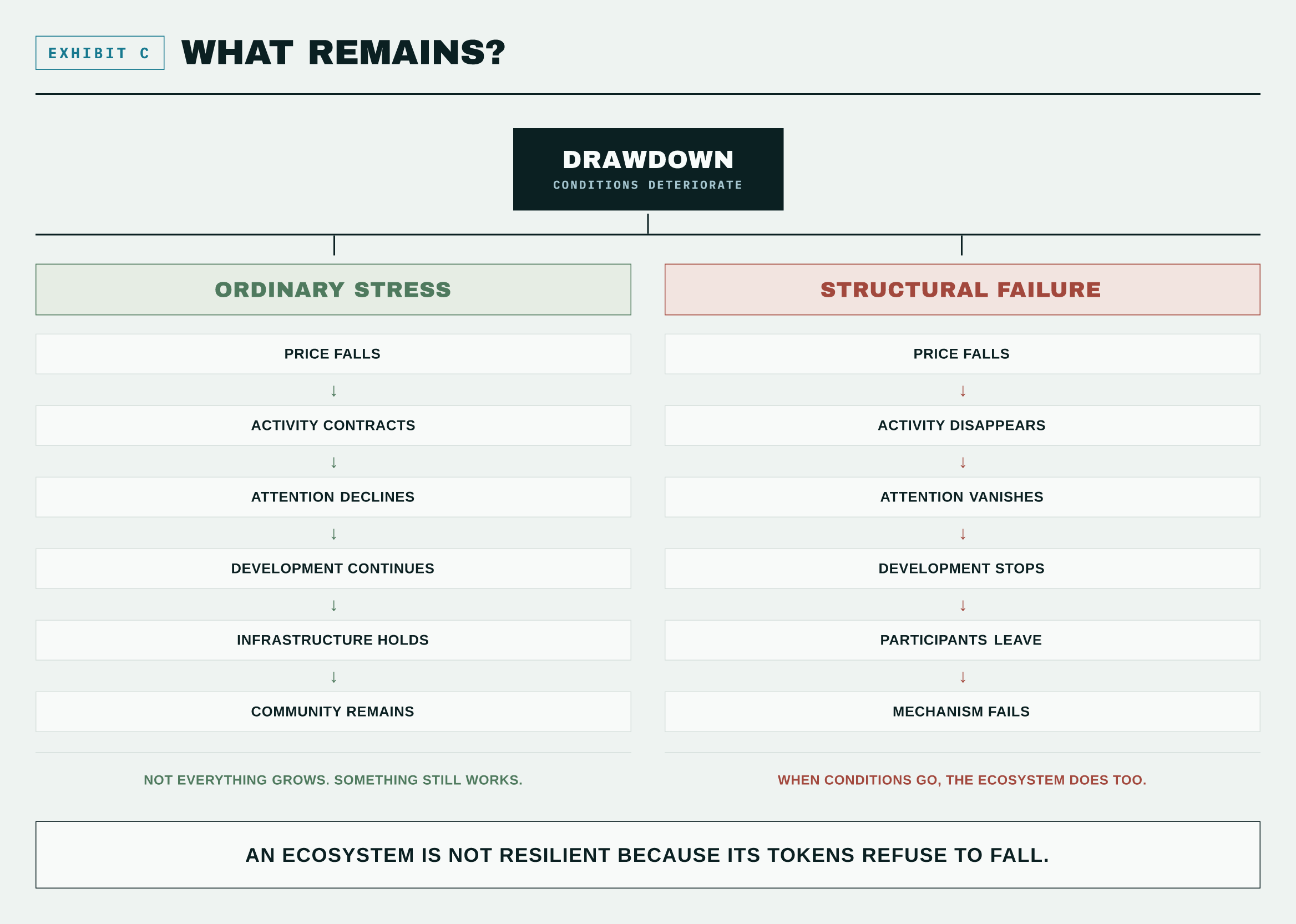
A healthy ecosystem does not need every measure to rise through a drawdown.
That would not be resilience.
It would be immunity.
The useful observations are what persists while conditions deteriorate.
| Observation | Ordinary stress | More concerning |
|---|---|---|
| Prices | Fall with the wider market | — |
| Trading activity | Contracts as speculation cools | Disappears almost entirely |
| Participation | Becomes less frequent | Becomes one-way exit |
| Development | Continues at a slower or unchanged pace | Stops with the price |
| New experiments | Become more selective | Cease altogether |
| Community | Attention declines | Conviction disappears with attention |
| Infrastructure | Continues functioning | Economics or mechanisms fail under lower activity |
No individual line proves durability.
Together they begin to describe it.
An ecosystem is not resilient because its tokens refuse to fall.
It is resilient if there remains an ecosystem after they do.
Belief is not evidence
One qualification is required.
There remain people who believe in the ecosystem.
Management counts itself among those interested in what it may become.
This is encouraging.
It is not evidence.
Conviction is useful precisely because it allows participants to continue operating while the evidence is incomplete. But conviction cannot subsequently be entered into the file as proof that the conviction was correct.
The stronger observation is what that belief produces.
If people who believe continue building, experimenting, providing liquidity, launching products, improving infrastructure and finding uses for the system while the financial reward for doing so becomes temporarily less obvious, something has been learned.
Not that the ecosystem will succeed.
That the ecosystem contains participants whose interest is not perfectly indexed to today's price.
There is a considerable difference.
A community that exists because prices rise is a market condition.
A community that continues producing things when prices fall may eventually become an ecosystem.
Belief is not the evidence. What people continue doing because of it can become evidence.
When the test arrives
Having requested a stress test, the investor may become emotionally incapable of observing it.
The drawdown arrives.
Volume falls.
Revenue slows.
The position declines.
The shareholder experiences the exact conditions previously described as analytically useful and immediately requests that they stop.
This is understandable.
It also defeats the exercise.
A stress test has value only if the observer allows enough of it to occur to identify what is being tested.
That does not mean holding blindly through deterioration. Patience still requires surrender conditions. Exits should still respond to evidence rather than the trader's discomfort.
When stress arrives, compare the result with the register.
If the metric expected to weaken weakens within the expected range, the stress test is proceeding.
If something expected to remain durable fails immediately, the thesis has learned something unpleasant and valuable.
If nothing fundamental changes and only price falls, the portfolio has learned something about its holder.
All three outcomes contain information.
Only one appears on the chart.
A note to the stonkholders
$STONKS is not exempt from any of this.
Nor should it be.
There will be easier periods to own it than this one. There may be considerably harder ones.
The firm does not intend to manufacture reassurance from the fact that people remain optimistic, nor manufacture a broken thesis from the fact that prices have fallen.
Both would give the screen authority it has not earned.
Instead, management intends to watch what remains.
There remains a functioning ecosystem.
There remain people building inside it.
There remain experiments being launched, infrastructure being developed and participants willing to spend time on something whose price currently offers considerably less encouragement than it did before.
Some of those participants will leave.
Some projects will fail.
Some mechanisms that looked durable in favourable conditions will prove not to be.
That is the purpose of the test.
The interesting question was never whether the ecosystem could attract people while everything was rising.
We are beginning to receive evidence about a better question.
Who remains when it isn't?
Another rally would have told us that people still enjoy rallies.
This can tell us considerably more.
The first draw-down has arrived.
Management is watching what survives it.
Stonks On Stonk is an editorial and meme project. This Brief is cultural commentary, not financial advice.