
The Federal Reserve employs no foreign workers.
This has not prevented much of the world from reporting to it.
A manufacturer in Vietnam, a property developer in China and a government in Brazil may never borrow directly from an American bank. They do not vote in American elections. They do not attend Federal Open Market Committee meetings. Most have never received a calendar invitation from Jerome Powell.
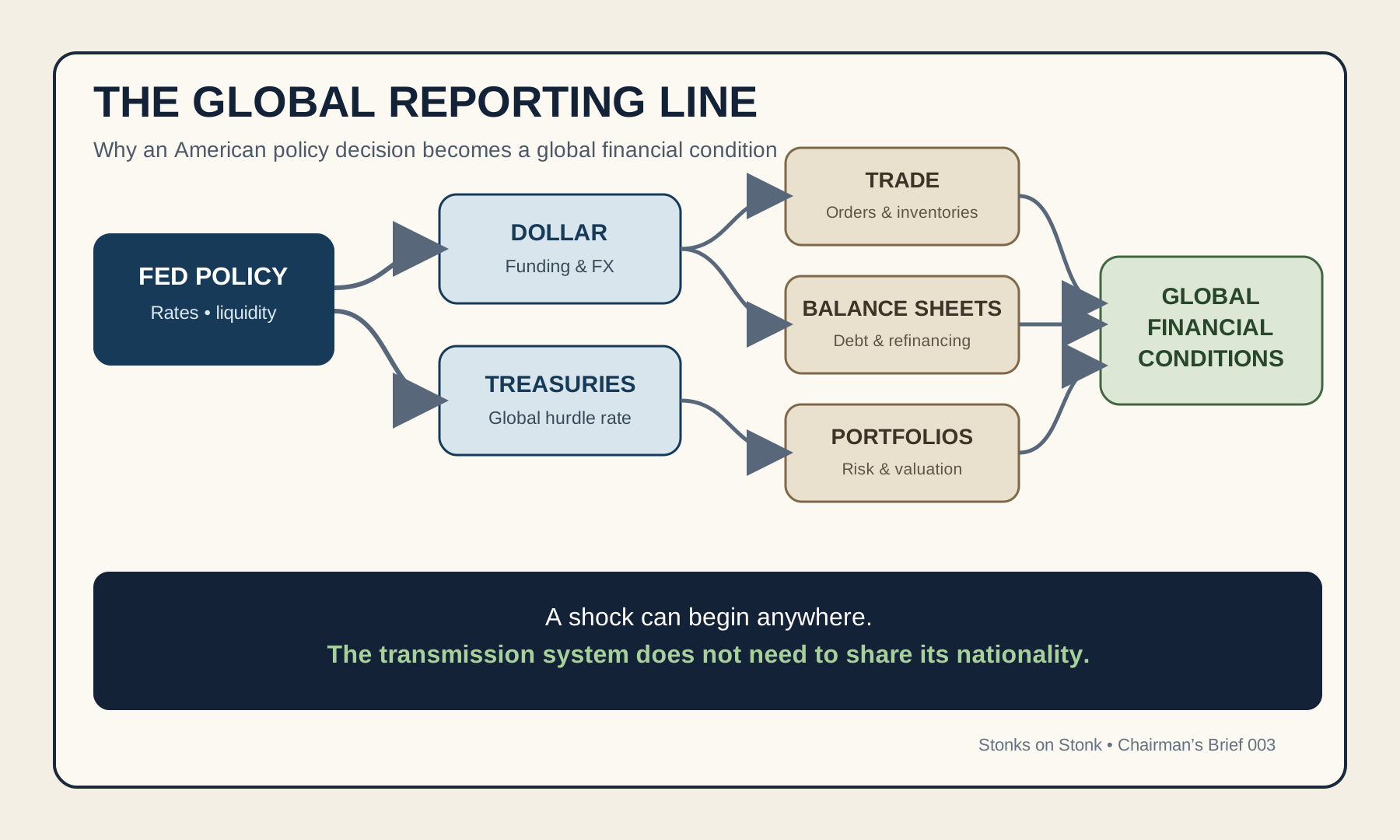
But if their revenues depend on American demand, their debts are denominated in dollars, their investors compare returns with US Treasuries or their currencies depend on global dollar liquidity, the Federal Reserve remains somewhere in the reporting line.
That reporting line explains why market analysis so often appears unreasonably interested in the United States. It also explains why these filings begin with American payrolls, inflation, Treasury yields and Federal Reserve policy even when the subject is a global market. Important events do not all begin in America. Many are still transmitted through American financial infrastructure.
Size is part of the answer, but not enough of it. China has an enormous economy. Europe remains a vast market. Japan is a major creditor. Commodity producers can alter the cost of energy and food for everyone.
The United States also supplies much of the infrastructure through which global activity is financed, valued and traded.
America is the customer.
The dollar is the payroll system.
Treasuries are the company benchmark.
And the Federal Reserve is the manager who insists it only supervises one department.
How the dollar acquired the office
The dollar did not receive this authority by natural law, and Bretton Woods did not create it from nothing.
Before the First World War, sterling sat at the centre of international trade and finance. Britain had the banking network, the liquid markets and the commercial empire. The United States had a large economy but a comparatively underdeveloped financial system.
The wars changed the balance sheet. European governments borrowed heavily, while the United States became a major creditor and accumulated gold. New York developed the markets needed to finance international trade. By the interwar period, the dollar was already competing with sterling; the exact year it moved ahead depends on which measure is used.SOURCE 02Federal Reserve History — Bretton Woods and the end of gold convertibilityOpen source ↗
Bretton Woods formalized the succession in 1944. Forty-four countries designed a system in which participating currencies were fixed to the dollar, while foreign monetary authorities could convert dollars into gold at $35 an ounce. Countries did not need to settle every international obligation in metal. They could hold the liability of the country that held most of it.
The arrangement contained its own tension. A growing world economy needed more reserve assets and therefore more dollars. Supplying them meant the United States had to run external deficits. Over time, foreign claims on American gold grew larger than the gold available at the promised price.
In August 1971, President Richard Nixon suspended the conversion of dollars into gold for foreign monetary authorities. The fixed-rate system broke apart over the following two years.SOURCE 02Federal Reserve History — Bretton Woods and the end of gold convertibilityOpen source ↗
What followed was more revealing than the collapse of the system itself.
The dollar remained dominant after its formal gold backing disappeared. By then, international trade was invoiced in dollars, banks borrowed and lent in dollars outside the United States, central banks held dollar reserves, and global investors relied on a deep market for US government debt. Each use made the others more convenient. Exporters accepted dollars because banks financed dollars; banks financed dollars because customers used them; reserve managers held dollars because the markets were liquid enough to absorb their money.
Gold had left the org chart. The reporting lines remained.
The world’s customer
The first relationship is the easiest to see.
American households buy an extraordinary quantity of goods and services produced elsewhere. A decision made in an American living room can become an export order in Germany, a factory shift in Vietnam, a freight booking in Singapore or a commodity shipment from Brazil.
When the American consumer is confident, credit is available and employment is expanding, that demand travels. When US households pull back, the effect does not stop at the border.
Exporters do not all depend equally on the United States. But American final demand is large enough that a change at the margin can alter inventories, production plans, shipping volumes and commodity demand across several economies.
So when analysts discuss US consumer strength, they are also discussing foreign export orders. Trade is the visible part of the reporting line. The more consequential relationship sits on the balance sheet.
The payroll is in dollars
The dollar is America’s domestic currency and the leading currency used to invoice trade, borrow across borders, hold official reserves and settle international payments.
The Federal Reserve’s own 2025 review found that the dollar accounted for roughly half of disclosed official foreign-exchange reserves and about half of international payments. Historical invoicing data show an even larger role outside Europe: 96% of trade invoicing in the Americas, 74% in Asia-Pacific and 79% across the rest of the world was denominated in dollars.SOURCE 01Federal Reserve — The International Role of the U.S. Dollar, 2025 EditionOpen source ↗
The Bank for International Settlements describes the same structure from the borrowing side. Although the United States accounts for roughly one quarter of global economic activity, around half of cross-border bank loans and international debt securities are denominated in dollars.SOURCE 03Bank for International Settlements — US dollar funding: an international perspectiveOpen source ↗
That creates a simple mismatch.
A company can earn revenue in pesos, won or rupiah while owing money in dollars.
If the dollar strengthens, the local-currency cost of that debt rises. If dollar interest rates increase, refinancing becomes more expensive. If global banks become less willing to lend dollars, a borrower can discover that its local business has not changed but its financial conditions have.
The factory may be in Indonesia while the refinancing decision is made in dollars.
This is one reason Federal Reserve tightening frequently travels further than the Fed’s formal mandate. Higher US rates can strengthen the dollar, attract capital toward dollar assets and increase the burden carried by borrowers whose income and liabilities use different currencies.
Local central banks then face an unpleasant choice. They can ease policy to support their own economy and risk further currency weakness, or maintain tighter conditions than domestic circumstances require in order to defend the currency and contain imported inflation.
Formal jurisdiction ends at the border. The funding constraint does not.
Treasuries set the hurdle rate
Borrowers do not need explicit dollar debt to feel the effect.
US Treasuries provide the benchmark risk-free yield curve at the centre of global finance. The US Treasury itself describes the market as a source of safe and liquid assets and the reference curve against which broader capital and credit are priced.SOURCE 04US Department of the Treasury — The role and resilience of the Treasury marketOpen source ↗
In practice, a higher Treasury yield raises the return that every riskier asset must offer. Corporate bonds need more spread. Infrastructure and property must clear a higher financing cost. Equity valuations must justify paying today for distant profits. Speculative assets must compete with the fact that cash now has a salary.
A movement in the US ten-year yield can therefore affect asset prices in countries whose own central banks have not changed policy. The Treasury curve is not the only interest-rate curve in the world, but it informs an enormous number of global allocation decisions.
America exports a hurdle rate as well as products and policy.
The emergency manager
The arrangement becomes clearest during a crisis.
When global demand for dollars overwhelms private funding markets, institutions outside the United States do not suddenly stop needing the currency. Trade still settles. Debts still mature. Collateral still has to be posted.
The Federal Reserve maintains standing dollar-liquidity swap lines with five major foreign central banks. Through those arrangements, the foreign central banks can deliver dollars to institutions in their own jurisdictions.SOURCE 05Federal Reserve Bank of New York — Central Bank Swap ArrangementsOpen source ↗
The New York Fed states the purpose plainly: improve liquidity in global money markets and reduce the risk that strains abroad spread back into US markets.SOURCE 06Federal Reserve Bank of New York — Central Bank Liquidity Swap OperationsOpen source ↗
The motivation is domestic financial stability. The operational effect is international dollar support.
That does not make the Federal Reserve the world’s central bank. The Fed neither sets policy for every economy nor backstops every country or borrower that chose the dollar.
It does demonstrate that a global dollar system eventually requires a credible source of dollars when private markets fail to provide them.
In ordinary periods, this looks like background plumbing. A dollar shortage reveals who controls the maintenance budget.
The capital-allocation committee meets in New York
There is also a less formal channel.
US capital markets are deep, liquid and heavily represented in global portfolios. American equities, credit funds, ETFs, dealers and asset managers help determine the marginal price of risk across borders.
When US financial conditions are easy, investors often move outward in search of higher returns. Capital reaches emerging-market bonds, growth equities, commodities and speculative assets.
When Treasury yields rise, volatility increases or US investors reduce risk, that process can reverse. Assets may be sold not because their local fundamentals deteriorated first, but because portfolios elsewhere need fewer risks, more dollars or more cash.
Correlations often rise during stress because different local assets can share the same marginal source of funding and the same need for cash.
Crypto has joined the foreign payroll
Crypto is global, trades continuously and prefers to describe itself as an alternative financial system.
It has nevertheless recreated a considerable amount of dollar infrastructure on-chain.
Many widely used stablecoins reference the US dollar. Reserve-backed stablecoins hold assets to support redemptions, frequently including cash and short-dated US government securities.SOURCE 07US Securities and Exchange Commission — Statement on StablecoinsOpen source ↗ Crypto markets price assets predominantly in dollar terms, while Treasury yields influence the opportunity cost of holding instruments that produce no cash flow.
That is less an escape from the dollar system than a new interface for it.
When dollar liquidity is abundant and the return on safe assets is low, investors have more reason to search for risk. When dollars become scarce, leverage becomes expensive or Treasury bills offer an attractive return, speculative capital has more alternatives and less patience.
Stablecoins can extend access to dollars beyond the traditional banking system, improve settlement and make dollar exposure available where domestic financial infrastructure is weaker. At the same time, they reinforce the unit of account from which crypto was supposedly separating.
The revolution has submitted its expenses in dollars.
For $STONKS, this does not mean that every price movement can be explained by the Federal Reserve, nor that macro conditions determine culture mechanically. Meme assets are built from attention, identity, participation and shared conviction—forces that do not appear neatly in central-bank models.
But the capital expressing that conviction still operates inside a wider market, where liquidity has an opportunity cost and risk appetite has a funding environment. Even internet culture must occasionally clear Treasury.
The reporting line can be reorganised
None of this makes the present org chart permanent.
The dollar's international role is not one job. It is a bundle of them: reserve asset, trade invoice, funding currency, collateral base, payment medium and unit of account. These functions reinforce one another, but they do not have to move together.
The dollar can lose reserve share without losing trade invoicing. It can lose some bilateral settlement without losing funding markets. New payment rails can bypass correspondent banks while the assets moving across them remain denominated in dollars.
De-dollarisation is usually framed too dramatically: a succession ceremony in which one challenger defeats the dollar everywhere at once.
The more plausible process is administrative.
A central bank diversifies a portion of its reserves. Two trading partners settle more commerce in their own currencies. A borrower chooses euro funding when the market is deeper or cheaper. A regional payment system removes the need for one category of transaction to pass through dollars.
No individual decision removes the Federal Reserve from the building. Each one shortens a reporting line.
At the end of 2025, the dollar still represented 56.77% of allocated foreign-exchange reserves, far ahead of the euro at 20.25% and the renminbi at 1.95%.SOURCE 01Federal Reserve — The International Role of the U.S. Dollar, 2025 EditionOpen source ↗ The Federal Reserve's broader index of international currency usage remained within a narrow range from 2010 through 2024.SOURCE 01Federal Reserve — The International Role of the U.S. Dollar, 2025 EditionOpen source ↗ The incumbent is not awaiting an imminent redundancy consultation.
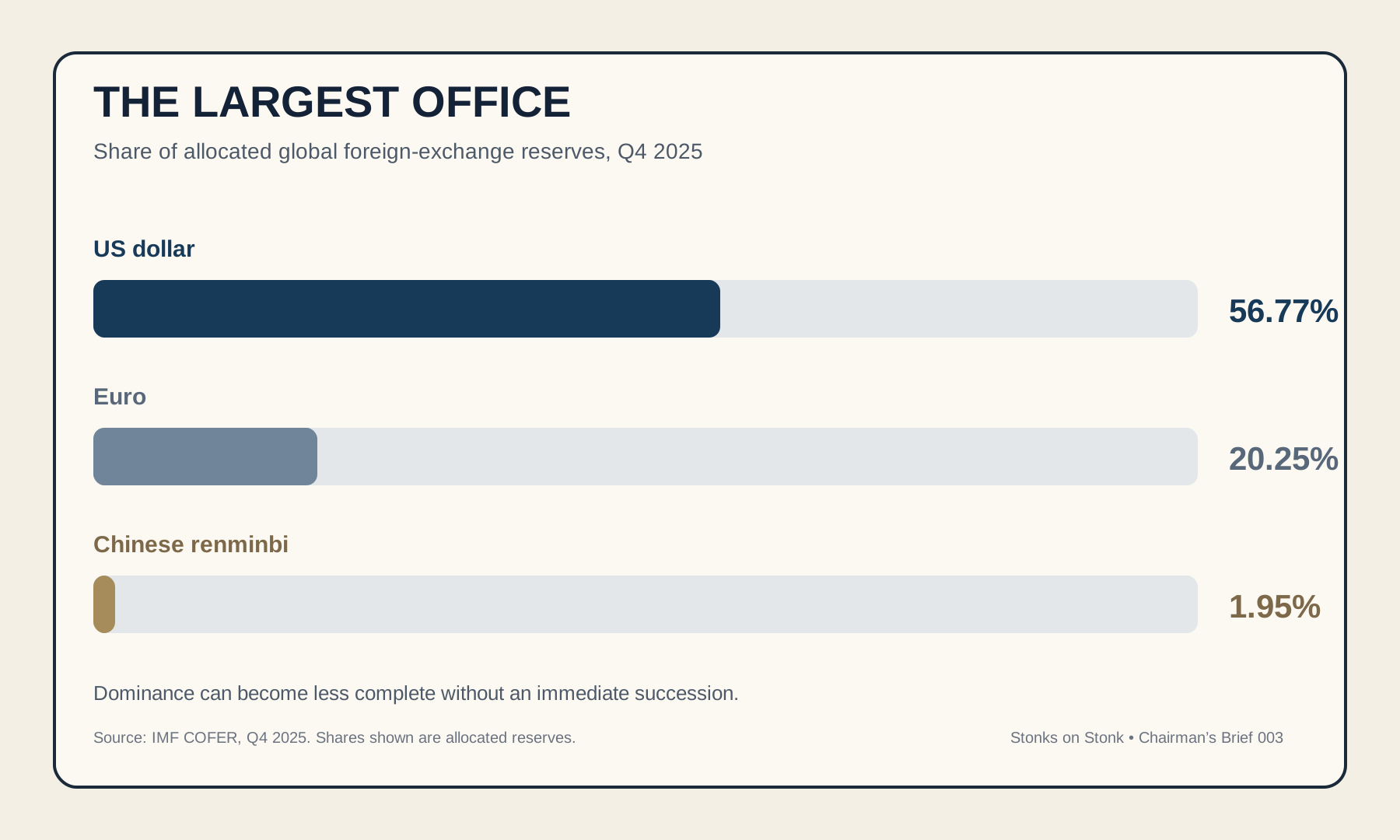
But dominance is not the same as completeness. The euro can gain in international lending or bond issuance without displacing the dollar in reserves. Gold can attract reserve demand without becoming ordinary trade money. The renminbi can become more important inside particular commercial relationships without becoming a universal funding currency.SOURCE 08European Central Bank — The International Role of the Euro, June 2026Open source ↗
No single successor is required. Different departments can move to different offices.
That is the boundary around our US-centric analysis. We watch the dollar system because it remains the principal transmission mechanism. We also watch the functions that begin to leave it. The world can become less financially American long before it stops being dollar-dominant.
The dollar can keep the largest office while no longer approving every expense.
America is not the whole world
There is an obvious objection to US-centric analysis.
It can become lazy.
China matters independently through manufacturing, credit creation, property, commodities and trade across Asia. Europe has its own monetary system, banking structure and political constraints. Japan can alter global markets through its enormous savings base, domestic bond market and the yen-funded carry trade. Energy producers can create inflation without requesting American approval.
Local institutions, demographics, fiscal choices and political shocks remain decisive. A framework that explains everything through the Federal Reserve will eventually explain nothing.
The narrower claim is that important events can begin anywhere and still become global through dollar funding, Treasury yields, exchange rates and American capital markets.
China can generate a growth shock, the Middle East an energy shock and Japan a funding shock. The global portfolio may still express the response by demanding dollars, buying or selling Treasuries and reducing risk through US-linked markets.
The origin of the problem and the transmission system are not required to share a nationality.
How to read the reporting line
This gives investors a more useful way to interpret American economic data.
An employment report, inflation print or Federal Reserve decision therefore raises five questions beyond whether it is good or bad for the United States:
- What does this do to the dollar? A stronger dollar can tighten conditions for foreign borrowers and currencies even when their domestic economies have not improved.
- What does this do to the Treasury curve? The front end reflects expected policy. The long end also reflects inflation, supply, growth and the premium investors demand for holding duration.
- What does this do to the availability of leverage? The price of funding matters, but so does whether balance sheets are willing to provide it.
- What does this do to the relative appeal of risk? Every speculative return competes with what can be earned in safer dollar assets.
- Where did the shock actually begin? US transmission should never be confused with US causation.
That final distinction matters most. Markets are not US-centric because the rest of the world is irrelevant. They are US-centric because much of the rest of the world conducts business through a currency, collateral base and pricing system whose conditions are heavily influenced by the United States.
The Federal Reserve has no foreign employees.
It merely conducts their performance reviews.
Source note
- [1] Federal Reserve, The International Role of the U.S. Dollar — 2025 Edition ↗, 18 July 2025. The IMF reported that the dollar represented 56.77% of allocated foreign-exchange reserves in 2025 Q4: IMF COFER data brief ↗, 27 March 2026.
- [2] Federal Reserve History, Creation of the Bretton Woods System ↗ and Nixon Ends Convertibility of U.S. Dollars to Gold ↗. For the earlier dollar–sterling transition, see European Central Bank Working Paper 1433, When did the dollar overtake sterling as the leading international currency? ↗, May 2012. The paper finds that the timing varies by measure and that the two currencies coexisted as important international currencies during the interwar period.
- [3] Bank for International Settlements, US dollar funding: an international perspective ↗, 18 June 2020. The BIS reported continued growth in foreign-currency dollar credit through 2025: global liquidity indicators at end-December 2025 ↗, 30 April 2026.
- [4] US Department of the Treasury, remarks on the role and resilience of the Treasury market ↗, 18 November 2024; Inter-Agency Working Group, The U.S. Treasury Market: 2024 Staff Progress Report ↗, 20 September 2024.
- [5] Federal Reserve Bank of New York, Central Bank Swap Arrangements ↗.
- [6] Federal Reserve Bank of New York, Central Bank Liquidity Swap Operations ↗.
- [7] US Securities and Exchange Commission, Statement on Stablecoins ↗, 4 April 2025. This supports the general reserve mechanism, not the composition of every stablecoin.
- [8] European Central Bank, The International Role of the Euro — June 2026 ↗, 2 June 2026. The report evaluates the euro separately across reserves, foreign-exchange settlement, international debt, loans, deposits and trade invoicing.
Stonks On Stonk is an editorial and meme project. This Brief is cultural commentary, not financial advice.