Stonkholders,
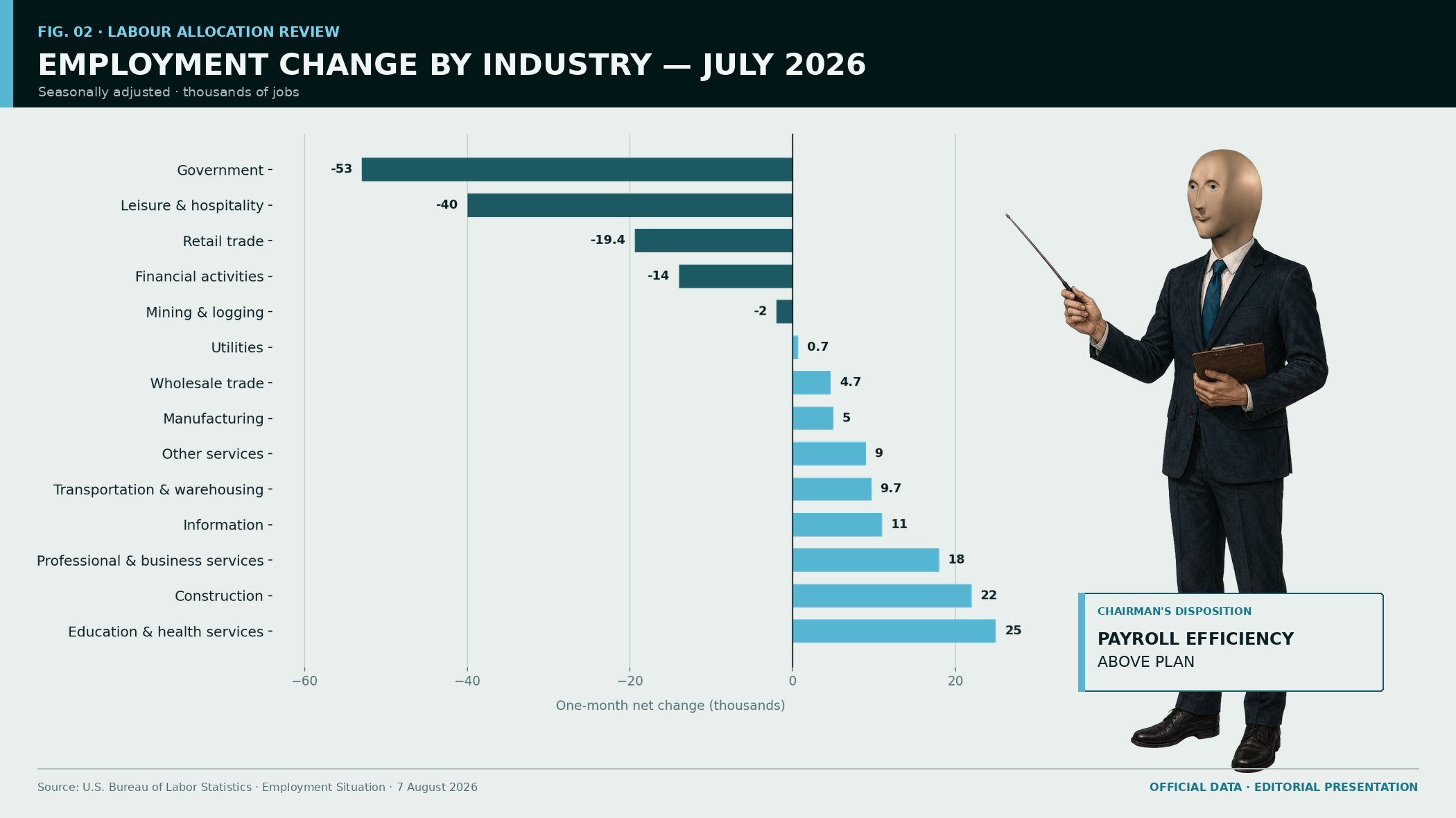
Management is pleased to report that the United States eliminated 23,000 positions in July.
Shareholders responded by creating value.
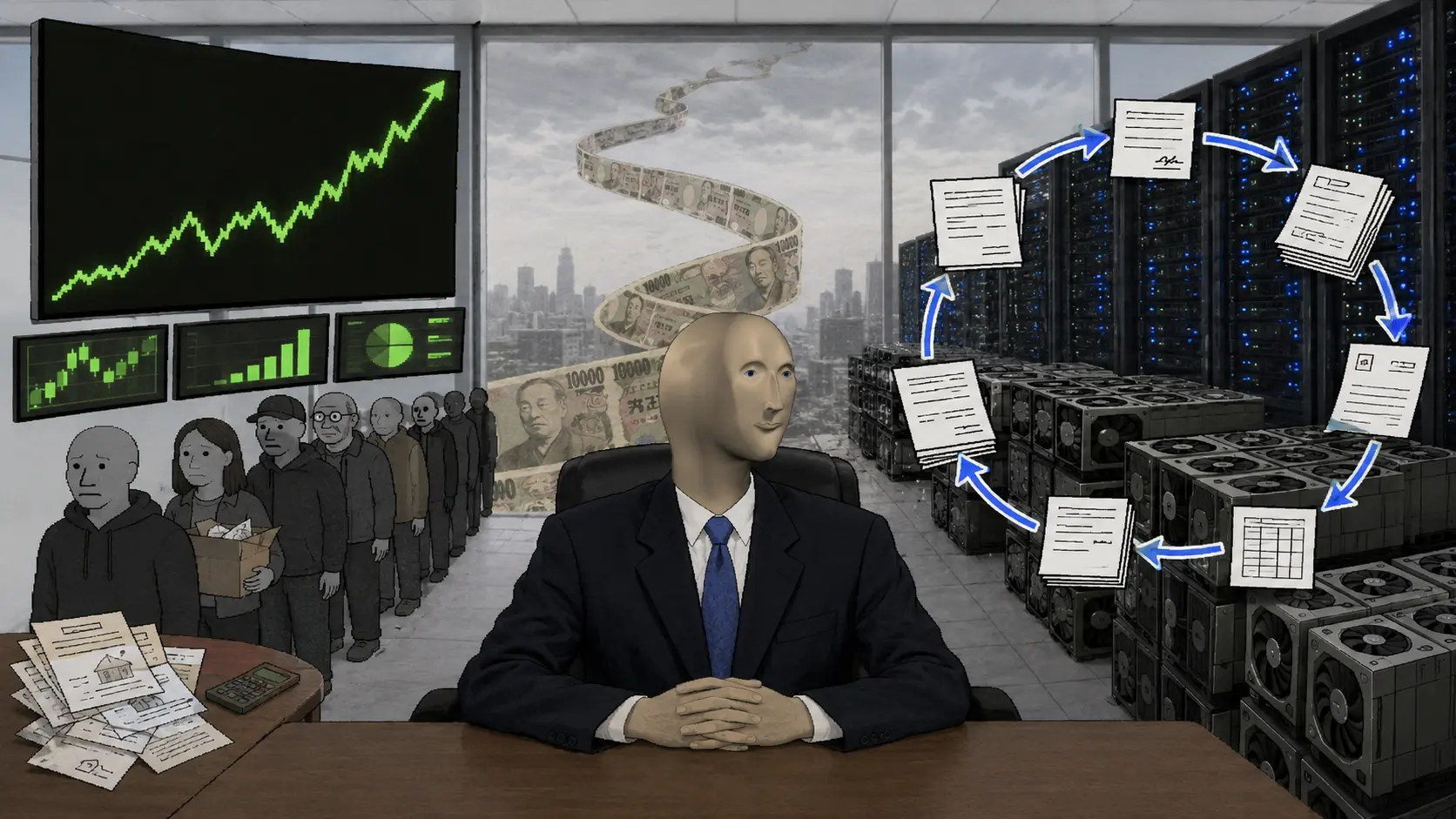
The S&P 500 closed at a record high. For avoidance of doubt, the national economy has not adopted a formal policy of increasing equity prices by reducing payrolls. The market has merely identified the operational efficiencies available to it.
The procedure is straightforward. Fewer jobs imply less pressure on the Federal Reserve. Less pressure on the Federal Reserve reduces the chance of another rate increase. A weaker economy is therefore entered into the system as a lower discount rate, and returned to investors as good news.
This is what $STONKS understood before the economists arrived: the arrow points upward; the supporting analysis may be filed later.
A conditional approval
July's report was not one untidy data point. May and June were revised down by a combined 103,000 jobs. The unemployment rate fell to 4.1%, helped by 264,000 people leaving the labour force.
Chairman Warsh now has ample paperwork with which to avoid raising rates in September.He does not yet have approval to declare the inflation matter closed. That decision has been delegated to Wednesday's CPI report, an unusually influential committee consisting entirely of numbers that have not yet been published.
Inflation remains above target. Energy prices remain exposed to the Strait of Hormuz. The ten-year Treasury yield was 4.69% on Thursday,which is not the bond market's customary method of announcing abundant monetary relief.
As this letter entered final review, an unnamed U.S. official informed Reuters that Iran and Oman were making progress and that Washington expected an agreement on the Strait “soon.” If an agreement is announced, restores unrestricted commercial shipping and is implemented to Washington's satisfaction, the United States says it will lift its blockade of Iranian ports.
No agreement has been announced. This is an important administrative detail, although not always a market requirement.
The latest communication follows several earlier assurances that a deal was close. A short-lived June memorandum reopened shipping and produced a ceasefire; hostilities resumed on 7 July.Earlier this week, Iran and Oman said they had agreed the proposed route's geographic coordinates, while shipping and insurance sources warned that the fee, sanctions and coverage arrangements were not commercially workable.
Management welcomes the expected return of the previously returned peace process. Markets have again been invited to price the expected implementation of an expected agreement. The ships will be consulted after closing.
If CPI remains firm, the Federal Reserve will be offered the standard stagflation agenda:
- support employment;
- defend purchasing power; and
- explain why the first two items cannot be completed together.
Equity markets have moved directly to Any Other Business and bought the dip.
There is precedent. During the first half of 2026, retail investors bought roughly three and a half times their normal daily amount on down days.Friday, however, should not automatically be recorded as another retail rescue. Citadel Securities reported that retail cash-equity volume had fallen about 20% from June's extreme levels. Retail became a net seller as July ended, particularly in technology, semiconductors and memory.
The dip was bought. The available evidence does not assign the order to the public.
That distinction matters. Liquidity is always excellent in the presentation. It becomes less available during implementation.
Violent reversals reward leverage on the way up and demand its removal on the way down. Each episode leaves fewer investors willing to warehouse the next one. The screen still displays a market. The price behind the screen becomes easier to move.
The yen is again standing near the emergency exit.
After American and Japanese intervention to support the currency, weak US employment data sent the yen sharply higher on Friday.Friday's move was insufficient to declare an unwind. The continued availability of agreeable yen funding has nonetheless entered the review queue.
If Japan tightens while America weakens, investors borrowing yen to own US assets can lose on the funding currency and on the asset. This is generally regarded as poor diversification.
“Sell America” is therefore back in the risk register. It is not yet the approved strategy. But a trade does not need to be the base case to become expensive when too many balance sheets are positioned against it.
Artificial intelligence, natural invoices
Management has also reviewed the AI transformation programme and can confirm that expenditure remains ahead of schedule.
Corporate AI spending is not falling in aggregate. Gartner expects worldwide AI expenditure to reach $2.52 trillion in 2026, up 44%. Microsoft recorded $41 billion of capital expenditure in its latest quarter. Alphabet continues to describe AI demand as supply-constrained.
The money continues to arrive under an increasingly demanding evidence policy.
Gartner places enterprise AI in a “trough of disillusionment.” PwC found that 89% of operations leaders surveyed said their technology investments had not fully produced the expected results.Accenture's bookings declined even as its AI-related work grew.
Enterprise procurement has progressed to the evidence phase.
This is an inconvenient stage of any programme. The pilot worked. The keynote was well received. The steering committee has now requested evidence.
Above it sits an infrastructure programme of historic scale. Five large technology companies have disclosed roughly $1.09 trillion of future payments under leases that have not yet commenced, largely for data centres. Much of that commitment will not appear as a recognised lease liability until the facilities are available.
The capacity is being built through an increasingly intimate financial arrangement. Chip suppliers invest in customers. Infrastructure providers guarantee capacity. Cloud companies fund frontier laboratories, which then buy cloud capacity. Data-centre vehicles borrow against future leases so that facilities can be completed for tenants whose demand forecasts depend on the AI adoption those facilities are intended to enable.
The arrangement may succeed. It is certainly well networked.

The demand appears genuine, which will please the repayment schedules.
It does make a purchase order less conclusive when the seller, investor, landlord and customer are all represented at the same closing dinner. Capital expenditure remains particularly effective at producing further capital expenditure.
Chinese model development adds the problem that the largest Western commitments are being made while the model layer becomes more competitive. DeepSeek offers a familiar API,while Moonshot's Kimi K3and Alibaba's latest Qwen release are open-weight. Frontier parity remains unproven. Testing the alternative has nonetheless become cheaper and considerably less eccentric.
Cheaper models may increase applications, token volumes and inference demand. Full data centres would not rescue the pricing assumptions of every frontier laboratory. Scarce compute is no longer sufficient evidence that intelligence itself will remain scarce.
Western laboratories have financed an expensive race for capability while Chinese competitors reduce the cost of entering it. A considerable number of valuations were prepared before this item was added to the agenda.
Regarding the household index
The Board has received complaints that record equity prices have not been reflected in grocery bills, rent or employment security. These complaints arise from a category error. The stock market is not a national wellbeing index and has never applied for the role.
The Federal Reserve completed its annual household filing before the latest round of economic improvements. By July, the University of Michigan's consumer-sentiment index stood at 55.2, up 11.5% from June but down 10.5% from a year earlier. Its measure of current economic conditions was 54.8, up 14.9% for the month and down 19.4% year on year. Management notes that the equity index was not similarly burdened.
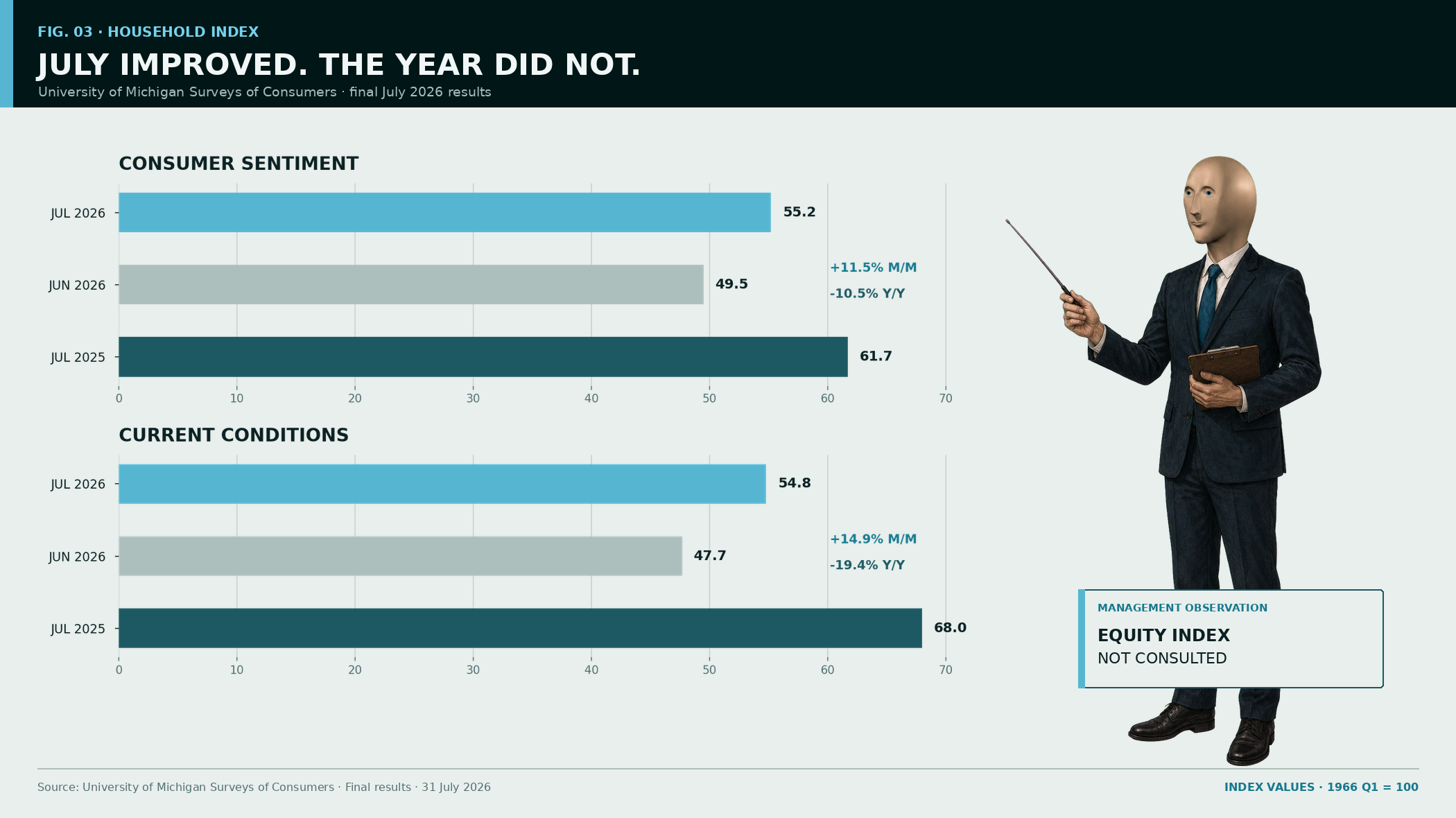
A record index beside weakening employment is procedurally valid. Management merely asks that it not be circulated as a household performance report.
$STONKShas never required the arrow to describe everyone's financial condition. It requires only that the arrow survive the meeting.
The original image required one mannequin, one suit and one upward arrow. Financial innovation has substantially increased the documentation while preserving the conclusion.
Management therefore has no recommendation to amend the meme.
The spelling error was corrected. The logic was retained.
Source note
- U.S. Bureau of Labor Statistics, The Employment Situation — July 20262026-08-07
Payrolls fell by 23,000. May and June were revised down by a combined 103,000; unemployment was 4.1%, and the labour force contracted by 264,000.
- Associated Press, How major US stock indexes fared Friday2026-08-07
The S&P 500 closed at a record 7,757.64. The market report also records inflation above 3% in the week’s economic backdrop.
- Federal Reserve, H.15 Selected Interest Rates2026-08-07
The ten-year constant-maturity Treasury yield was 4.69% on 6 August 2026.
- Federal Reserve, Kevin Warsh takes office as Chairman2026-05-22
The release confirms Kevin Warsh’s chairmanship of the Federal Reserve and his role on the FOMC.
- Reuters, Global markets week ahead2026-08-07
The report sets out the timing of the next CPI release, September-rate expectations and the energy-related inflation risk.
- Reuters, U.S. expects Iran–Oman Strait deal soon2026-08-07
A U.S. official expected an agreement soon; blockade removal remained conditional on a completed and implemented agreement.
- Reuters, Iran and Oman agree proposed route coordinates2026-08-05
Iran and Oman agreed the proposed route’s geographic parameters while material commercial and security terms remained unresolved.
- Reuters, Shipping concerns over proposed Hormuz arrangement2026-08-06
Shipping-industry sources said sanctions, fees and insurance provisions made the proposed arrangement difficult to implement.
- Citadel Securities, August — After the Reset2026-08
The note describes elevated first-half retail dip-buying, a roughly 20% fall in retail cash-equity volume from June extremes and late-July net selling.
- Reuters, Yen surges after U.S. jobs data2026-08-07
The yen strengthened after weak U.S. employment data following U.S.-Japan intervention, renewing attention on carry-trade risk.
- Gartner, Worldwide AI spending forecast2026-01-15
Gartner forecasts $2.52 trillion of worldwide AI spending in 2026, up 44%, while describing enterprise AI as entering a trough of disillusionment.
- Microsoft, FY2026 Q4 earnings2026-07-29
Microsoft reported $41 billion of capital expenditure in its latest quarter.
- Alphabet, Q2 2026 earnings call2026-07-22
Alphabet described cloud demand as strong and parts of AI capacity as supply-constrained.
- PwC, 2026 Digital Trends in Operations Survey2026-04-23
Eighty-nine percent of surveyed operations leaders said technology investments had not fully delivered the expected results.
- Financial Times, Accenture Q3 coverage2026-06
Accenture’s quarterly bookings declined while its AI-related work continued to grow.
- Reuters, AI data-centre race builds $1 trillion lease burden2026-08-04
Five large technology companies disclosed about $1.09 trillion of uncommenced lease payments, largely for data centres.
- Reuters, Companies pour billions into AI infrastructure2026-07-22
The deal summary documents supplier investment, cloud financing and capacity-backstop relationships across the AI infrastructure chain.
- DeepSeek, DeepSeek V4 release documentation2026-04-24
DeepSeek documents familiar API compatibility for its V4 release.
- Moonshot AI, Kimi K3 model repository2026-07
Moonshot AI’s repository documents Kimi K3 as an open-weight model release.
- Qwen, Qwen 3.8-Max release2026-08-03
Alibaba announced an open-weight Qwen-Max-class release.
- University of Michigan, Surveys of Consumers — Final Results for July 20262026-07-31
Sentiment was 55.2, up 11.5% month on month and down 10.5% year on year. Current conditions were 54.8, up 14.9% month on month and down 19.4% year on year.