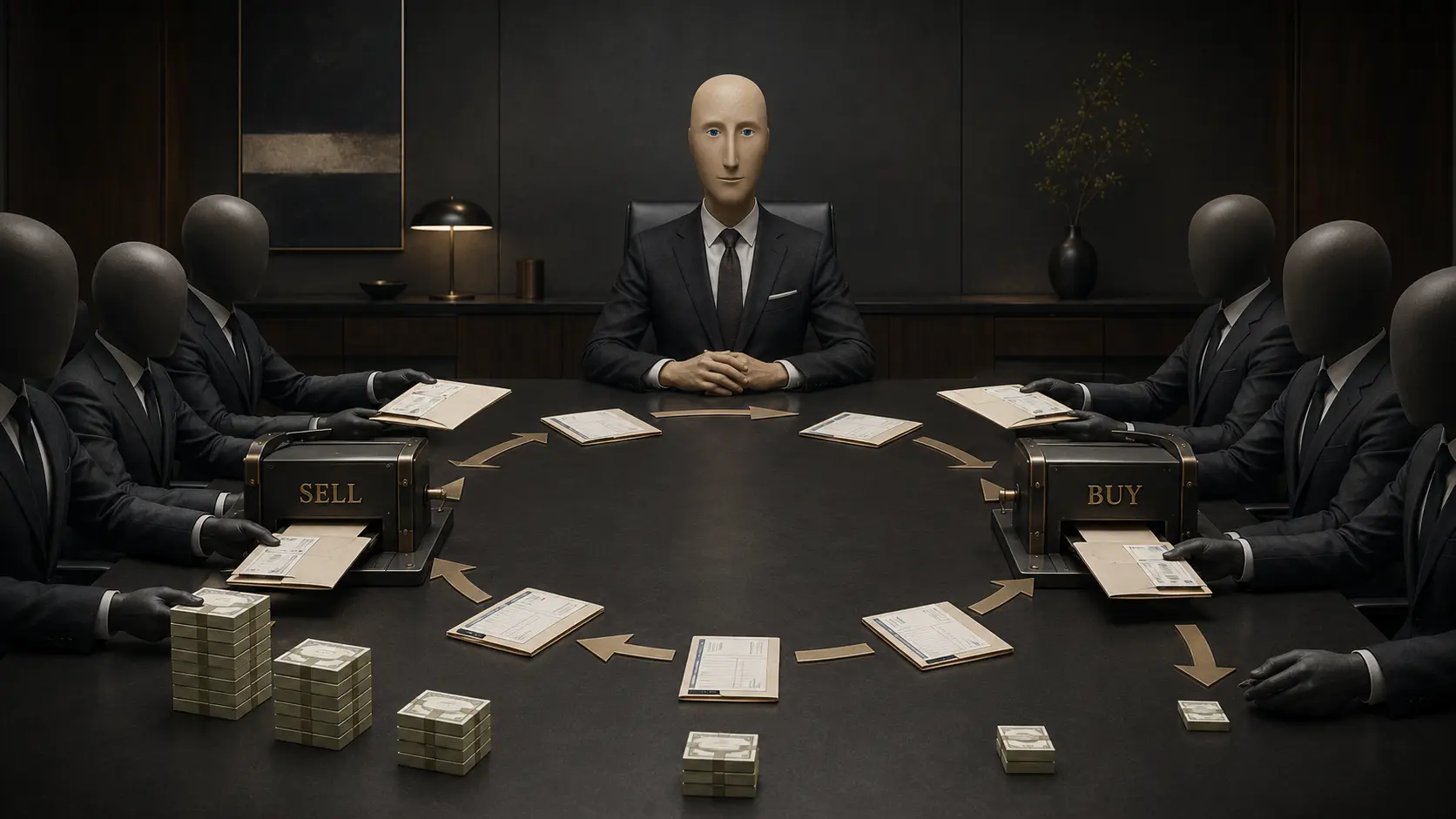
Stonkholders,
Management has reviewed its historical capital-allocation decisions and identified a recurring expense that was not properly disclosed.
It was the cost of doing something.
The Chairman has paid this expense personally. They have sold positions that had become uncomfortable, purchased replacements that felt temporarily more convincing, and mistaken the relief of making a decision for evidence that the decision was good.
They have also watched the same process repeat across the firm.
The pattern rarely begins with recklessness. It begins with discomfort. A position falls, stalls or simply fails to provide the immediate validation expected of it. Nothing fundamental may have changed. But uncertainty accumulates, and uncertainty creates a strong demand for corporate action.
The trader sells.
The trader buys something else.
For several minutes, governance appears to have been restored.
This is how activity becomes confused with progress.
The market charges for emotional relief
Every change of position contains at least two decisions: the decision to leave one asset and the decision to enter another. On chain, both sides may carry a toll through some combination of trading fees, spread, slippage and price impact. The precise cost depends on the asset, venue, liquidity and execution.
The arithmetic is less dependent on opinion.
Consider a deliberately simplified illustration. Assume that selling a position reduces capital by 1%, and purchasing its replacement consumes another 1%. Each full rotation therefore leaves 98.01% of the capital that entered it.
| Full rotations | Capital remaining from 100 |
|---|---|
| 0 | 100.0 |
| 5 | 90.4 |
| 10 | 81.8 |
| 20 | 66.9 |
| 35 | 49.5 |
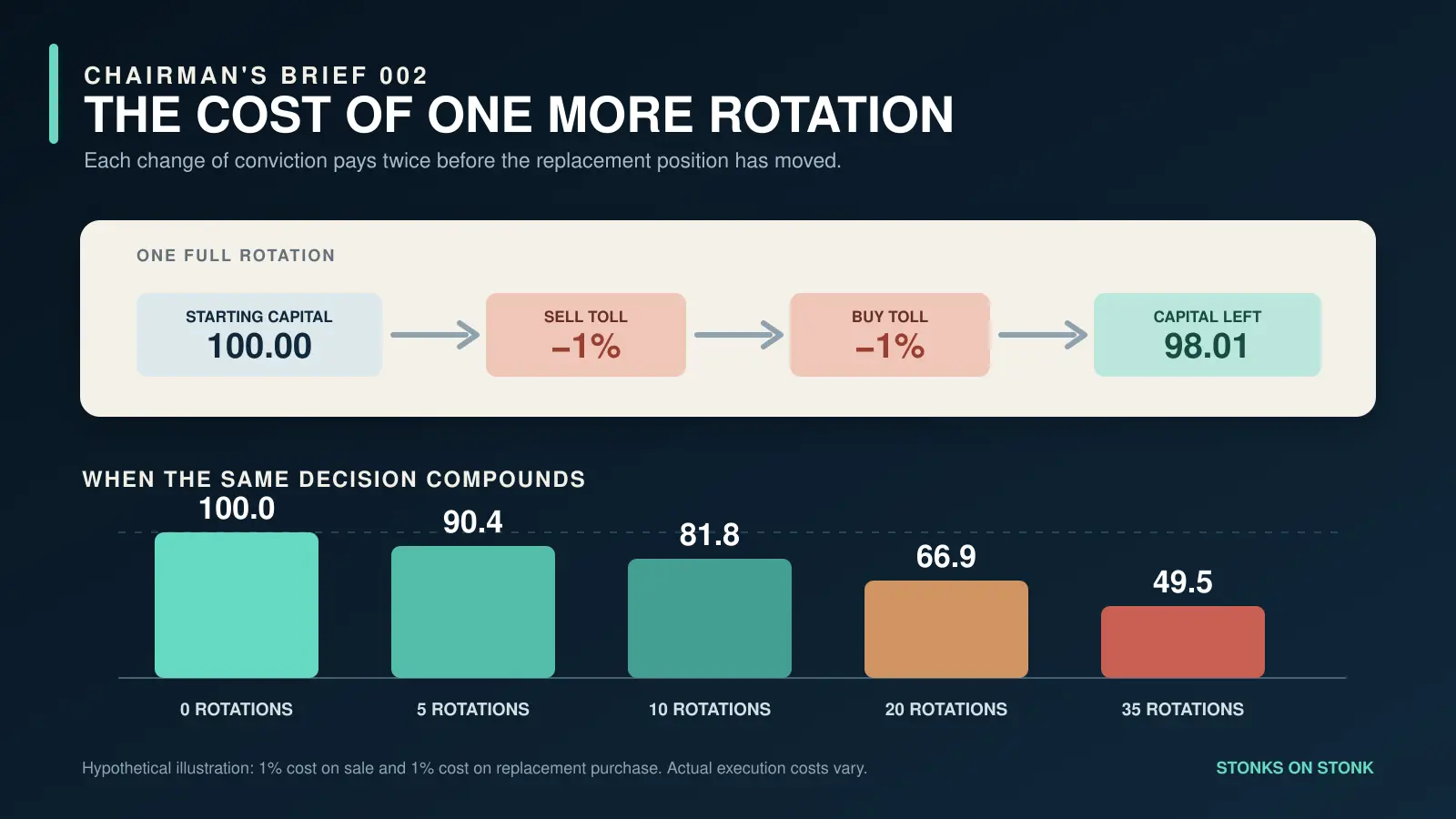
These figures are hypothetical, not an estimate of universal trading costs. Some rotations will cost less. Illiquid or poorly executed rotations may cost considerably more.
The purpose of the illustration is narrower: a small round-trip cost becomes a large capital impairment when repeated often enough.
Every new conviction must first recover the cost of abandoning the previous one.
And this table records only the visible toll. It does not include the position that recovers immediately after it is sold. It does not include the replacement purchased after it has already moved. It does not include the quality of judgment deteriorating as the account shrinks and the urgency to recover grows.
The market does not need every new idea to be wrong. It only needs the shareholder to keep paying admission.
The rotation has a third cost
Execution friction is only the amount charged at the door. After the rotation, the shareholder has also exchanged one set of price movements for another.
Three things can now happen:
- The replacement position falls.
- The abandoned position rises.
- Both occur at the same time.
The third outcome is particularly efficient. The shareholder loses money in the asset they now own while watching the asset they sold recover without them. The damage is no longer limited to fees and slippage. It includes the widening performance gap between the old decision and the new one.
Consider another deliberately hypothetical example. A shareholder begins with 100, pays the assumed 1% sell cost and 1% replacement-buy cost, and enters the new position with 98.01. The replacement then falls 10%, leaving 88.21. Over the same period, the abandoned position rises 10% and would have been worth 110 before any hypothetical exit costs.
| Outcome after the rotation | Capital value |
|---|---|
| Replacement position after costs, then down 10% | 88.21 |
| Abandoned position, had it instead risen 10% | 110.00 |
| Relative shortfall | 21.79 |
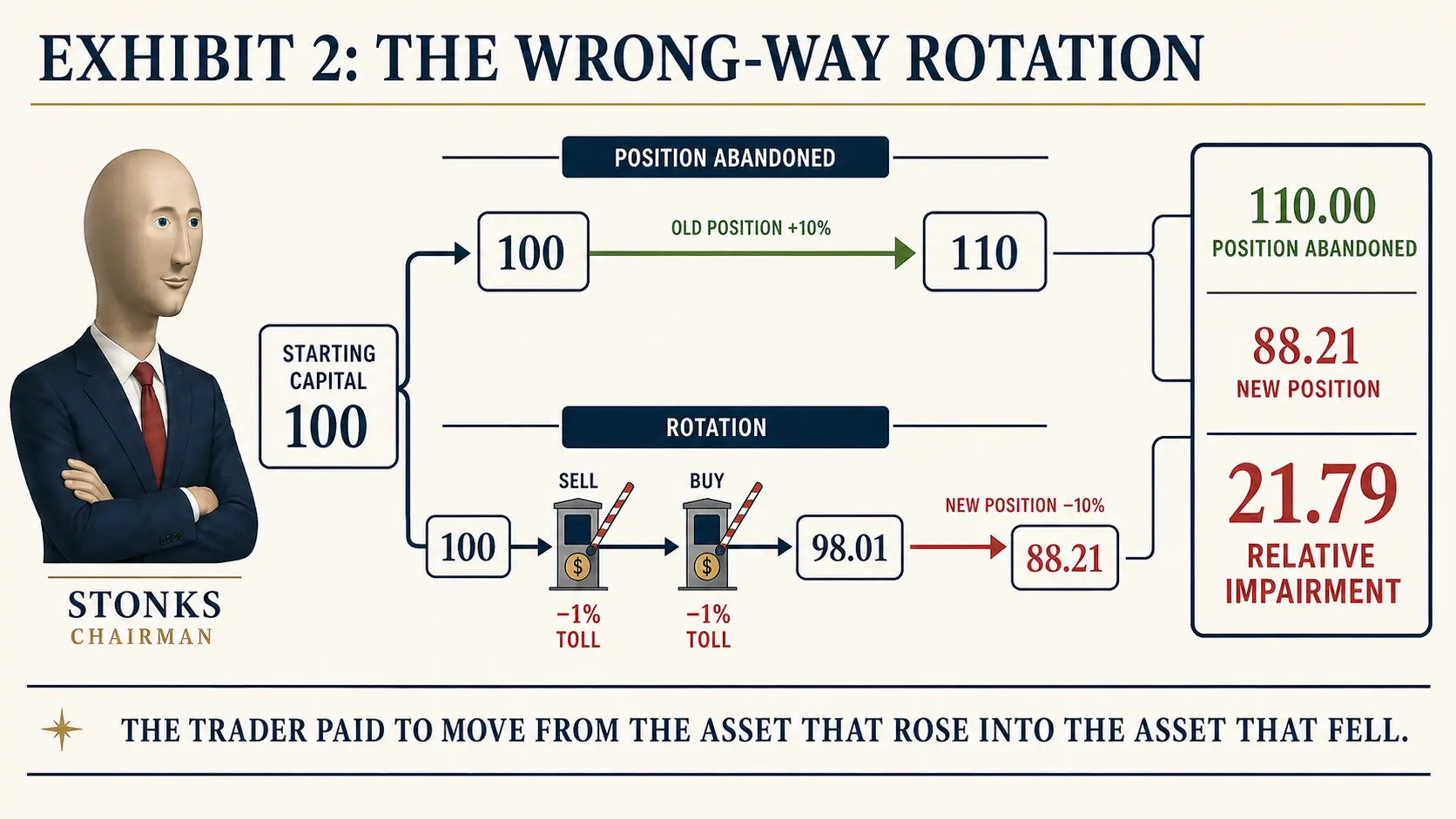
The shareholder did not merely lose 11.79 from the account. They finished 21.79 behind the position they had just abandoned.
This does not prove that rotating is always wrong. Sometimes the old thesis is broken and the replacement is still the better decision. It means the evidentiary threshold must reflect the full wager being made. A rotation is not one view. It is a simultaneous claim that the asset being sold has become less attractive and the asset being purchased has become more attractive—by enough to overcome the cost of moving between them.
Changing one's mind is rational. Requiring the new idea to outperform both the old idea and the toll is governance.
The slow liquidation
Accounts are not always destroyed by one cinematic act of financial misconduct. Many are liquidated gradually through a series of individually defensible decisions.
A small loss is realized to “protect capital.” A new position is opened to “capture momentum.” That position becomes uncomfortable and is replaced by a “higher-conviction opportunity.” The vocabulary improves as the capital base declines.
Eventually, the trader no longer owns a thesis. They own a sequence of reactions.
This is what makes the process difficult to recognize. Each trade can be explained. Each trade may even be reasonable in isolation. The damage exists in the pattern: repeated changes made without a meaningful change in evidence, financed from an account that becomes less capable of surviving each subsequent mistake.
Insolvency is sometimes less an event than a subscription service.
The psychological loop is straightforward:
- Uncertainty becomes uncomfortable.
- Discomfort is interpreted as a demand for action.
- Action produces temporary emotional relief.
- Execution costs reduce the capital base.
- The smaller account creates greater urgency.
- Greater urgency shortens the time horizon and lowers the standard for the next trade.
The shareholder believes they are escaping uncertainty. In practice, they are purchasing it again in a different ticker.
Rules must exist before the emergency
The answer is not to hold every position forever. Selling is not weakness, and inactivity is not a virtue when the facts have changed.
New information arrives. Theses break. Risk limits are reached. Capital sometimes has a clearly better use elsewhere. A disciplined trader must be capable of changing their mind.
But there is a material difference between changing a position because the evidence changed and changing it because continuing to hold became emotionally unpleasant.
The Chairman's preferred control is therefore not a promise to “be more disciplined.” It is a set of decision rules established before the position begins negotiating with the nervous system.
Before entering, management should be able to answer:
- What is the thesis?
- What observable evidence would invalidate it?
- What loss is acceptable if the thesis is wrong?
- What time horizon does the thesis require?
- What position size allows that horizon to be survived?
- Under what conditions may the position be increased, reduced or closed?
These answers do not guarantee a good outcome. They create a standard against which action can be judged.
If the rules are invented after the price moves, they are not decision rules. They are minutes drafted after the meeting.
This also resolves the apparent conflict between patience and adaptability. A position should not be protected from new evidence. It should be protected from the trader's temporary need to feel in control.
Position size is behavioural infrastructure
Traders often discuss position sizing as if it were only a mathematical exercise. It is also the architecture within which judgment must operate.
A survivable position allows time for information to develop. An oversized position converts ordinary volatility into a personal emergency. Once every price movement materially affects sleep, mood or the ability to think about anything else, the market has acquired voting control over the investment process.
At that point, discipline becomes much harder because the position is no longer being evaluated from a distance. It is being experienced as a threat.
A position that requires constant emotional intervention was probably too large when it was opened.
This does not mean conviction should be small. It means position size should reflect the volatility, liquidity and time horizon that conviction must survive. Being correct eventually is of limited value if the path to eventually forces the holder out first.
The market does not need to prove you wrong. It only needs to keep you uncomfortable for longer than your capital and temperament can withstand.
Trading less is an outcome, not an oath
Management is not announcing a prohibition on trading. Such a policy would be both unrealistic and, under certain market conditions, professionally embarrassing.
The objective is to raise the evidentiary threshold for action.
When the thesis changes, act.
When a predefined risk limit is reached, act.
When the original time horizon expires without the expected evidence emerging, review the position honestly and act if required.
When the only new information is that holding has become uncomfortable, no corporate action may be necessary.
Trading less is therefore not the governing principle. It is the natural consequence of having rules strong enough to distinguish information from emotion.
A note to the stonkholders
The culture of $STONKS should not require shareholders to convert every fluctuation into a corporate event.
Conviction is not measured by the number of times it is announced, defended or rearranged. Nor is patience the refusal to admit error. The useful middle ground is conviction without hysteria, patience without dogma, and sufficient surviving capital to remain capable of making the next rational decision.
The purpose of capital preservation is not to avoid every loss. It is to prevent a sequence of ordinary losses, unnecessary tolls and emotional interventions from removing the shareholder's ability to participate at all.
There will always be another chart, another narrative and another apparently urgent opportunity to reconsider the entire portfolio.
The market will provide unlimited opportunities to reconsider your position.
Management is under no obligation to pay for all of them.
Stonks On Stonk is an editorial and meme project. This Brief is cultural commentary, not financial advice.