
Stonkholders,
The previous Letter observed that markets had been granted permission to postpone an argument. The argument has now been raised by a party without a microphone.
American households reduced their spending in July. They also reported the weakest confidence reading of the year. Neither of those is a forecast — they are the minutes of a decision already taken by roughly seventy per cent of the economy.
Management notes the response. Equities recorded a record close on Thursday, a third consecutive weekly gain and the lowest volatility reading of 2026. Expectations for a September rate increase fell by roughly twenty percentage points across the week. And the thirty-year Treasury yield rose to a level last seen in 2007.
That final item is the one worth examining. For most of the last two decades, weak consumption arrived at the bond market as good news. Softer demand implied softer inflation, which implied a lower path for policy, which implied a lower price for long-dated money. The mechanism was so dependable that traders stopped describing it and simply used it.
Last week it did not operate. Spending fell, sentiment fell, hike expectations fell, and the cost of financing the United States for thirty years went up.
The Chairman regards this as the most significant development of the week, and it did not appear in any headline.
The number households actually filed
Retail sales declined 0.6% in July. Consensus expected an increase of roughly 0.1%. It was the largest monthly decline in more than a year, and it followed a June increase of 0.2%.
Management wishes to record the mitigating detail before drawing the conclusion, because the composition is doing real work here. Retail sales are measured in dollars. Gasoline prices fell during July, and gasoline stations are a reported category. Vehicle sales also declined. A household that fills the same tank at a lower price has reduced retail sales without reducing its standard of living. Some portion of this figure is disinflation wearing the costume of distress.
The sentiment report is harder to reframe. The University of Michigan's preliminary August index fell to 51.0 from 55.2, against expectations nearer 55. The long-run average of that series is approximately 84. Respondents continued to identify prices as their principal concern.
These two releases arrived on a labour market that had already softened. July payroll employment fell by 23,000. May and June were revised down by a combined 103,000. The unemployment rate held at 4.1%, assisted by 264,000 people leaving the labour force entirely.
Consumer spending is roughly two-thirds of American output. It has been carrying the expansion for several quarters while manufacturing, housing and hiring took turns being disappointing. The question is not whether households are irritated — surveys have recorded that for two years without much consequence. The question is whether irritation has begun converting into behaviour.
One month does not settle it. Management is not filing a recession notice on a single print that contains a gasoline effect. But three separate instruments — employment, spending and sentiment — moved the same direction in the same fortnight, and each of them is measured differently.
This is the first month in which the complaint and the behaviour agree.
The index recorded the week as a gain
The equity market's interpretation was not unreasonable, and it deserves to be stated properly rather than dismissed.
The S&P 500 closed at a record on Thursday, its twenty-seventh of 2026, then eased roughly 0.2% on Friday as the consumer data landed. It still finished with a third consecutive weekly advance, its longest run since April, and remains up approximately 14% for the year. The Dow slipped 108 points to close near 53,732. The Nasdaq Composite ended at 26,729.
Earnings support this. With 455 of the 500 index constituents reported through late Thursday, 87% had exceeded earnings estimates and 68% had exceeded revenue estimates. Second-quarter profit growth is tracking at a rate not seen outside post-recessionary rebounds.
The internal detail was more interesting than the index level. Broadcom fell 5.9% and Oracle fell 3.7%, while AMD gained 6.5%, Micron added 2.3% and SanDisk rose 7.4% after a double-digit advance the previous session. Capital is not leaving the artificial-intelligence complex. It is moving within it, from the companies that sell the compute to the companies that supply the memory the compute now requires.
The volatility market took the most confident position of all. The VIX fell below 14.4 during the week, a 2026 low, and closed near 14.5.
The Chairman has no quarrel with a low volatility reading. He would like to know what it is a price for. A VIX at these levels is the market's stated cost of insuring against disorder over the coming month. That month contains the minutes of the last Federal Reserve meeting, four large retailers explaining a weak consumer, the flash purchasing-managers surveys, Japanese inflation, Nvidia's results and a new Federal Reserve Chair's first address at Jackson Hole.
Insurance is cheapest immediately before it becomes interesting.
The long end declined to celebrate
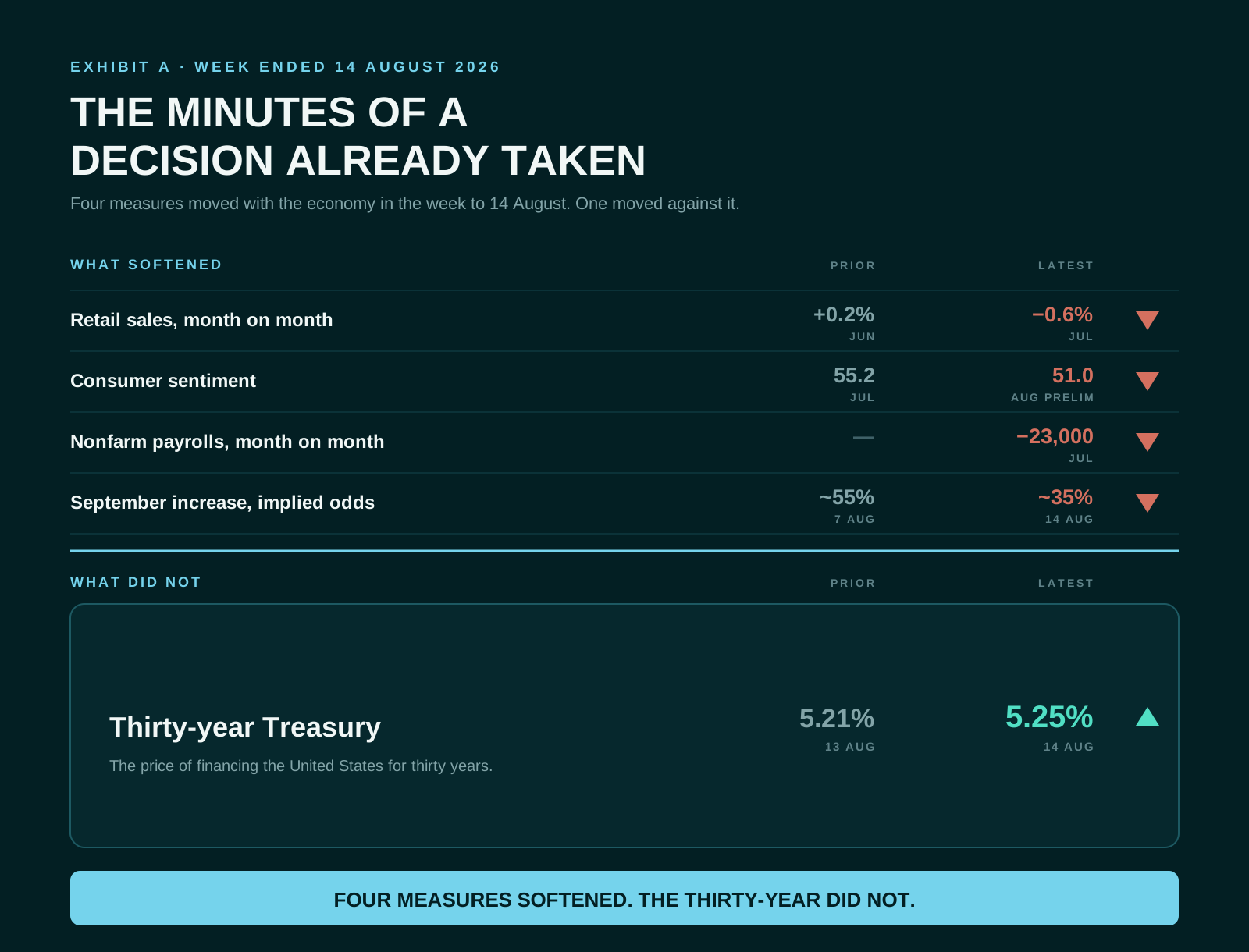
The ten-year Treasury yield ended Friday at 4.68%, having tested 4.75% on Tuesday — a nineteen-month high. The thirty-year finished at 5.25%, its highest level in roughly nineteen years. The two-year closed at 4.17%.
In the same week, market-implied odds of a September rate increase fell to approximately 35% from around 55% seven days earlier.
Those two sentences describe a curve that has stopped taking instructions from a single committee.
The proximate trigger was communication rather than data. Chairman Warsh indicated that a rate increase may not be his preferred instrument for addressing inflation. The front end read that as a reduced probability of near-term tightening and rallied accordingly. The long end read the same sentence and reached a different conclusion: that the institution most responsible for defending the currency's purchasing power over thirty years had just described its principal tool as optional.
Both interpretations are internally consistent, because they are pricing different questions.
This is the structural point of the Letter, and it is worth stating without decoration. The long end has stopped discounting the economy and started discounting the balance sheet. It is pricing the obligations that must be financed regardless of what output does, the supply of paper required to finance them, and the durability of the commitment to price stability while both of those things are true.
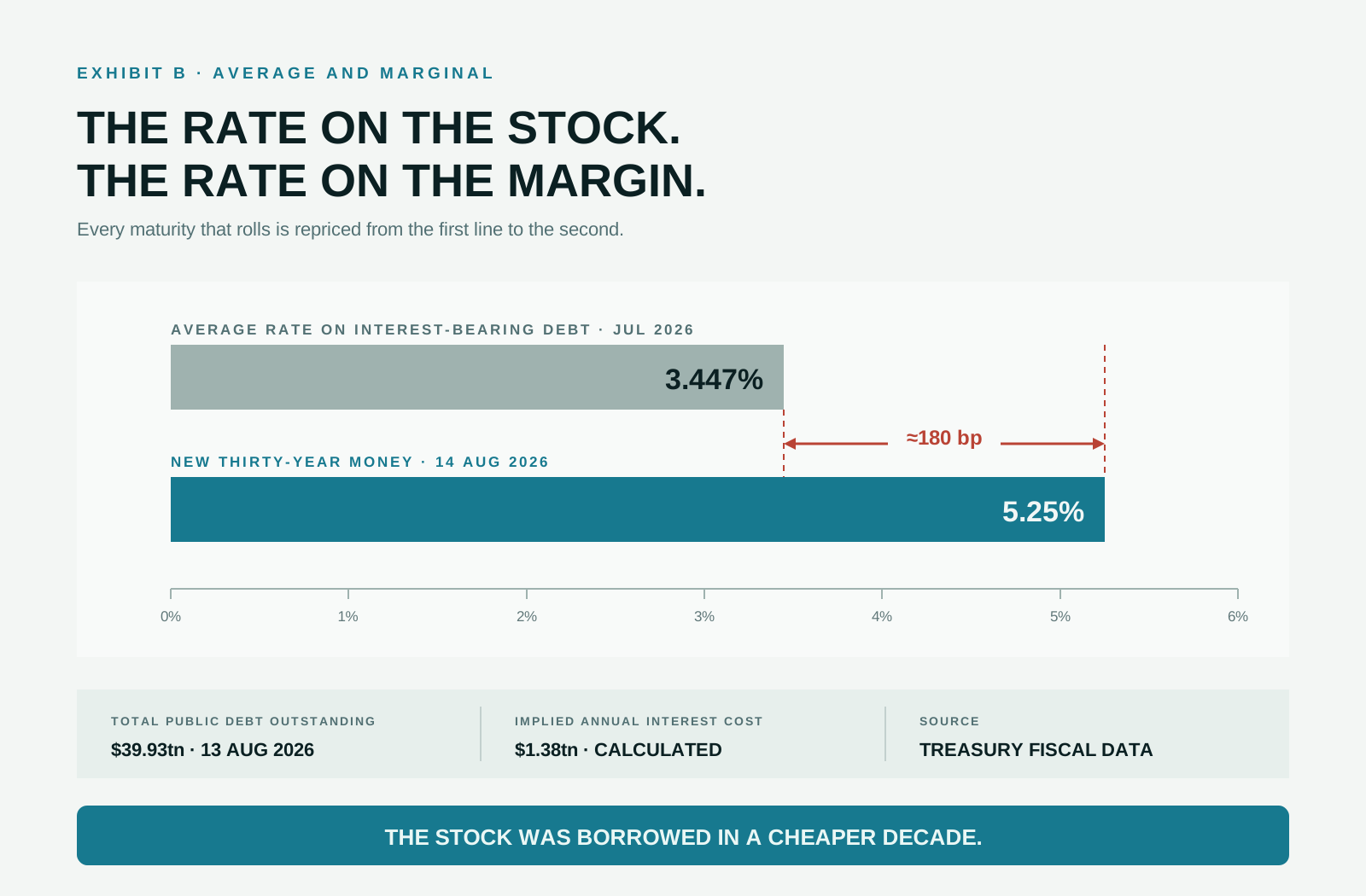
The desk's own conditions panel makes the arithmetic concrete. Total public debt outstanding stood at $39.93 trillion on August 13. The average rate carried across all interest-bearing debt is 3.447%, implying an annual interest cost of roughly $1.38 trillion. New thirty-year money costs 5.25%.
The distance between the average and the marginal rate is the entire issue. The existing stock was assembled in a cheaper decade and has not been repriced. Every maturity that rolls does so at today's price rather than the one it was issued at, and the average grinds upward on a schedule nobody votes on.
The previous Letter noted that the Treasury placed thirty-year debt on August 13 at a high yield of 5.216%, with orderly coverage and normal bidder composition. Private demand arrived, at a price. Within two sessions the secondary market moved through that level. The auction did not establish a ceiling. It established a receipt.
There was a second source of pressure, and it did not originate in Washington. Traders continued to weigh the possibility that Japan's Ministry of Finance might liquidate a portion of its substantial reserves to defend the yen. Those reserves are largely held in United States Treasury securities.
A weakening American consumer would normally be the bond market's preferred news. It received that news and asked for more compensation anyway. The change is on the lending side of the table.
Part of the relief is rented
The disinflation that markets celebrated the previous week has a landlord.
July consumer prices rose 0.1% on the month and 3.4% over the year, with core inflation easing to 2.5%. Producer prices were unchanged on the month. Both releases were softer than expected and both were assisted materially by energy.
Energy is not a domestic policy variable at present. The Strait of Hormuz has been effectively closed since February. Gasoline is running roughly a dollar per gallon above pre-conflict levels, which is why consumer sentiment keeps identifying prices as the dominant grievance even as the annual inflation rate falls.
The weekend brought movement in both directions. Bloomberg reported on Saturday that Iran and Oman have converged on an arrangement for managing routing through the strait, describing agreement on the transit corridors that have been the principal obstacle to ending nearly six months of conflict.Against that, two UAE tankers were attacked while transiting the strait on Friday, the Treasury Secretary indicated that measures aimed at the "economic isolation" of Iran were being prepared, and the Defense Secretary raised the prospect of an indefinite blockade of Iranian ports. Crude closed Friday up 1.4% near $82.40.
The accounting problem is that a single unresolved variable is currently performing three separate services for the American data. It is suppressing headline CPI and producer prices, and, through the gasoline-station category, the retail sales figure that spooked the market on Friday.
Management has no position on the diplomacy and no forecast for the outcome. It does observe that the improvement in the inflation picture and the deterioration in the consumption picture are, in part, the same fact entered twice.
A discount financed by a conflict is not a structural improvement. It is a lease.
Japan forwards its invoice
The Bank of Japan holds its policy rate at 1.0%, the highest since 1995, following June's increase. Policy was held in July by an eight-to-one vote, with one board member preferring 1.25%.
Reporting last week indicated that an earlier move has come into view, with a strong possibility of an increase at the September 17–18 meeting and the potential for a faster subsequent pace. The stated concerns were price pressure from the Middle East conflict, global demand associated with artificial intelligence, and continued yen weakness. The five-year Japanese government bond yield reached a record high on the reporting.The Prime Minister's administration is understood to be supportive of a near-term move.
That expectation met a complication on Sunday evening. Japanese second-quarter output grew at an annualised 1.1%, against expectations nearer 2.0% and a first quarter of 2.1%. On the quarter it was 0.3% where 0.5% was forecast.
The composition rhymes with the American one, which is the reason it is in this Letter rather than a footnote. Exports added roughly half a percentage point, assisted by the weak yen rather than by volume. Domestic demand subtracted two tenths. Private consumption was flat and capital expenditure fell. Part of the drawdown was the government releasing national oil reserves to manage the Middle East conflict — the same unsettled variable that is currently flattering the American inflation data, now visible in Japanese output. The GDP deflator held at 2.6%, so the inflation argument for tightening is intact. The growth argument is not: the Bank of Japan has said that steady domestic demand would justify further increases, and domestic demand has just declined to supply it.
The currency has not cooperated with the intervention that preceded all of this. The yen strengthened 0.2% on Friday to around 159.3 per dollar and remains close to 160, despite the rare joint operation conducted with the United States last month.
The sequence now has a shape. Intervention purchased time without altering the rate differential that created the pressure. The differential is now expected to close from the Japanese side. Closing it requires a central bank to tighten into a government that intends to borrow more, in a bond market it has spent a decade dominating.
Sunday's release makes that requirement harder without making it disappear. The reflex reading is that a weaker quarter lowers the odds of a September increase, and the reflex reading is probably right about September. It does not close the differential. Only the Bank of Japan can close the differential, and it has just been handed a reason to wait.
And if the currency deteriorates before the meeting arrives, the most liquid asset available to defend it is a portfolio of American government debt.
A soft Japanese quarter is therefore not obviously good news for the American long end. It is this Letter's argument, filed in a second currency.
This is why Monday's Treasury International Capital release deserves more attention than it usually receives. It reports June, which is stale, and it reports the composition of foreign demand for American paper, which is not.
The yen is a Japanese problem. Its settlement currency is not.
The week ahead
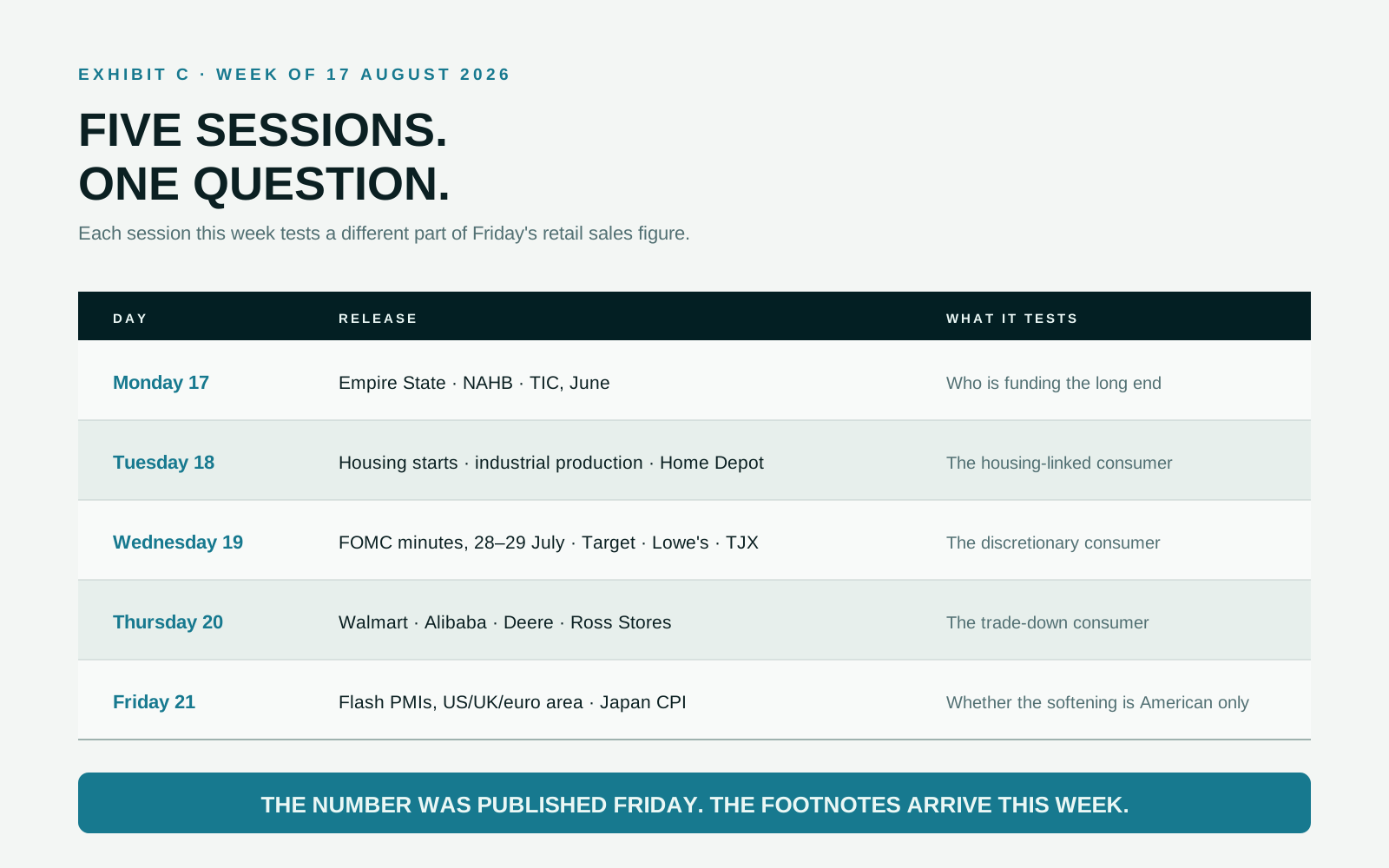
The calendar has arranged itself with unusual thematic discipline.
Monday. The Empire State manufacturing survey and the NAHB housing index open the week, both expected to remain in the vicinity of recent readings. Treasury International Capital data for June follows in the afternoon.
Tuesday. Housing starts and building permits, import and export prices, and industrial production. Home Depot reports, which is the housing-linked consumer.
Wednesday.The Federal Reserve releases the minutes of the July 28–29 meeting at 2:00 p.m. Target, Lowe's and TJX report, which is the discretionary consumer.
Thursday. Walmart, Alibaba, Deere and Ross Stores. Walmart is the trade-down consumer, and is the single most informative filing of the week for the question the retail sales report raised.
Friday. Flash purchasing-managers surveys for the United States, the United Kingdom and the euro area. Japanese consumer prices.
The structure is convenient. On Friday the Commerce Department stated that American households spent less in July. This week, four companies that sell to those households must explain what they actually observed at the register — whether volumes fell or only prices, whether the trade-down accelerated, and whether the July figure was a pause or a decision.
The minutes on Wednesday will be read for a narrower purpose. They cover a meeting that concluded before the payroll report, before both inflation releases and before the consumer data. They are diagnostic rather than predictive: they establish how divided the Committee was before the evidence arrived, which determines how much a single Chair's preference can move it.
Beyond this week, the schedule tightens considerably. Nvidia reports on August 26. The Jackson Hole symposium runs August 27–29, with Chairman Warsh delivering his first address there on August 28, on the theme of financial innovation and payments policy. The Federal Open Market Committee decides on September 16. The Bank of Japan follows on September 17–18.
Two of the largest events of the quarter are separated by roughly thirty-six hours. The volatility market has priced this at a 2026 low.
The standing file
Management maintains a public schedule of the conditions this desk reports against, and beneath it a ledger of the claims made in these Letters. Each claim carries the single measurable condition under which it would be considered to have failed, written at the moment of filing and evaluated in every session since. The ledger holds five entries. All five are sustained.
Management wishes to place that result in proportion. The oldest entry was filed on August 8. A nine-day record of being correct is not a record. It is a sample.
EC-003, filed on August 10, holds that weak employment can lower the expected path of policy rates without producing a durable fall in long-term borrowing costs. It requires the thirty-year yield to stay at least 85 basis points above the two-year. The spread was 100 basis points at filing and 108 on Friday, having widened by eight across five sessions in a week when the economy softened.
That entry is doing more than surviving. It describes the mechanism this Letter has spent several pages examining, and it was filed four days before the evidence arrived. Management notes this without satisfaction, since being early is indistinguishable from being lucky until it happens twice.
EC-001, filed on August 13, requires the thirty-year yield to hold at or above 5.00% in every session. It was 5.21% at filing and 5.25% on Friday.
EC-005, filed on August 8, requires the unemployment rate to hold at or above 4.0% in every release. One release has occurred since filing, and it was unchanged at 4.1%. Management records this as sustained and untested, which are not the same word. EC-004, on the French premium over Germany, sits in the same position at 78 basis points then and 78 basis points now, on a single observation.
One entry has moved against the desk. EC-002 holds that the curve is conducting two meetings, and requires the thirty-year yield to stay at least 40 basis points above the ten-year. That spread was 58 basis points at filing and 57 on Friday. The margin is still wide and the entry is in no danger. The direction is nonetheless the wrong one, and the reason deserves stating: the ten-year rose slightly faster than the thirty-year last week. That is the repricing this Letter describes, arriving one maturity earlier than the claim anticipated.
The column recording how close each claim has come to failing is the one Management reads first. On four of the five entries, the closest approach remains the value on the day of filing, and nothing has moved against them at all. On the fifth, the closest approach is Friday.
A file in which nothing has failed is either a sound process or a short week.
What is filed this week
Two claims from this Letter enter the record, each with the condition that would end it.
The case against both is respectable and should be stated properly.
The July retail sales figure may be revised, and the control group that feeds output calculations may prove sturdier than the headline. Lower gasoline prices are a genuine benefit to households even where they flatter the inflation data. Sentiment surveys have been detached from spending behaviour for two years without consequence. Corporate earnings are strong across a broad base rather than a narrow one. And a strait agreement that is implemented rather than reported would lower energy prices for a settled reason, improving the inflation picture and the consumption picture at once.
Further evidence Management would accept, none of it reducible to a single threshold: retail earnings this week showing volume growth rather than price-driven revenue; foreign private demand for Treasury securities holding steady in the capital-flow data; and payrolls stabilising without further contraction in the labour force.
Several of these may occur. None of them occurred last week.
Management's conclusion
The market spent the week receiving evidence that the economy is slowing and concluding that policy would therefore be gentler. That conclusion is probably correct about September and largely irrelevant to 2056.
Three markets read the same five days and filed three different opinions. Equities recorded a record and a low volatility print, on the reasonable basis that earnings are strong and near-term tightening risk has fallen. Households cut their spending and reported the weakest confidence of the year. The long-bond market marked the price of financing the United States to a nineteen-year high, on a week of uniformly soft data, which is not what that market has historically done in such a week.
None of the three has to be wrong for the others to be right.
The Chairman's interest is in the third one, because it is the only one that has changed behaviour rather than direction. A bond market that stops rallying on weak growth has quietly reassigned its attention from the economy to the balance sheet. That reassignment does not produce a crisis. It produces a higher hurdle rate, applied indefinitely, to every distant cash flow anyone wishes to be paid for.
For stonkholders, the transmission is unglamorous and reliable. $STONKSoperates inside internet-finance culture, and internet-finance culture rents its liquidity from the wider system at the wider system's rates. When the long end raises the rent, speculative enthusiasm is required to work harder for the same result.
Management has recorded the dissent, and notes that the dissenting party controls two-thirds of the economy.
Source notes
- 01U.S. Census Bureau — Advance Monthly Sales for Retail and Food Services, July 2026 ↗
- 02University of Michigan Surveys of Consumers — preliminary August 2026 ↗
- 03U.S. Bureau of Labor Statistics — The Employment Situation, July 2026 ↗
- 04U.S. equity market close, 14 August 2026 — index levels and weekly performance
- 05S&P 500 second-quarter reporting statistics through 13 August 2026
- 06Cboe Volatility Index, week ended 14 August 2026 ↗
- 07U.S. Treasury par yield curve rates and September policy pricing, week ended 14 August 2026 ↗
- 08U.S. Bureau of Labor Statistics — Consumer Price Index and Producer Price Index, July 2026 ↗
- 09Bloomberg — Iran–Oman convergence over Strait of Hormuz routing, 15 August 2026
- 10Reporting on U.S. statements regarding Iran sanctions and a port blockade, and on tanker attacks in the strait, 14 August 2026
- 11Crude oil settlement, 14 August 2026
- 12Bank of Japan — Statement on Monetary Policy, July 2026 meeting ↗
- 13Reuters — Bank of Japan deliberations toward a September increase, 14 August 2026
- 14Bloomberg — Japanese government support for a near-term rate increase, 13 August 2026
- 15USD/JPY, 14 August 2026
- 16Federal Reserve Bank of Kansas City — 2026 Jackson Hole Economic Policy Symposium ↗
- 17Stonks On Stonk — conditions panel, refreshed hourly from Treasury FiscalData ↗
- 18Stonks On Stonk — the Chairman's position ledger, carried beneath the conditions panel ↗
- 19Japan Cabinet Office — preliminary second-quarter GDP, 16 August 2026, as reported ↗
This material is provided for editorial and cultural commentary, not financial advice.