
Stonkholders,
Markets enter the new week having completed an unusual piece of accounting.
Economic deterioration has been recorded as an improvement in liquidity.
Friday's employment report reduced expectations for another Federal Reserve rate increase. Treasury yields fell, technology shares rallied, and a labour market that has stopped meaningfully expanding was treated as constructive because it might eventually produce easier policy.
That trade continued in Asia on Monday. The Nikkei closed 2.1% higher, led by technology and electronics shares, as investors continued to favour the valuation benefit of lower rate expectations before receiving confirmation that inflation will permit them.
No policy was eased.
No liquidity was injected.
The economy simply became weaker than the market expected.
Over the weekend, reporting clarified the immediate American objective but did little to resolve the underlying dispute. President Trump is reportedly prepared to end the war if Iran fully reopens the Strait of Hormuz, even without first securing a nuclear agreement. He later said the United States was “low-keying it” and only “semi-negotiating” while economic pressure builds inside Iran. Commercial traffic remains far below normal.
Wednesday's CPI report will test whether weaker employment has actually created room for the Federal Reserve to support markets. Persistent inflation, continued energy disruption or pressure at the long end of the Treasury curve would leave the economy weaker without guaranteeing easier financial conditions.
The week begins with a classification error
Before Friday's employment report, markets assigned roughly a 57% probability to a September rate increase. After the report, that probability fell to 44%.
The policy rate did not change.
The expected path changed because the economy was weaker than anticipated.
Lower expected rates can support asset prices immediately by reducing the discount rate applied to future cash flows. But the information that lowered those expectations also implies weaker labour demand, weaker household income formation and, eventually, weaker consumption.
The market has recognised the valuation benefit and deferred the earnings consequence until a later meeting.
That can be rational when inflation is falling. The Federal Reserve can respond to weakness, financial conditions can ease, and bad economic news can genuinely create the prospect of supportive policy.
The trade becomes less comfortable when headline PCE inflation is 3.7%, core PCE inflation is 3.3%, and three members of the Federal Open Market Committee have just preferred a rate increase.
Stagflation removes the clean policy response on which the “bad news is good news” framework depends.
The weaker the economy becomes, the more support it requires.
The more persistent inflation becomes, the less support the Federal Reserve can provide.
This is the contradiction the market must carry into Wednesday—not a promise that weaker employment will automatically become easier money.
Wednesday must decide which weakness the market owns
July CPI will be released Wednesday morning. PPI follows on Thursday.
One inflation report cannot conclusively declare stagflation. It can determine whether the policy constraint tightening around the economy is real.
There are four useful outcomes to consider before the number arrives.
- Headline rises; core cools.The immediate problem looks more like an energy shock than broad reacceleration. The Federal Reserve retains more room than the headline alone suggests.
- Headline and core remain elevated.Weakening employment meets persistent price pressure. The assumption that bad jobs data will produce policy relief becomes harder to defend.
- Services or core reaccelerate.The economy asks for support while the part of inflation least responsive to temporary energy relief refuses to cooperate.
- CPI and PPI are both hot.Markets must consider whether price pressure is still moving through the production pipeline.
A materially cooler core reading would weaken the Chairman's stagflation thesis. That result should be acknowledged in advance rather than explained away afterward.
The purpose of the week is not to predict the number.
It is to identify what the number must prove.
The economy carries a weaker denominator into the print
Wednesday does not begin from a neutral position.
The unemployment rate fell from 4.2% to 4.1% in July, but household employment also fell by 87,000 while 264,000 people left the labour force. The number classified as unemployed declined by 178,000, while the number outside the labour force rose by 381,000.
The rate improved because the denominator contracted.
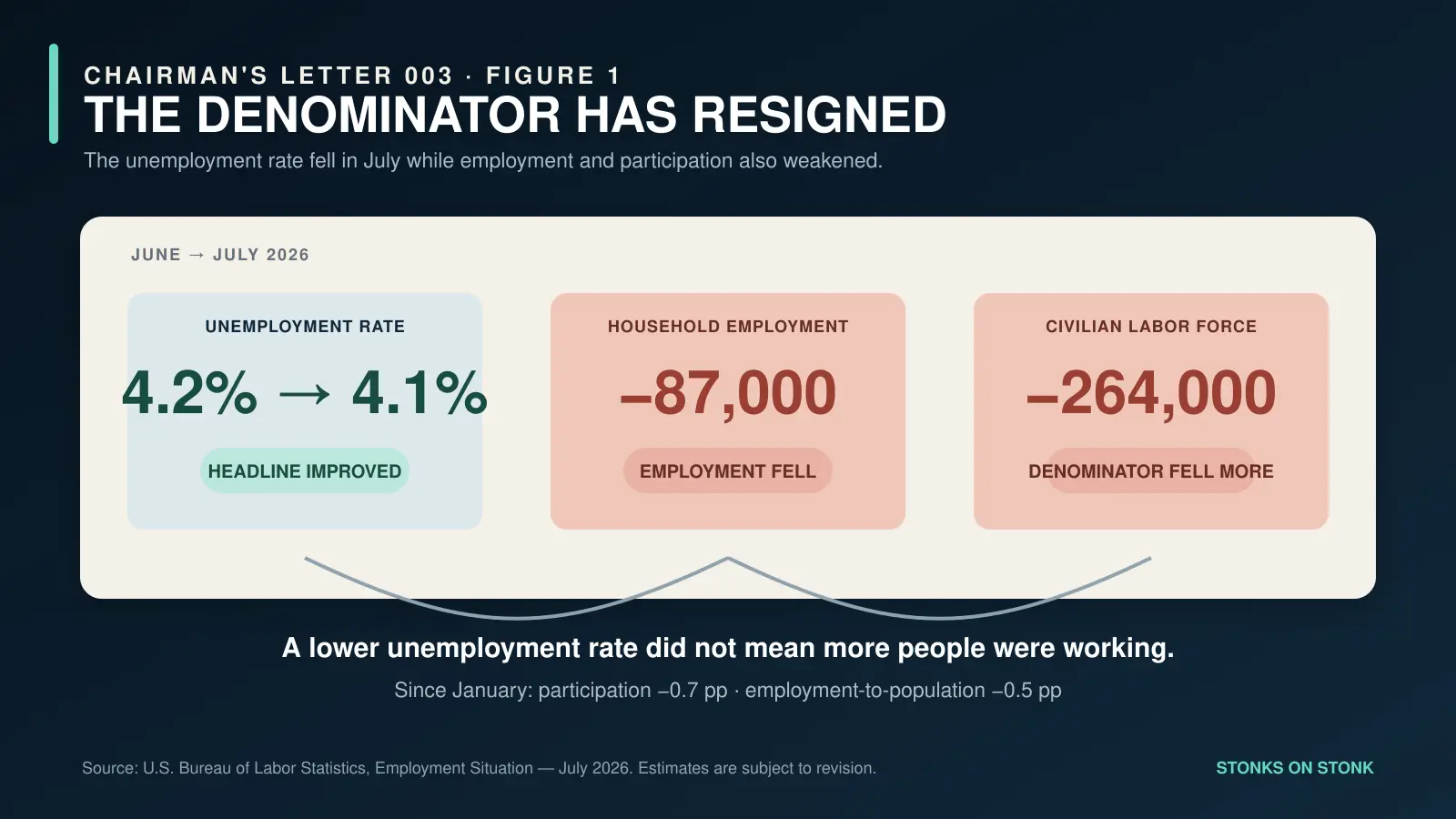
Since January, the labour-force participation rate has fallen 0.7 percentage point, to 61.4%. The employment-to-population ratio has fallen 0.5 point, to 58.9%.
This does not mean every person leaving the labour force has become discouraged. The official number of discouraged workers was essentially unchanged in July. Demographics, immigration changes, caregiving, retirement and the volatility of household-survey estimates also matter.
It does mean the headline unemployment rate is becoming a less complete description of labour-market health.
Payrolls fell by 23,000 in July. May and June were revised down by a combined 103,000. Average monthly payroll growth over the preceding year was only 34,000.
Edition 002 addressed the deterioration itself. The question for this week is what policy can do about it if inflation remains elevated.
If CPI cools, the market can argue that the labour weakness is purchasing room for the Federal Reserve.
If CPI does not cool, the economy will have paid for policy flexibility without receiving it.
The growth cushion is real, narrow and expensive
The economy is not uniformly contracting.
That is precisely why the stagflationary transition has been difficult to see.
Real GDP grew at a 1.5% annualised rate in the second quarter, down from 2.1% in the first. Corporate revenues continue to rise. FactSet's blended estimate shows S&P 500 revenue growth of 15% in the second quarter, with all 11 sectors reporting year-over-year growth.
The thesis therefore does not require us to pretend that every company outside AI has stopped selling things.
Nominal revenue can rise with prices. Large public companies can gain share while smaller firms struggle. Earnings can expand through operating leverage and unusual investment gains. Strong corporate reporting can coexist with weak hiring.
The more relevant question for the week ahead is how much protection this growth provides if inflation or long-term yields surprise upward.
AI-linked investment is supporting data-centre construction, electrical equipment, power infrastructure, machinery, semiconductors and their supply chains. The Bank for International Settlements estimates that the five largest hyperscalers will spend more than $1 trillion on AI-related capital expenditure across 2025 and 2026.
This is an extraordinary investment cycle.
It is also concentrated, capital-intensive, increasingly balance-sheet-intensive and comparatively light on employment. The BIS finds that more AI-exposed U.S. sectors have recorded higher productivity growth partly at the expense of employment growth.
Corporate America has not stopped growing.
It has simply become less necessary for that growth to include workers.
The national balance sheet is expanding alongside it. Domestic nonfinancial debt reached $81.9 trillion in the first quarter. Corporate debt reached $14.5 trillion and grew at an annualised pace of 8.8%. Federal government debt reached $34.5 trillion.
Debt-to-GDP remained flat, and household debt relative to disposable income remained near multi-decade lows. This is not a generalised household leverage crisis.
It is an economy leaning more heavily on government borrowing and a concentrated corporate investment cycle to sustain aggregate growth.
That matters this week because a capital-intensive, debt-supported expansion is not indifferent to the cost of capital. A soft jobs report may lower the expected policy path. It does not guarantee that the long-term financing rate on which this growth depends will follow.
The weekend did not remove the energy risk
The week begins with a clearer picture of the American objective and no corresponding evidence that the Strait of Hormuz is about to reopen.
The Wall Street Journal reported Sunday that President Trump had told senior aides he could end the war if Iran fully restored commercial traffic through the Strait, even without first securing a nuclear agreement. The immediate U.S. objective is therefore narrower than the settlement Washington had previously sought.
Iran's stated conditions show why that may not produce a quick agreement. A senior Iranian security official called for a permanent end to the war, removal of the U.S. naval blockade, withdrawal of American troops from the region, sanctions relief, access to frozen assets and war reparations.
Iranian officials also said the proposed arrangement with Oman was in its final stages. That agreement would define shipping lanes; it would not by itself reopen the waterway. Iran's foreign minister said there were still no direct talks with the United States and that messages were passing through intermediaries.
Trump described the United States on Sunday as “low-keying it” with Iran and “only semi-negotiating.” He said the administration was watching Iran contend with “huge inflation” and “the fact they have no money.” Axios also reported that Trump made no new military threats after being persuaded not to resume major combat operations.
The comments indicate that Washington is prepared to give economic pressure more time before escalating again. Trump's claim that Iran has “no money” is an exaggeration, but the financial constraint is real: sanctions, restricted export revenues and limited access to external funding make a prolonged conflict much harder for Tehran to finance.
There is an obvious irony in an American president pointing to another country's inflation and finances while U.S. inflation remains above target and federal borrowing continues to expand. The comparison ends at financing capacity. Washington borrows in its own reserve currency through the world's deepest sovereign-debt market. Tehran does not.
Shipping data have not validated last week's optimism. Thirty-three vessels crossed the Strait from Monday through Thursday, down from 50 during the equivalent period a week earlier and roughly 130 to 140 under normal conditions. Only six crude-oil tankers exited during those four days.
Brent fell more than 7% last week on hopes of an agreement before recovering to approximately $84 a barrel early Monday. The reduced military temperature matters, but it has not restored commercial traffic. The evidence to watch this week remains physical: vessel movements, insurance coverage, energy flows and the oil risk premium.
The front end received the jobs report. The long end received everything else.
Weak employment can pull down the expected path of policy rates without producing a durable fall in long-term borrowing costs.
The front end of the Treasury curve responds most directly to the expected Federal Reserve path. The long end must also absorb persistent inflation, heavy government issuance, fiscal uncertainty, a less dependable foreign-buyer base and the term premium investors demand for holding duration.
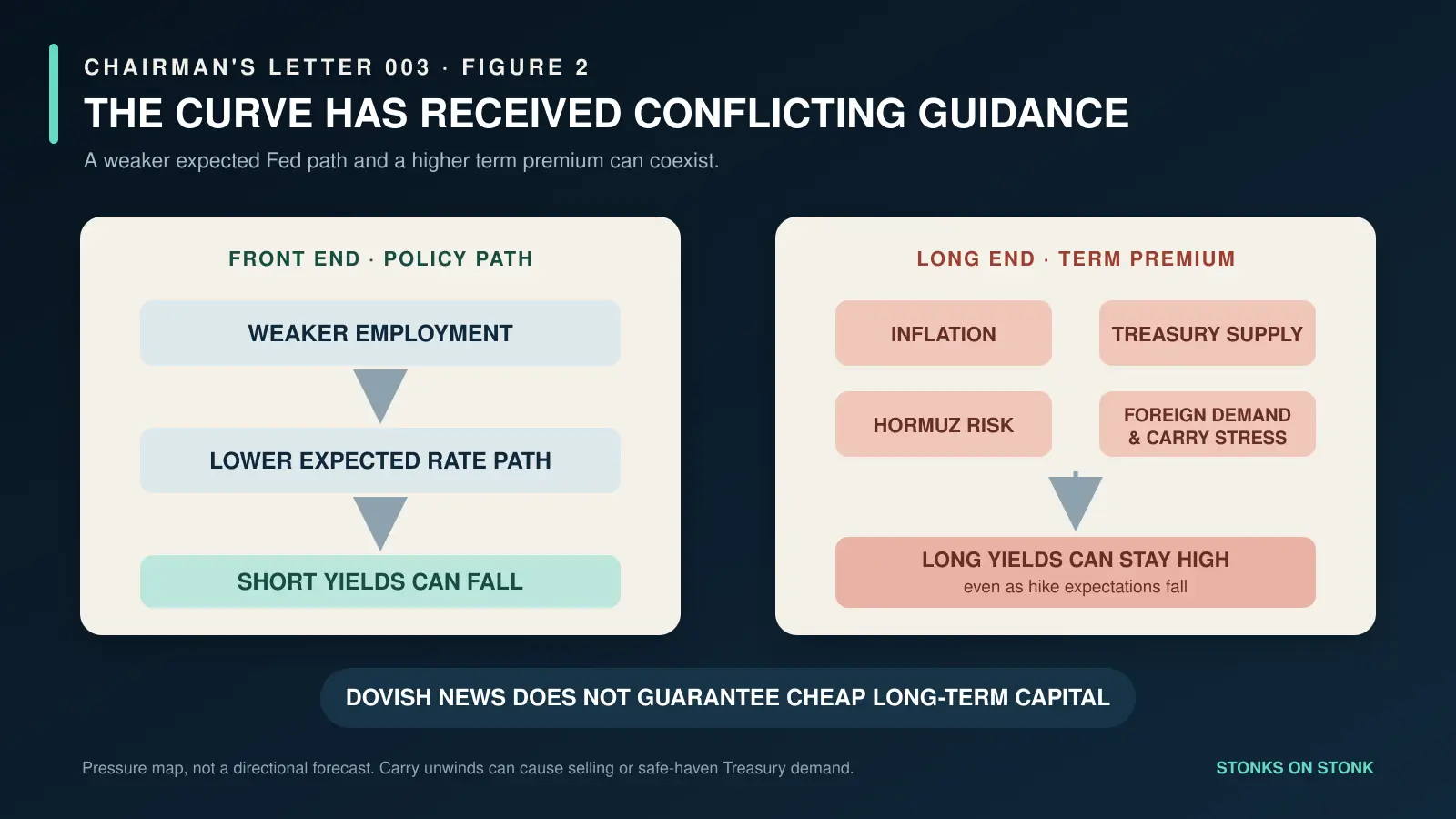
Japan adds a credible but easily exaggerated vulnerability. Higher Japanese yields make domestic bonds more competitive with currency-hedged Treasuries. Large paper losses on Japanese insurers' bond portfolios reduce balance-sheet flexibility. A stronger yen or narrower rate differential can encourage repatriation and destabilise leveraged yen-funded positions.
None of this proves an immediate forced sale of Treasuries.
Paper losses only move the market twice when someone is forced to act on them.
Nor does a carry unwind guarantee that Treasury yields rise. Repatriation, margin-driven deleveraging or foreign-bond liquidation could pressure yields upward. A disorderly global risk-off move could create safe-haven demand and send them downward.
The first-order conclusion is not direction. It is fragility.
This week, the curve will tell us whether Friday's dovish interpretation can survive contact with inflation and supply. A cooler CPI accompanied by stubborn or rising long yields would suggest that the term premium, issuance or foreign-demand concerns are overpowering the expected policy path. A hot CPI would pressure both the policy assumption and the long end at once.
The market may have received the rate outlook it wanted on Friday.
It has not yet received the financing conditions it requires.
Maximum confidence leaves minimum margin
Bank of America's Bull & Bear Indicator reportedly reached 9.7 out of 10 on Friday, its highest level since 2021 and deep inside the bank's contrarian sell range.
This is not a scheduled market crash.
The indicator reflects positioning, credit conditions, capital flows and market breadth. Comparable sell signals have historically been followed more often by tactical drawdowns than immediate bear markets.
Its relevance to the coming week is narrower.
Extreme positioning becomes dangerous when the narrative supporting it has no room for an adverse result.
Investors have celebrated weaker employment because it reduced the perceived probability of a rate increase. They have done so while inflation remains elevated, geopolitical energy risk remains unresolved, debt issuance is accelerating, long-end demand is less automatic and bullish positioning is already crowded.
The rally therefore requires a very specific set of outcomes:
- Enough inflation relief to restrain the Federal Reserve.
- Not enough economic weakness to damage earnings.
- Enough diplomatic progress to calm energy markets.
- Not enough concession to reveal how urgently Washington requires a deal.
- Enough Treasury demand to ensure that a lower expected policy path reaches long-term financing costs.
This is a demanding weekly objective.
Management's agenda for the week
Management has identified the following dates upon which the market will be asked to provide supporting documentation.
| Date | Catalyst | What it tests |
|---|---|---|
| Mon 10 Aug | Hormuz traffic, Iranian conditions and the U.S. response | Whether the narrower American objective produces a workable agreement, reflected in vessel traffic, insurance coverage and the oil risk premium. |
| Tue 11 Aug | $58bn 3-year Treasury auction 1:00 p.m. ET | Demand near the policy-sensitive end after weak employment reduced expectations of further tightening. |
| Wed 12 Aug | July CPI 8:30 a.m. ET $42bn 10-year auction 1:00 p.m. ET | The cleanest experiment: does softer inflation lower the whole curve, or does weak duration demand keep the long end elevated? |
| Thu 13 Aug | July PPI 8:30 a.m. ET $25bn 30-year auction 1:00 p.m. ET | Whether price pressure remains in the production pipeline—and whether investors absorb long-duration supply without demanding a larger premium. |
| Fri 14 Aug | July retail sales 8:30 a.m. ET Michigan sentiment 10:00 a.m. ET | Whether labour weakness is reaching consumption, and whether household inflation expectations remain anchored. |
Calendar: CPI/PPI · Treasury auctions · retail sales · Michigan survey.
The three coupon auctions form a $125 billion quarterly refunding that will raise approximately $28.7 billion of new cash. CPI arrives four and a half hours before the 10-year auction. PPI arrives four and a half hours before the 30-year.
Recent demand provides a mixed rather than broken baseline. The latest nominal coupon sale—the $44 billion seven-year auction on 28 July—cleared at 4.473% with a 2.49 bid-to-cover ratio. It was slightly soft but orderly. July's comparable 10-year and 30-year auctions were both respectable.
Next week is therefore not a referendum on an established buyer strike. It is a test of whether investors remain willing to absorb duration after weak employment, persistent inflation risk and renewed questions about the foreign buyer base.
Outside the scheduled releases, the Chairman will continue to watch the yen and funding conditions. A rapid yen appreciation, rising volatility or signs of deleveraging would matter more than the headline size of any institution's unrealised bond losses.
The stagflation thesis would weaken if core inflation cools materially, participation begins to recover, payroll revisions improve, investment broadens beyond the AI complex, Hormuz reopens durably and long-term inflation compensation falls.
It would strengthen if weak labour data are followed by persistent core inflation, continued energy disruption and a long end that refuses to rally.
Management remains capable of revising its position.
The economy has demonstrated the same capability with its payroll reports.
The Chairman's position
The United States appears to be entering a stagflationary transition.
Not every industry has stopped growing. Not every company is in distress. Corporate revenues remain positive, and the AI investment cycle is real.
But the growth that remains is becoming increasingly concentrated, capital-intensive, debt-financed and unable to generate enough employment to offset weakness elsewhere.
For $STONKS holders, the purpose of identifying this regime is not to predict a single CPI print or declare an immediate market collapse.
It is to recognise when a liquidity narrative is being used to make economic deterioration sound constructive—and to know what the narrative must prove next.
Speculative markets can continue rising under these conditions. Crowded positioning can become more crowded. A weaker economy can support valuations for longer than expected if investors remain focused on the policy response rather than the cause.
But unchanged rates are not stimulus.
A lower probability of additional restraint is not an injection of capital.
And the absence of another rate increase does not repair the labour market, broaden investment, lower the term premium or reopen a shipping lane.
The market begins the week having priced the policy response.
It must now receive the inflation, diplomacy and financing conditions required to justify it.
Management acknowledges that bad news may still be good news.
It simply requests that the good part be delivered before Friday.
Source note
- [1] U.S. Bureau of Labor Statistics, The Employment Situation — July 2026 ↗
- [2] Reuters, U.S. job losses and the repricing of September rate expectations ↗
- [3] U.S. Bureau of Labor Statistics, 2026 release calendar ↗
- [4] U.S. Treasury, August 2026 quarterly refunding statement ↗
- [5] U.S. Treasury, 28 July 2026 seven-year auction result ↗
- [6] U.S. Census Bureau, Economic Indicator Release Schedule ↗
- [7] University of Michigan Surveys of Consumers, 2026 release dates ↗
- [8] U.S. Bureau of Economic Analysis, Personal Income and Outlays — June 2026 ↗
- [9] U.S. Bureau of Economic Analysis, GDP advance estimate — second quarter 2026 ↗
- [10] Bank for International Settlements, Annual Economic Report 2026 ↗
- [11] Federal Reserve, Financial Accounts of the United States — first quarter 2026 ↗
- [12] FactSet, S&P 500 Earnings Season Update — 7 August 2026 ↗
- [13] Reuters, Iran says U.S. talks will not happen while the interim agreement is breached ↗
- [14] The Wall Street Journal, Trump Thought Opening the Strait of Hormuz Was Imminent. Iran Had Other Plans ↗
- [15] Reuters, Iran says Oman deal is in final stages but U.S. must act to open Hormuz ↗
- [16] Bank of Japan, Financial System Report Annex: life insurers’ interest-rate risk ↗
- [17] Japan Times/Bloomberg, Nippon Life books first impairment loss on domestic bonds ↗
- [18] Reuters, yen surges after U.S. jobs data as intervention risk persists ↗
- [19] Bank of America Bull & Bear Indicator, reported reading from 7 August 2026 strategy note
- [20] Axios, Trump says the U.S. is ‘low-keying it’ with Iran ↗
- [21] Reuters, Trump says the U.S. is ‘low-keying it’ with Iran and stresses economic pressure ↗
- [22] Reuters, vessel traffic through Hormuz dwindles as markets watch Iran–Oman talks ↗
- [23] Reuters, oil rises as Iran tempers hopes for a swift Hormuz reopening ↗
- [24] Reuters, global markets as the Nikkei rallies on lower U.S. rate expectations ↗
Stonks On Stonk is an editorial and meme project. This Letter is cultural commentary, not financial advice.