
Stonkholders,
July’s inflation reports gave markets permission to postpone an argument. Markets used that permission immediately.
Consumer prices rose by 0.1% in July and 3.4% over the year. Core inflation eased to 2.5%. The figures were broadly consistent with expectations and reduced the immediate pressure on the Federal Reserve to raise rates in September. A day later, producer prices were unchanged, below consensus, and the annual rate slowed from 5.5% to 4.7%. Equities rose. Treasury yields eased. The financial system received the reports as good news.
Management recognises the relief. The repair has not yet been filed.
Inflation remains above target. Energy prices remain materially higher than a year ago. The United States is drawing down its strategic petroleum reserve even as this week’s commercial crude stocks increased. Employment has weakened. Long-term government yields remain elevated across several major economies. The yen has surrendered much of the ground recovered through intervention. France is paying close to 4% to borrow for ten years while preparing another large issuance programme. South Korea has raised its policy rate while expanding fiscal and housing support. Japan’s long bond market is attempting to rediscover price formation after years of central-bank dominance.
The countries involved are not sharing a crisis. Their bondholders are asking a related question in different languages:
Two benign inflation releases can change the next meeting. Thirty-year capital requires a longer answer.
The number the market needed
The July CPI release was useful because it was undramatic.
Headline prices increased 0.1% over the month after falling 0.4% in June. Core prices rose 0.2%. The year-on-year rates eased from 3.5% to 3.4% for headline inflation and from 2.6% to 2.5% for core inflation.
That was enough to reduce the probability of an immediate rate increase. Investors were not required to reconsider the entire inflation regime. They could remove some near-term danger premium and return to the market’s preferred activity: purchasing duration-sensitive assets with renewed confidence.
The initial response followed that script. The S&P 500 opened 0.5% higher and the Nasdaq gained 0.9%. The two-year Treasury yield fell roughly four basis points and the ten-year yield fell roughly three.
That response was rational. Inflation moved in the right direction, and recent weakness in employment gives the Federal Reserve a reason to wait. The filing becomes less persuasive only when “no immediate escalation” is promoted to “no remaining constraint.”
The producer-price report delivered a second opportunity to make that mistake.
Final-demand prices were unchanged in July after declining 0.1% in June. The annual rate slowed from 5.5% to 4.7%. Both figures were below consensus. Read at the headline level, the report strengthened the case that the inflation shock is losing momentum and further reduced the burden on the Federal Reserve to act immediately.
The composition was less submissive. Final-demand goods prices fell 0.7%, helped by a 3.1% decline in energy and a 0.9% decline in food. Services rose 0.2%. The index excluding food, energy and trade services increased 0.4% during the month and 4.7% over the year.
The headline deserves the relief it produced. It also received considerable assistance from volatile goods while underlying service categories remained firm. Pricing pressure has reduced its hours. Management has not processed the retirement paperwork.
For markets, the distinction is familiar. The next Federal Reserve decision is sensitive to the direction of inflation. The long-term price of capital is sensitive to whether that direction proves durable after energy relief, fiscal issuance and service-sector pressure are included.
The composition still matters
Headline inflation is often reduced to a single number because one number is easier to trade. Households and institutions remain burdened by the composition.
Energy prices fell 1.5% during July, yet remained 14.7% higher than a year earlier. Gasoline was 24.6% higher. Food prices were up 3.0%. Shelter rose only 0.1% during the month, but accounted for roughly two-thirds of the increase in the headline index.
There were encouraging details. Shelter inflation moderated. Vehicle insurance declined. Core inflation has softened. There was no clear evidence in this report of the earlier energy shock spreading uncontrollably across the consumption basket.
There were also reminders that the all-clear has not been issued. Services excluding energy services were 3.0% higher over the year. Medical-care services increased 0.6% in July. Airline fares rose 2.2% during the month and 25.5% over the year.
The petroleum balance contains the same conflict between immediate relief and structural resilience. Commercial crude inventories increased by 17.4 million barrels in the week ended August 7, the largest weekly build since January 2023. Imports rose and exports fell, leaving commercial tanks with 424.4 million barrels. The Strategic Petroleum Reserve moved in the opposite direction, declining by 6.1 million barrels to 298.7 million, its lowest level since 1983. Gasoline and distillate inventories remained below their five-year averages.
The market is entitled to trade the flow. More commercial crude and weaker demand forecasts helped lower oil prices on August 13. Management must also inspect the buffer. The United States entered the week with fuller commercial tanks and a smaller emergency reserve.
Refining capacity adds another distinction. Yemen’s Houthis said on August 13 that they had attacked Saudi Aramco’s 400,000-barrel-per-day Jizan refinery with two drones. At the research cutoff, neither Saudi Arabia nor Aramco had confirmed damage from the latest claimed attack. The refinery was already shut after an earlier strike, and a tentative August 15 restart had been discussed. Oil pared part of its decline after the report, but the operational effect remained unverified.
Crude in storage is not gasoline, diesel or jet fuel delivered to a customer. A fuller tank can lower today’s price while depleted emergency reserves and threatened refining capacity leave tomorrow’s price more sensitive to disruption. Part of the present discount has been financed from resilience.
The Federal Reserve is therefore balancing incomplete disinflation against a weakening labour market, not choosing between two tidy outcomes.
July payroll employment fell by 23,000. The unemployment rate remained 4.1%, but labour-force participation has declined by 0.7 percentage point since January and the employment-to-population ratio has fallen by 0.5 percentage point.
The policy choice is therefore becoming less convenient. Higher rates may restrain inflation while adding pressure to employment, investment and debt service. Easier policy may support growth while risking renewed inflation or reduced confidence in the commitment to price stability.
The CPI report did not resolve that tension. It gave the Federal Reserve additional time to sit inside it.
The long end has its own committee
The Federal Reserve controls an overnight policy rate. It influences, but does not command, the rate at which investors will lend to the United States for thirty years.
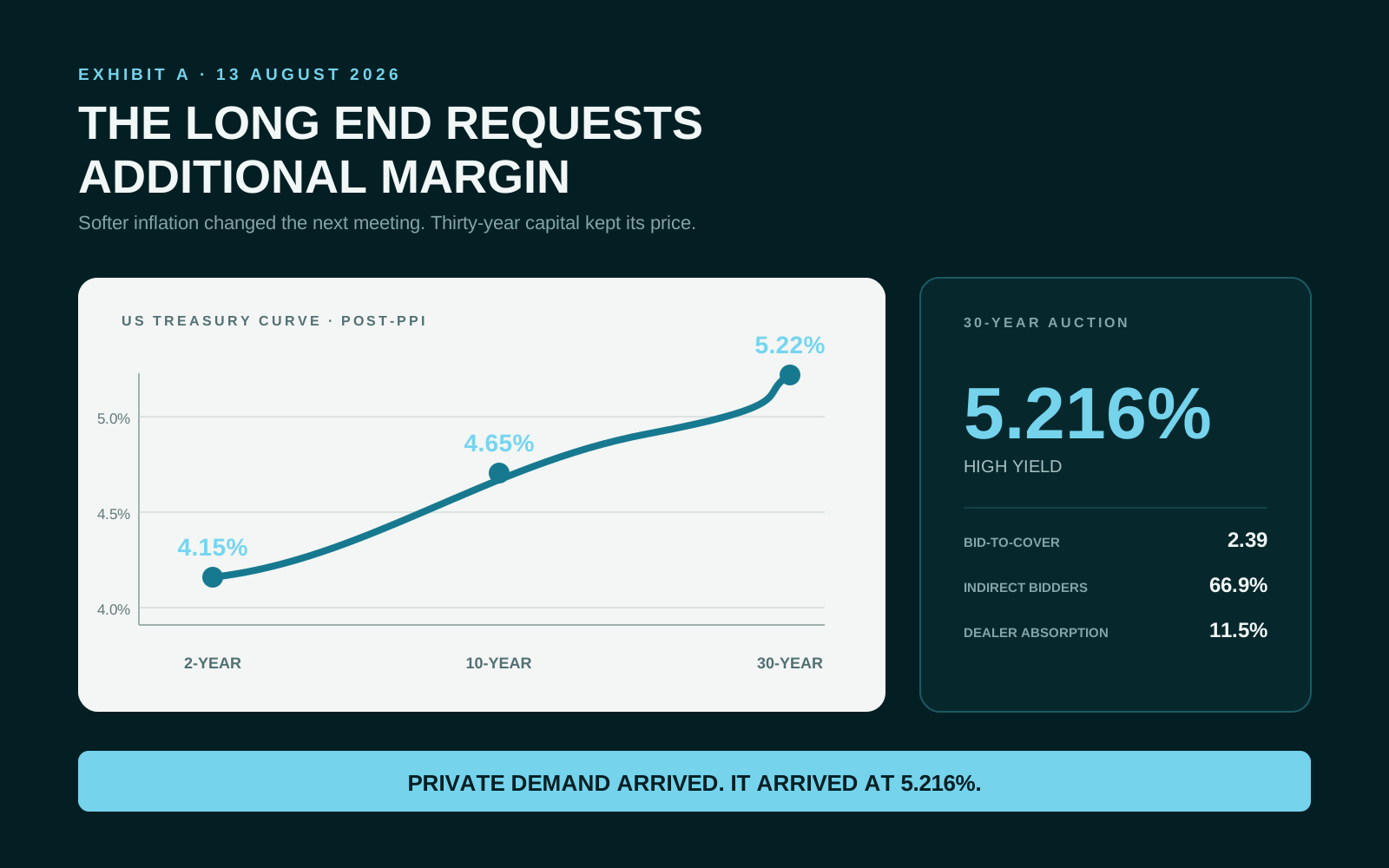
On August 12, the two-year Treasury yield closed at 4.20%. The ten-year closed at 4.68%. The thirty-year closed at 5.24%. After the softer PPI report on August 13, the curve rallied modestly. By shortly after the afternoon auction, the two-year yield was near 4.15%, the ten-year near 4.65% and the thirty-year near 5.22%.
The curve is conducting two meetings. The shorter end is pricing the likely path of the Federal Reserve. The long end is discussing inflation uncertainty, fiscal borrowing, term premium and the wisdom of holding a government’s nominal promise for three decades.
This helps explain why cooler CPI and PPI prints can lower expectations for the next rate increase without restoring cheap long-term capital. The market can believe that the Federal Reserve will wait in September while still demanding more than 5% to fund the government until 2056.
The August 13 auction made the distinction unusually clear. The Treasury sold $25 billion of new thirty-year bonds at a high yield of 5.216%. The bid-to-cover ratio was 2.39. Indirect bidders received 66.9% of the competitive awards, direct bidders received 21.6% and primary dealers absorbed the remaining 11.5%.
The auction did its job. Coverage and bidder composition were close to recent norms, the issue cleared near the prevailing when-issued yield and dealers were not left holding an unusual share. Private demand arrived.
It arrived at 5.216%.
The equity market has interpreted each absence of bad news as authorisation to proceed. The long-bond market has issued no equity forecast. It has continued to request additional margin for fiscal supply, inflation uncertainty and duration. A routine auction above 5.2% establishes the rate at which the current balance sheet can be financed without disorder.
That matters beyond the Treasury market. Long-term sovereign yields help establish the hurdle rate for mortgages, infrastructure, corporate borrowing and equity valuation. They influence how investors judge distant earnings streams. They also compete directly with risk assets for capital.
The AI complex can continue growing throughout this process. Capital expenditure may continue, revenues may rise and the technology may deliver real productivity gains. Its financial structure still becomes more vulnerable when funding costs rise, monetisation arrives late or current valuations require cash flows from an increasingly distant future.
Management is not bearish on technological progress. Management remains unwilling to classify capital as free because the product is impressive.
France is not America, but the bondholder recognises the form
France illustrates the same pressure through a different institutional structure.
Its 2025 general-government deficit was 5.1% of GDP and public debt reached 115.6% of GDP. The European Commission expects the deficit to remain at 5.1% in 2026, widen to 5.7% in 2027 and push debt to roughly 120% of GDP.
The French state plans €310 billion of medium- and long-term issuance in 2026. Its expected debt-service cost is €59.3 billion. The ten-year French yield is now close to 4%, approximately 80 basis points above the equivalent German benchmark.
France operates under different constraints from the United States. Monetary policy belongs to the European Central Bank, while fiscal decisions remain national. France cannot independently create euros to meet its obligations, although it belongs to a monetary union whose central bank treats sovereign fragmentation as a policy concern.
It must nevertheless refinance and issue large quantities of debt while growth remains weak and fiscal consolidation remains politically expensive. Bondholders have priced the inconvenience.
The spread over Germany is the useful signal. A rise in all European yields may reflect shared inflation or monetary-policy expectations. A wider French premium indicates that investors are also distinguishing among sovereign balance sheets.
The European Central Bank has already noted that very long-term yields have risen materially across advanced economies. Greater sovereign supply is one contributor. The eventual effect on government funding costs develops gradually because much debt matures before thirty years and debt offices can adjust issuance. The private-sector effect can arrive sooner through mortgages, corporate financing and portfolio allocation.
France is a reminder that membership in a monetary union does not repeal arithmetic. It changes the meeting at which the arithmetic is discussed.
South Korea has more fiscal room and less policy room
South Korea has a materially lower government-debt burden than France and retains greater fiscal capacity. Its difficulty is not an exhausted balance sheet. It is a narrowing list of choices.
The Bank of Korea raised its base rate by 25 basis points to 2.75% in July. Korean ten-year government yields had already moved above 4.3% in July, roughly one and a half percentage points higher than a year earlier. The move incorporated more than the policy rate: inflation and currency concerns were joined by expectations of additional government issuance and stronger nominal growth from the semiconductor cycle.
At the same time, fiscal policy is moving in the opposite direction. The original 2026 budget increased expenditure by 8.1% and planned 232 trillion won of Treasury-bond issuance. An additional budget responding to the Middle East shock lifted total planned spending further. The government is also directing new financing toward semiconductor infrastructure, exporters and housing construction.
The central bank is attempting to contain inflation and currency pressure while the government uses its healthier balance sheet to support strategic investment and domestic demand. Monetary restraint now shares the premises with industrial policy.
Housing sharpens the contradiction. The government announced that policy support for construction-project financing would rise to at least 47.8 trillion won and introduced additional loans for young and newly married homebuyers. At the same time, it continues to describe household debt and property speculation as risks. The official target for household-debt growth has now been raised from 1.5% to around 3%.
The policy objective is understandable: increase supply without reigniting speculative demand. The implementation problem is equally clear. Credit does not always respect the purpose written on its application form.
Korea also matters because its growth support is unusually concentrated in technology exports and semiconductor investment. The sector is genuinely strong. The domestic economy, housing market and household balance sheets have not received the same upgrade. Global equity investors have encountered the same accounting issue: strength in a strategically important sector does not automatically consolidate every entity supporting it.
The KOSPI has made that distinction unusually expensive for retail investors. After an AI- and semiconductor-led surge, the index was down 33% from its June peak by August 7. Samsung Electronics and SK Hynix accounted for 76% of the 2,257.8 trillion won reduction in KOSPI market value. Leveraged exchange-traded funds tied to the chipmakers amplified the volatility.
Concentration worked in both directions. Two companies carried a disproportionate share of the rally, encouraged retail participation and made the index appear broader than it was. When expectations around AI spending, competition and foreign positioning changed, the same concentration accelerated the reversal. Margin borrowing and leveraged single-stock products converted index volatility into household losses.
Retail behaviour already shows the damage. Korean investors purchased $4.6 billion of US equities in July, well above their 2025 monthly average, while deposits in domestic trading accounts fell from a record 140 trillion won in early June to 102.8 trillion won by early August. The result is more than disappointed shareholders. Capital moving back overseas can add pressure to the won, which further constrains the Bank of Korea.
The sequence is now visible. Industrial policy supported semiconductors. Semiconductor strength lifted a concentrated index. Retail leverage followed. The unwind damaged household confidence and redirected savings abroad. The Bank of Korea has inherited the currency consequences of a trade it did not create.
Korea therefore supplies a useful counterexample to a purely fiscal explanation for higher yields. A government can possess more borrowing capacity than France and still face a rising price of capital because inflation, currency exposure, private leverage, industrial policy and bond supply are all competing for the same room.
Japan demonstrates the cost of postponement
Japan provides the clearest example of a central bank dominating the bond market for long enough that normalisation becomes its own source of instability.
The ten-year Japanese government bond yield recently approached 3%. Thirty-year yields are near 4%, above the comparable German yield and no longer far removed from the United States. The Bank of Japan is trying to normalise policy and reduce its bond holdings while the government is expected to increase issuance to fund stimulus and tax cuts.
This creates a familiar institutional conflict. Higher yields improve the prospective return available to savers and restore information to the bond market. They also increase the government’s financing burden. Renewed central-bank purchases might contain disorderly moves, but they could also suggest fiscal dominance and weaken confidence in the Bank of Japan’s inflation mandate.
The recent currency intervention belongs inside that structure. Joint action briefly strengthened the yen from above ¥162 to around ¥157 before it weakened back through ¥159.
The next policy meeting is now live. Japan’s corporate-goods price index rose 7.2% from a year earlier in July, while yen-denominated import prices increased 29.1%. Markets were assigning a 76% probability to a September rate increase on August 13, up from 24% before the latest BOJ meeting. Reporting based on people familiar with the government’s position also indicates that Prime Minister Sanae Takaichi’s administration would support a near-term move, most likely in September or October. The Prime Minister’s office publicly maintained that the decision belongs to the BOJ.
The distinction matters. A move in September would signal that the BOJ is prepared to follow currency intervention with policy. Waiting until October would provide more time to assess the June increase, but it would also test a market that has already priced an earlier response. The next signal may arrive before either meeting: Deputy Governor Ryozo Himino is scheduled to speak on August 27.
Intervention changed the price and bought the BOJ time. It did not close the rate differential, reduce government borrowing needs or remove the incentives supporting the carry trade. The invoice has now been forwarded to monetary policy.
America has attended this meeting before
Japan should not be treated as America’s destination. It is a record of the choices available when the cost of servicing the balance sheet begins to govern monetary policy.
The first Japanese lesson followed the collapse of the late-1980s asset bubble. Banks and companies spent years repairing damaged balance sheets. Losses were recognised slowly. Private demand remained weak enough that repeated fiscal support prevented worse outcomes without consistently producing a self-sustaining expansion. Real GDP growth averaged 1.5% during the 1990s, down from more than 4% in each of the previous two decades, and consumer-price inflation eventually turned negative in 1998.
That path would become relevant to the United States if a concentrated investment boom ended with companies protecting balance sheets rather than funding the next round of expenditure. The present conditions do not yet meet that description. US inflation remains above target, the financial system is more market-based and there is no broad private-sector balance-sheet recession. Management will not declare Japanification merely because an expensive asset has encountered gravity.
The second lesson is closer to the current filing. Once a government becomes accustomed to financing large obligations at low rates, the central bank can suppress long yields through bond purchases or an explicit yield target. The immediate funding cost falls. Responsibility for clearing the bond market migrates onto the central-bank balance sheet. Price discovery becomes an administered service, the currency may absorb more of the adjustment and departure becomes more complicated with every year spent inside the arrangement.
The United States has its own precedent. In 1942, the Federal Reserve agreed to peg the Treasury-bill rate at three-eighths of one percent and effectively capped long Treasury yields at 2.5% to support wartime financing. Maintaining the structure required securities purchases and subordinated monetary policy to the government’s funding objective. After the war, inflation increased and the Treasury still wanted cheap financing. The institutional dispute ended with the 1951 Treasury–Federal Reserve Accord, which restored the Fed’s ability to set rates independently.
The episode demonstrated that a sovereign issuer can instruct its central bank to alter the market price of duration. It also demonstrated that the resulting yield is a policy decision, not proof that the underlying financing pressure has disappeared.
Current US arithmetic makes the precedent relevant. The Congressional Budget Office projects debt held by the public rising from 101% of GDP in 2026 to 120% in 2036. Net interest outlays are projected to increase from $1.0 trillion to $2.1 trillion over the same period. Those projections are not a forecast of crisis. They show how quickly the interest-rate assumption becomes a governing variable.
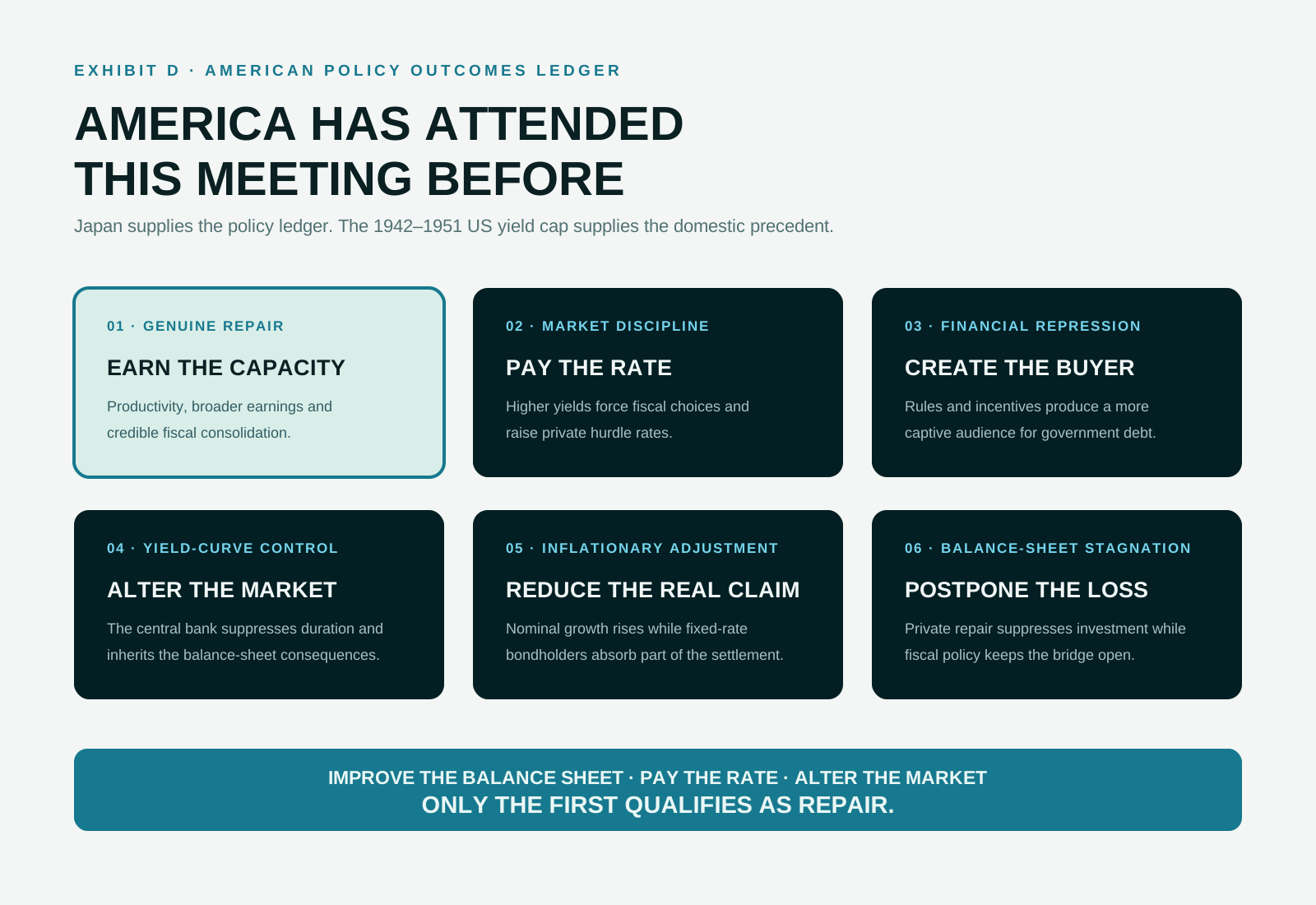
If private markets continue requesting additional margin, the government eventually faces three choices: improve the balance sheet, pay the rate or ask the central bank to alter the market. History contains examples of all three. Only the first qualifies as repair.
| Potential outcome | What shareholders would observe |
|---|---|
| Genuine repair | Productivity, broader earnings growth and fiscal consolidation improve debt capacity without financial coercion. |
| Market discipline | Long yields remain elevated, forcing fiscal choices and raising private-sector hurdle rates. |
| Financial repression | Regulation and institutional incentives create a more captive audience for government debt. |
| Yield-curve control | The central bank suppresses long yields and assumes the balance-sheet, currency and inflation consequences. |
| Inflationary adjustment | Nominal growth reduces the real debt burden while holders of fixed-rate claims absorb part of the settlement. |
| Balance-sheet stagnation | An asset bust leaves companies repairing leverage, investment weak and fiscal policy supporting an economy that no longer compounds unaided. |
America differs from Japan in ways that matter. The dollar remains the principal reserve currency, US capital markets are deeper and foreign investors play a larger role in financing the system. Those advantages expand the available room. They may also make the adjustment more visible through the currency and term premium because the investor base is less captive.
Japan is therefore useful as a policy ledger, not a prophecy. It records what governments and central banks have previously done when the market price of money became operationally inconvenient.
Gold receives the same filing differently
Gold has declined to provide a single explanation for its recent rally.
The metal rose after the CPI release, reached a two-month high and has gained more than 8% during August. The immediate mechanism was straightforward: reduced expectations of a near-term Federal Reserve increase lowered the opportunity cost of holding an asset that produces no interest.
The wider move began before this CPI print. Weaker economic data, geopolitical uncertainty and demand from reserve managers and private investors have all contributed. First-half central-bank purchases were the lowest since 2022, so the official sector is not buying without interruption. Net demand nevertheless remained positive, and surveys continue to show strong institutional interest.
Gold is not an infallible referendum on monetary credibility. It is volatile, generates no cash flow and can fall sharply even while the long-run concern remains intact. The IMF has recently emphasised that its diversification and hedging benefits are conditional and that it should be treated as a high-risk reserve asset rather than a substitute for liquidity.
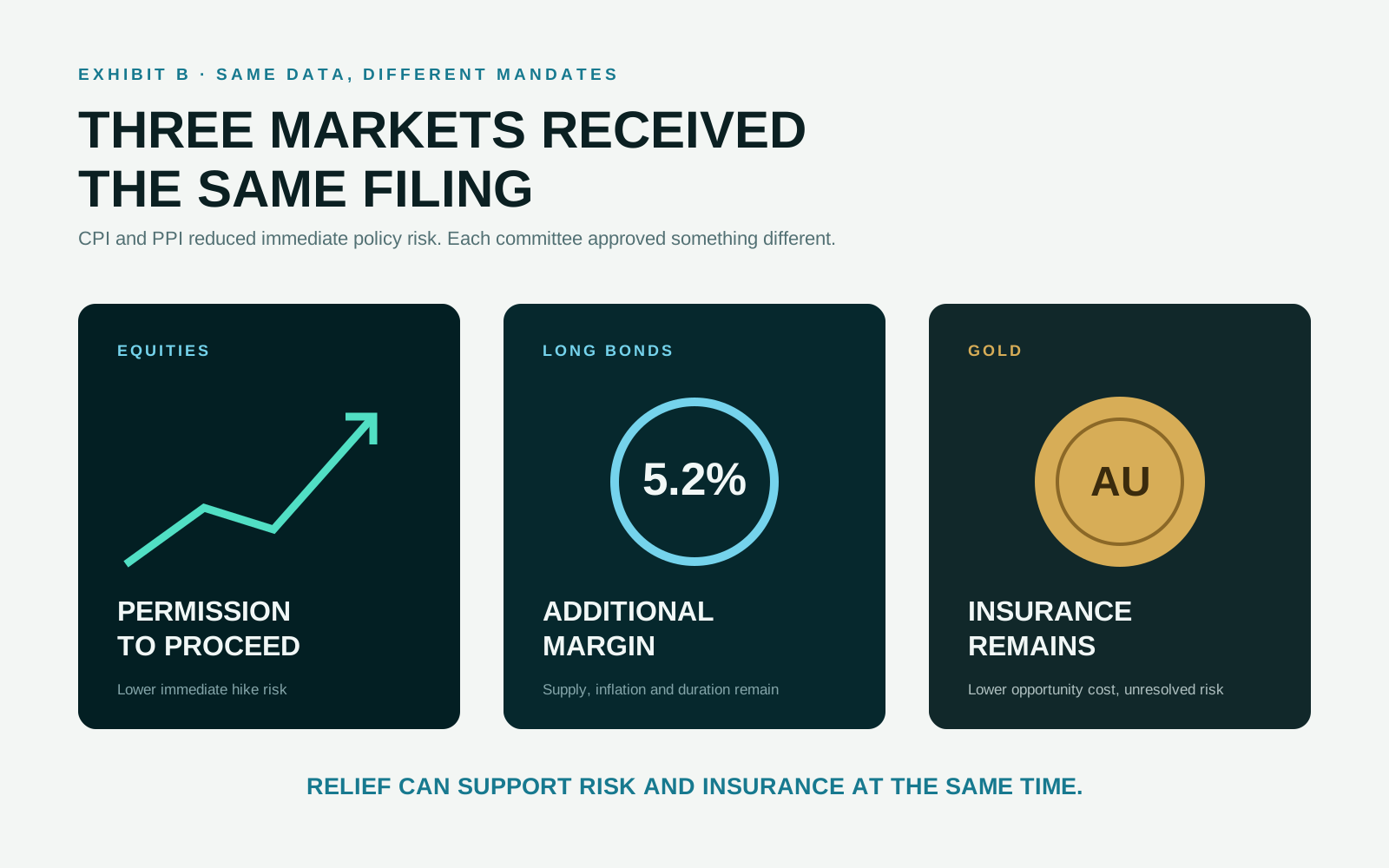
Equities rallied because the CPI report reduced the chance of near-term tightening. Gold rallied because the same reduction improved its relative appeal while inflation, fiscal supply and geopolitical risks remained unresolved. Both reactions can be rational at the same time.
One market celebrated the possibility that policy would become less restrictive. Another continued to insure against the reasons policy may struggle to remain restrictive.
The repricing has local explanations
Long-term yields have risen across several advanced economies without waiting for a single cause or a universal diagnosis.
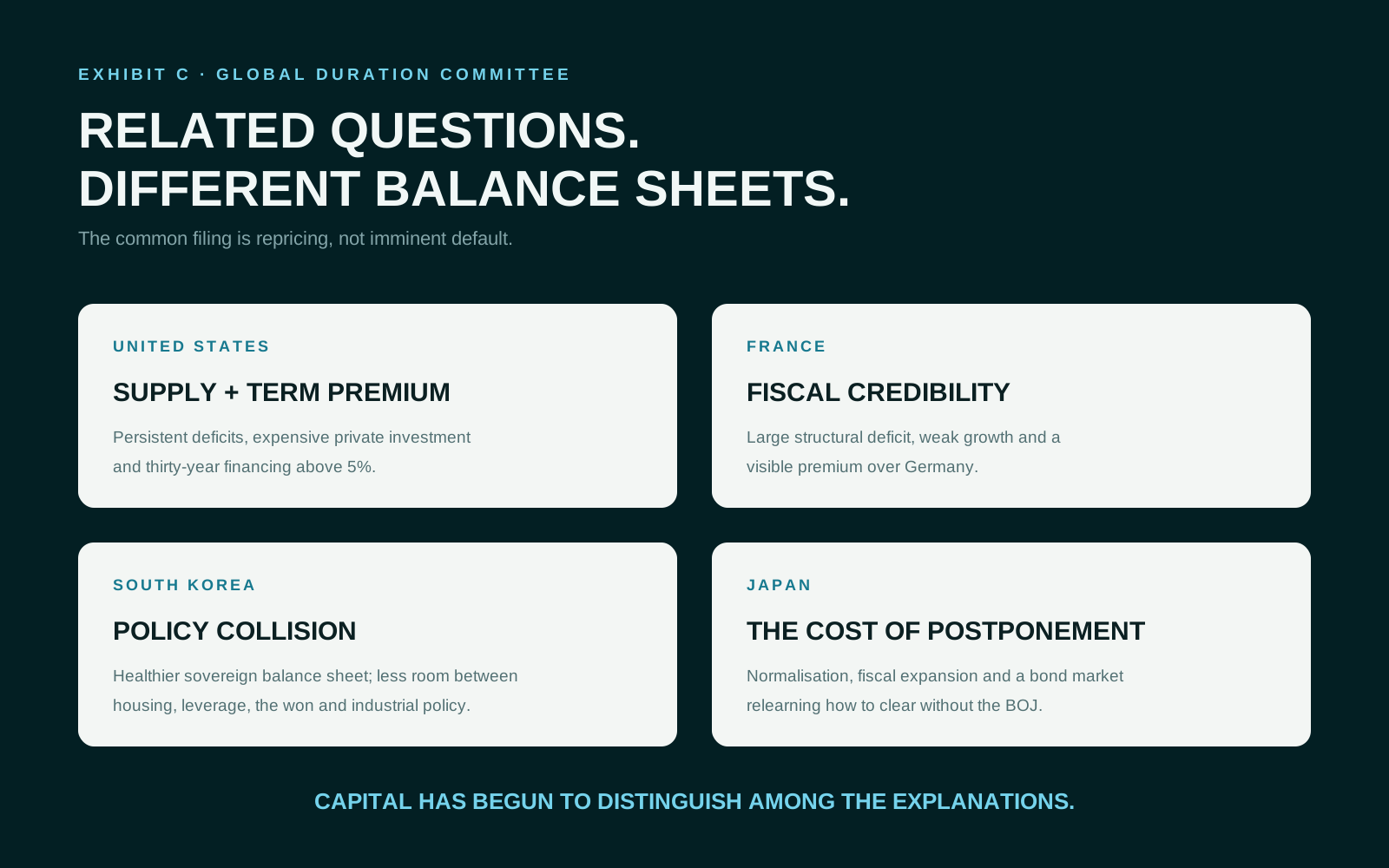
The United States is pricing inflation risk, Treasury supply, fiscal credibility and the uncertain return to expensive private investment. France adds a structural deficit and political limits to consolidation. Korea has a healthier public balance sheet but is asking it to support housing, strategic industry and domestic demand while the central bank restrains inflation and the currency. Japan is trying to normalise a bond market shaped by years of central-bank ownership while preparing more fiscal expansion. In the United Kingdom, inflation exposure and government financing requirements are also competing for investor attention. Across the euro area, long and very-long yields have steepened even where sovereign spreads remain contained.
The common filing is repricing, not imminent default.
Governments grew accustomed to financing large obligations in a world where inflation was subdued, policy rates were low and central banks were major marginal buyers. That arrangement can unwind without producing a dramatic crisis. It can simply require more interest, reduce fiscal space, raise private-sector borrowing costs and lower the valuation investors will pay for distant cash flows.
The process is slow enough to be dismissed and broad enough to matter.
What would count as repair
Management would welcome evidence that the structure is strengthening.
Repair would not require every yield to fall or every inflation measure to return immediately to target. It would require a more coherent combination:
- inflation continuing to moderate without renewed energy transmission;
- labour-market stabilisation rather than deterioration disguised by lower participation;
- fiscal trajectories becoming credible enough to reduce the term premium demanded by investors;
- long-term bond auctions clearing with durable private demand;
- productivity and earnings growth broadening beyond a narrow group of capital-intensive leaders;
- AI monetisation and cash generation beginning to catch up with expenditure;
- currencies responding to fundamentals rather than requiring repeated intervention.
Several of these improvements may occur. July CPI and headline PPI are constructive data points. The thirty-year auction showed that conventional private demand remains available at current yields. Together they may prove to be the beginning of durable disinflation and orderly market normalisation. Long yields could retreat as growth slows or geopolitical pressure eases. France may produce a credible consolidation path. Korea may convert strategic investment into broader growth without reigniting property leverage. Japan may normalise without losing control of its debt market.
That is the case against the Letter, and it is respectable. The current evidence has not completed it. It has shown that inflation was better than feared and that markets remain eager to reward any reduction in immediate policy risk.
Relief is real. Repair requires more than the absence of a worse number.
Management’s conclusion
The market received permission to defer an argument and used it efficiently. Equities rose. Rate-hike expectations fell. Gold retained most of its recent advance despite profit-taking. Oil fell until another claimed attack on refining infrastructure interrupted the decline. Governments continued paying long-term rates that would have appeared improbable during the previous decade.
None of these assets is required to deliver a single unified message. Markets are not a committee and prices do not circulate minutes.
The Chairman’s task is to identify what each market is being paid to ignore. Equities require earnings growth to outrun the cost of capital. Long bonds demand compensation for inflation, supply and duration. Gold sits outside another institution’s liability structure. Currency traders test the distance between official preference and economic incentive.
For stonkholders, this is not a price call. $STONKS lives in internet-finance culture; internet-finance culture still rents its liquidity from the wider system. When that rent rises, enthusiasm is required to work harder.
July CPI and PPI improved the near-term inflation picture. The auction then demonstrated that the Treasury can still place thirty-year debt without disorder, provided it pays 5.216%. The thesis survives in a more precise form.
Equities are looking for permission to sustain the rally. The long-bond market is not predicting where equities must go next. It is requesting additional margin for financing the journey.
Markets are permitted to celebrate the absence of a new emergency. Management is still required to inspect the old ones.
Source notes
- 01U.S. Bureau of Labor Statistics, “Consumer Price Index — July 2026,” August 12, 2026 ↗
- 02Reuters, “Market shrugs off in-line July CPI report,” August 12, 2026 ↗
- 03U.S. Bureau of Labor Statistics, “The Employment Situation — July 2026,” August 7, 2026 ↗
- 04U.S. Department of the Treasury, Daily Treasury Par Yield Curve Rates, August 12, 2026 ↗
- 05INSEE, “In 2025, the public deficit stands at 5.1% of GDP, the public debt at 115.6% of GDP,” March 27, 2026 ↗
- 06European Commission, “Economic forecast for France,” May 21, 2026 ↗
- 07Agence France Trésor, “The State budget — 2026” ↗
- 08Financial Times market data, government bond spreads, accessed August 13, 2026 ↗
- 09European Central Bank, “Financial and macroeconomic implications of the rise in very long-term yields,” Economic Bulletin Issue 2/2026 ↗
- 10Bank of Korea, “Monetary Policy Decision,” July 16, 2026 ↗
- 11Korea 10-year government-bond market data, July 2026 ↗
- 12Reuters, “South Korea to boost budget spending in bid to spur AI-led growth,” August 29, 2025, and “South Korea proposes $17.3 billion extra budget to mitigate Middle East shock,” April 2026 ↗
- 13Reuters, “South Korea unveils package to boost housing supply, support young buyers,” August 13, 2026 ↗
- 14Reuters, “Japan fund managers chase retail cash as JGB yields surge,” August 12, 2026 ↗
- 15Reuters, “BOJ’s rate-hike path runs into Takaichi’s bond market problems,” August 10, 2026 ↗
- 16Reuters, “Dollar gains, yen slips as US CPI meets expectations,” August 12, 2026 ↗
- 17Reuters, “Gold off two-month peak as traders seek inflation cues,” August 13, 2026 ↗
- 18World Gold Council, “Central Banks — Gold Demand Trends Q2 2026” ↗
- 19International Monetary Fund, “Gold in Central Bank Reserves: Strategic Considerations, Market Risks, and Practical Guidance,” June 30, 2026 ↗
- 20Reuters, “Korean ‘ants’ swarm back to Wall Street as KOSPI rout dents homecoming drive,” August 7, 2026 ↗
- 21U.S. Bureau of Labor Statistics, “Producer Price Index — July 2026,” August 13, 2026 ↗
- 22U.S. Energy Information Administration, “Weekly Petroleum Status Report,” data for week ended August 7, 2026 ↗
- 23Reuters, “Yemen’s Houthis say they attacked Saudi Aramco refinery in Jazan with two drones,” and “Oil pares losses after reports Houthis attacked Saudi Aramco refinery,” August 13, 2026 ↗
- 24Reuters, “Stocks rise as traders reduce rate hike bets, oil prices drop,” August 13, 2026, and live U.S. government-bond market data accessed shortly after 1:00 p.m. ET ↗
- 25U.S. Department of the Treasury, Fiscal Data, “Treasury Securities Auctions Data,” 30-year bond auction of August 13, 2026, CUSIP 912810UW6 ↗
- 26Bank of Japan, “Corporate Goods Price Index — July 2026” and release schedule; Reuters, “Japan’s wholesale inflation stays hot, bolstering odds of September BOJ hike” and “Rate hike bets leave yen’s post-intervention gains at BOJ’s mercy,” August 13, 2026; Bloomberg reporting on Japanese government support for a near-term move, republished by The Edge, August 13, 2026 ↗
- 27Bank of Japan, “Japan’s Post-Bubble Experience in Monetary Policy Studies,” September 16, 2010 ↗
- 28Federal Reserve History, “The Treasury-Fed Accord,” and Board of Governors of the Federal Reserve System, “Federal Reserve Experiences with Very Low Interest Rates” ↗
- 29Congressional Budget Office, “The Budget and Economic Outlook: 2026 to 2036,” February 11, 2026 ↗
Market levels reflect the cited publication cutoff. Commentary only; not financial advice.