
Stonkholders,
There were too many important stories this week, which usually means there was one story being told badly in several places.
Nvidia reported another extraordinary quarter. The Federal Reserve reminded markets that inflation still exists. The U.S. Treasury adjusted the plumbing of the long-bond market without reducing the government's financing requirement. Japan disclosed record currency intervention. France offered another reminder that developed-market fiscal arithmetic is still arithmetic. Shipping conditions through the Strait of Hormuz improved, then deteriorated again. Gold, Bitcoin and smaller companies all received fresh instructions from the bond market.
These are not the same story. They do, however, arrive at the same capital-allocation committee.
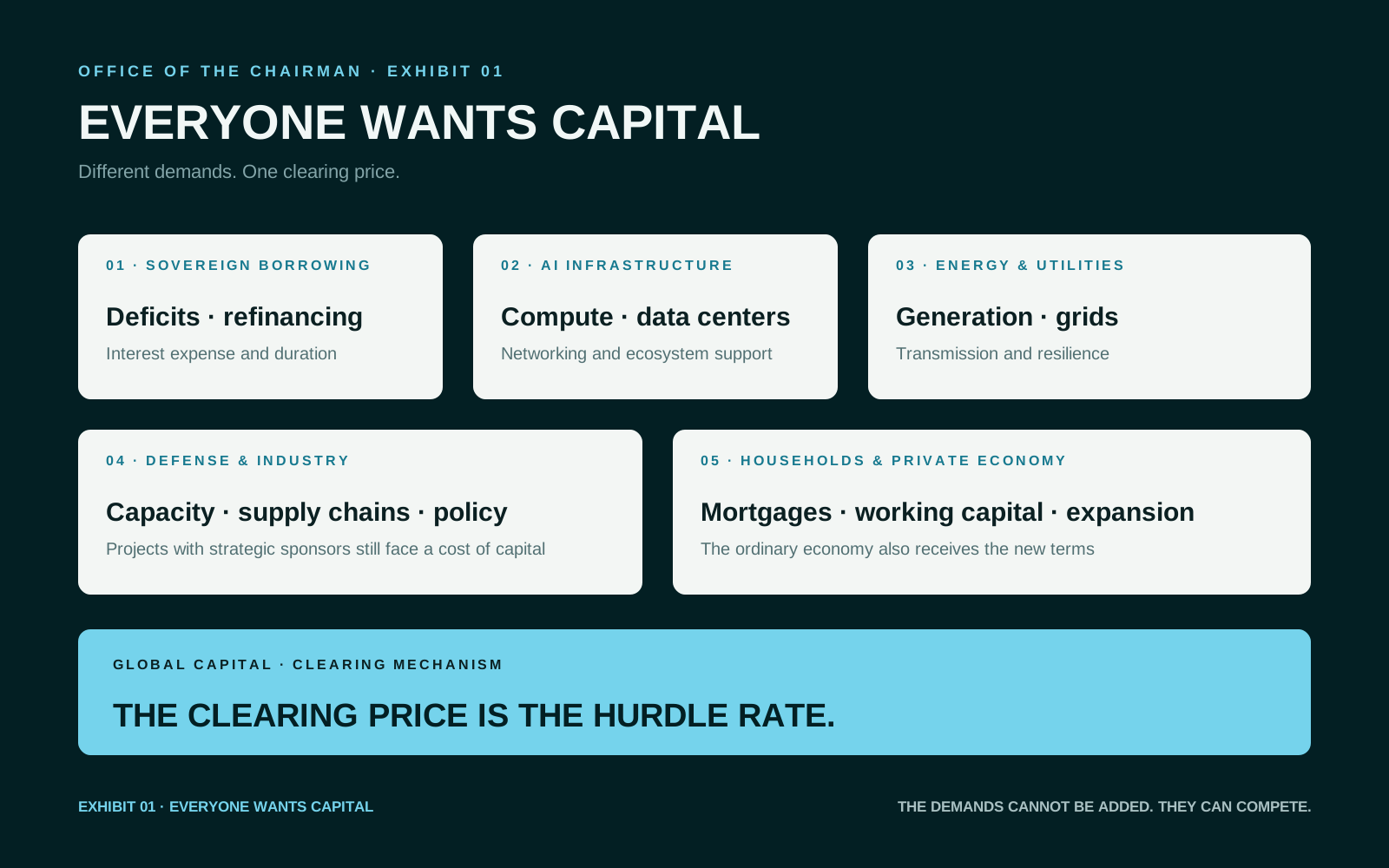
The economy is asking for cheaper capital at precisely the moment inflation, energy risk, sovereign financing requirements and monetary normalization are arguing for the opposite. Unfortunately, capital has recently rediscovered pricing.
That does not require a crisis. It only requires a higher hurdle rate.
AI Demand Is Not the Problem
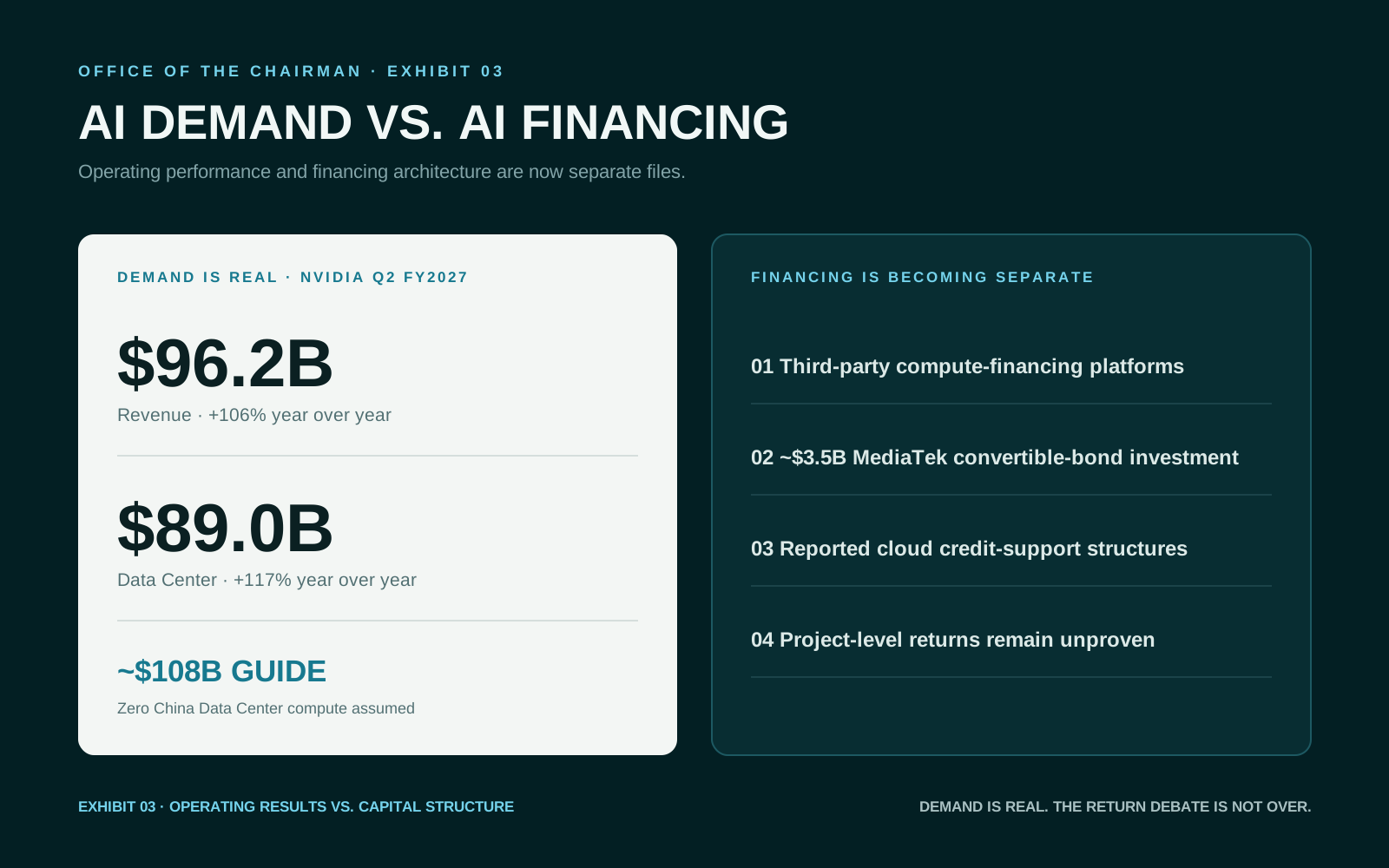
Nvidia's quarter removed any reasonable doubt about near-term demand for AI infrastructure. Revenue reached $96.2 billion, up 106% from a year earlier. Data Center revenue reached $89.0 billion, up 117%. The company guided to approximately $108 billion of revenue next quarter while assuming no Data Center compute revenue from China.
The AI demand debate is over for now. The AI return-on-capital debate is not.
Those are different debates, and collapsing them produces poor analysis. Demand can be real, urgent and enormous while the eventual return on the infrastructure remains uneven. A supplier can report exceptional revenue while its customers, financiers and ecosystem partners still have to prove that the installed capacity earns an acceptable return.
The relevant question is no longer whether the buildout exists. It is who funds it, at what price, against which cash flows, and with how much support from the firms selling the equipment.
The Financing System Around AI
That financing architecture is becoming easier to see.
Nvidia announced in its quarterly materials that it was working with major asset managers and financial institutions on compute-financing platforms intended to mobilize third-party capital over time. On Monday, Reuters reported that Nvidia would invest roughly $3.5 billion in MediaTek convertible bonds as MediaTek develops products around Nvidia's NVLink ecosystem. Separately, The Wall Street Journal reported that Nvidia had paused some proposed credit-support and revenue-sharing arrangements with smaller AI cloud providers after internal concerns about possible antitrust scrutiny.
The reported pause should not be overstated, and the MediaTek investment is not evidence of weak end demand. Together, however, these developments make the financing question more visible.
The supplier of the critical infrastructure is increasingly also helping finance, organize or support the ecosystem purchasing and integrating that infrastructure. This may be entirely rational. It may accelerate adoption and broaden access to compute. It also makes the eventual return on capital more important, not less.
The boom is real. The cost of sustaining it is becoming part of the story.
The Fed Does Not Appear Interested in Solving Everyone's Problem
Friday provided a useful live demonstration of what happens when the expected price of money changes.
At Jackson Hole, Federal Reserve Chair Kevin Warsh said the Fed would have work to do if policymakers could not be confident that underlying inflation was returning to 2%. The market moved the implied probability of a September rate increase from roughly 35% before the remarks to about 56% by Friday's close; by Monday, estimates were around 60%.
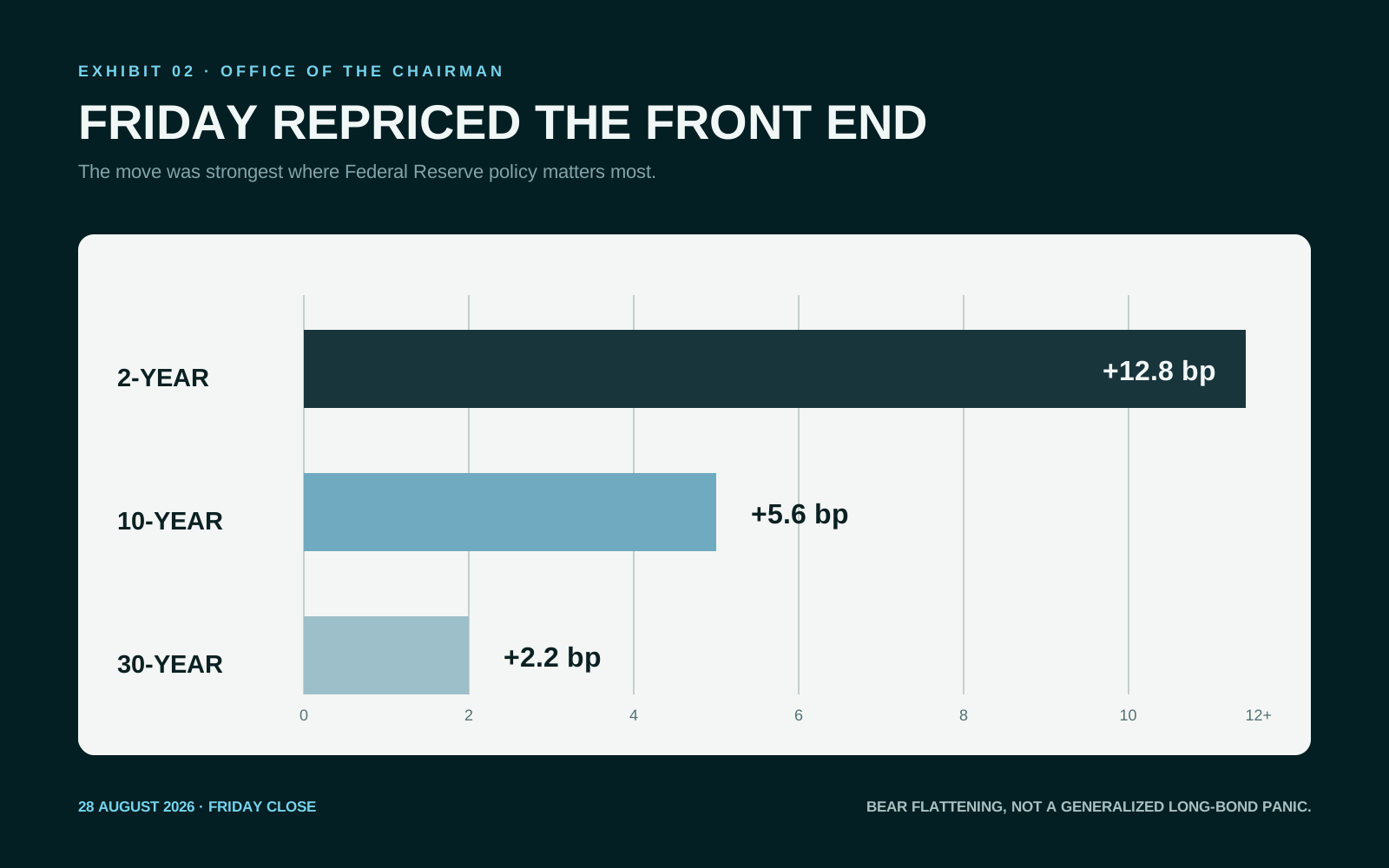
The Treasury curve did not stage a generalized revolt. It bear-flattened.
The two-year yield rose 12.8 basis points on Friday to 4.36%. The ten-year rose 5.6 basis points to 4.728%. The thirty-year rose only 2.2 basis points to 5.213%. The largest move occurred where expectations for Federal Reserve policy matter most.
By Monday morning, the two-year yield had eased toward 4.33% and the ten-year toward 4.71%. The long end remained expensive, but it did not become disorderly.
The correct interpretation is narrower than a sovereign-bond panic and more consequential than an ordinary bad afternoon. Friday was primarily a repricing of the expected cost of short-term money. Nothing fundamental about a data center, a Treasury bond or the Bitcoin network changed during those hours. The expected price of money did.
The labor data did not give the Fed an uncomplicated alternative. The Bureau of Labor Statistics' preliminary benchmark estimate showed 79,000 fewer nonfarm jobs in March 2026 than previously estimated, a revision of 0.1%. That is evidence of somewhat softer labor demand, not collapse. Inflation, meanwhile, remains too high for weaker growth alone to guarantee lower rates.
Lower growth does not guarantee lower rates. Management regrets that this sentence continues to require maintenance.
The Government Also Needs the Money
The U.S. Treasury recently increased the maximum size of liquidity-support buybacks in longer-dated nominal securities from $2 billion to at least $4 billion per operation for the remainder of the refunding quarter.
That can improve market functioning. It does not make the borrowing requirement disappear.
Buybacks can replace less-liquid securities with more-liquid ones and reduce friction in particular parts of the curve. They do not cancel scheduled issuance, reduce the deficit or create a new class of investor that has no alternative use for capital.
The U.S. government is therefore competing for financing alongside AI data centers, power generation, transmission, defense production, industrial policy, households and the rest of the private economy. These demands cannot be cleanly added into one number, but they do meet in the same markets.
The bond market is the clearing mechanism. It does not need to declare a crisis. It can simply demand a higher return.
Japan Is Running Out of Painless Options
Japan disclosed that it spent a record ¥15.4 trillion, approximately $96.5 billion, supporting the yen between July 30 and August 26. USD/JPY nevertheless remained near 160.
This is not evidence that intervention is useless. It is evidence that intervention must compete with the underlying economics of relative interest rates, fiscal policy and global capital allocation.
The adjustment is increasingly visible in Japan's own bond market. The ten-year Japanese government bond yield recently reached a three-decade high, while the two-year yield reached its highest level since the mid-1990s. Short-dated Japanese yields matter because they change the opportunity set for domestic savers and institutions. Japanese bonds become less ignorable. Overseas allocation becomes less automatic. The economics of funding global positions in permanently cheap yen become less permanent.
U.S. Treasury Secretary Scott Bessent described recent yen moves as relatively contained and not disorderly. That is important contrary evidence. Japan is not currently a disorderly-market story. It is a structural normalization story whose consequences are increasingly expressed through domestic yields.
Europe's Fiscal Problem Has Not Gone Away
France remains a warning, not a crisis.
French assets weakened as election and budget risks were repriced, then partly rebounded. The premium on French ten-year debt over German debt widened to roughly 88 basis points during August. Growth was flat in the second quarter, while preliminary August inflation rose to 2.7% on the EU-harmonized measure, helped by higher energy prices. France's domestic CPI measure was lower at 2.4%.
The market has not concluded that France is unfinanceable. It is asking what price should be attached to difficult political arithmetic: public services, industrial policy, defense, interest expense, unpopular taxes and unpopular spending cuts.
Eventually bondholders are asked to reconcile the promises. France merely received the meeting invitation early.
Hormuz Improved — Then Re-Escalated
Energy remains the cleanest example of why inflation risk is nonlinear.
By Friday, improving expectations around shipping through the Strait of Hormuz had helped oil finish lower on the day and materially lower on the week. On Sunday, U.S. forces struck two Iranian launchers on Larak Island. Iranian media subsequently reported retaliation against U.S. bases in Jordan. Brent moved back above $90 on Monday.
Operational conditions also weakened. Reuters reported that visible commodity-vessel transits through the strait fell to five per day over the weekend. UK Maritime Trade Operations issued a time-late report that a tanker had been struck by an unknown projectile while entering the strait on Saturday; no casualties or environmental impact were reported at the time of the notice.
The distinction between confirmed facts and claims matters. The U.S. strike is confirmed. Iran's reported retaliation was attributed to Iranian media and the Revolutionary Guards. The tanker incident was reported by UKMTO. Claims about other targets and damage remain contested. The strait should not be described as fully closed on the available evidence.
Several days of improving traffic can reduce the inflation impulse. One military escalation can widen the distribution of outcomes again. Energy does not move through the economy in a straight line, and it does not wait for the monthly inflation report before changing expectations.
Gold, Bitcoin and the Price of Money
Gold and Bitcoin increasingly function as expressions of concern about fiscal credibility, currency debasement and the long-run supply of sovereign liabilities. They are not exempt from the price of money.
On Friday, the dollar index rose 0.61% to 99.71. Gold fell 3.19%. Bitcoin fell 3.34% to roughly $77,400. USD/JPY moved above 160. By Monday morning, the dollar index had eased toward 99.5 and Treasury yields had partly retraced, but the central message remained intact.
Assets can express a long-run concern about fiat institutions and still fall when expected real rates and the dollar rise. Structural dollar weakness is challenged in the near term, not disproven. The same qualification applies to store-of-value trades: a persuasive long-run narrative does not remove the discount rate.
Leverage Remains a Terrible Substitute for Conviction
The crypto move became more mechanical as Friday progressed. CoinGlass data reported by market publications put total 24-hour liquidations near $486 million, including roughly $368 million of long positions. Bitcoin did not continue cascading lower over the weekend.
That makes the episode look more like a leverage reset following a macro repricing than a crypto-specific fundamental break.
Leverage converts an ordinary change in price into a forced change in ownership. The asset does not need to become worthless. The holder merely needs to become undercapitalized before the thesis has time to recover.
Management continues to believe that liquidity matters. Management is less convinced that borrowing money to prove this point is necessary.
Something Changed Beneath the Indexes
The broad market remained notably calm.
On Friday, the S&P 500 fell 0.25%, the Nasdaq Composite fell 0.52%, and the Dow was essentially flat. The Russell 2000 fell 1.4%. Monday futures were modestly lower rather than disorderly. Major indexes remained broadly intact after an exceptional Nvidia quarter and a sharp shift in rate expectations.
This is the most important contrary observation in the letter.
Markets noticed the higher cost of capital, but they did not break. Smaller companies and rate-sensitive assets weakened more because their financing needs, cash-flow duration and balance-sheet flexibility make the hurdle rate more immediate. Large index weights and strong cash-generating firms can absorb the first adjustment more easily.
The repricing of capital does not need to produce a crisis to matter. It only needs to increase dispersion between strong and weak borrowers, businesses, sovereigns and trades.
External Conditions Ledger
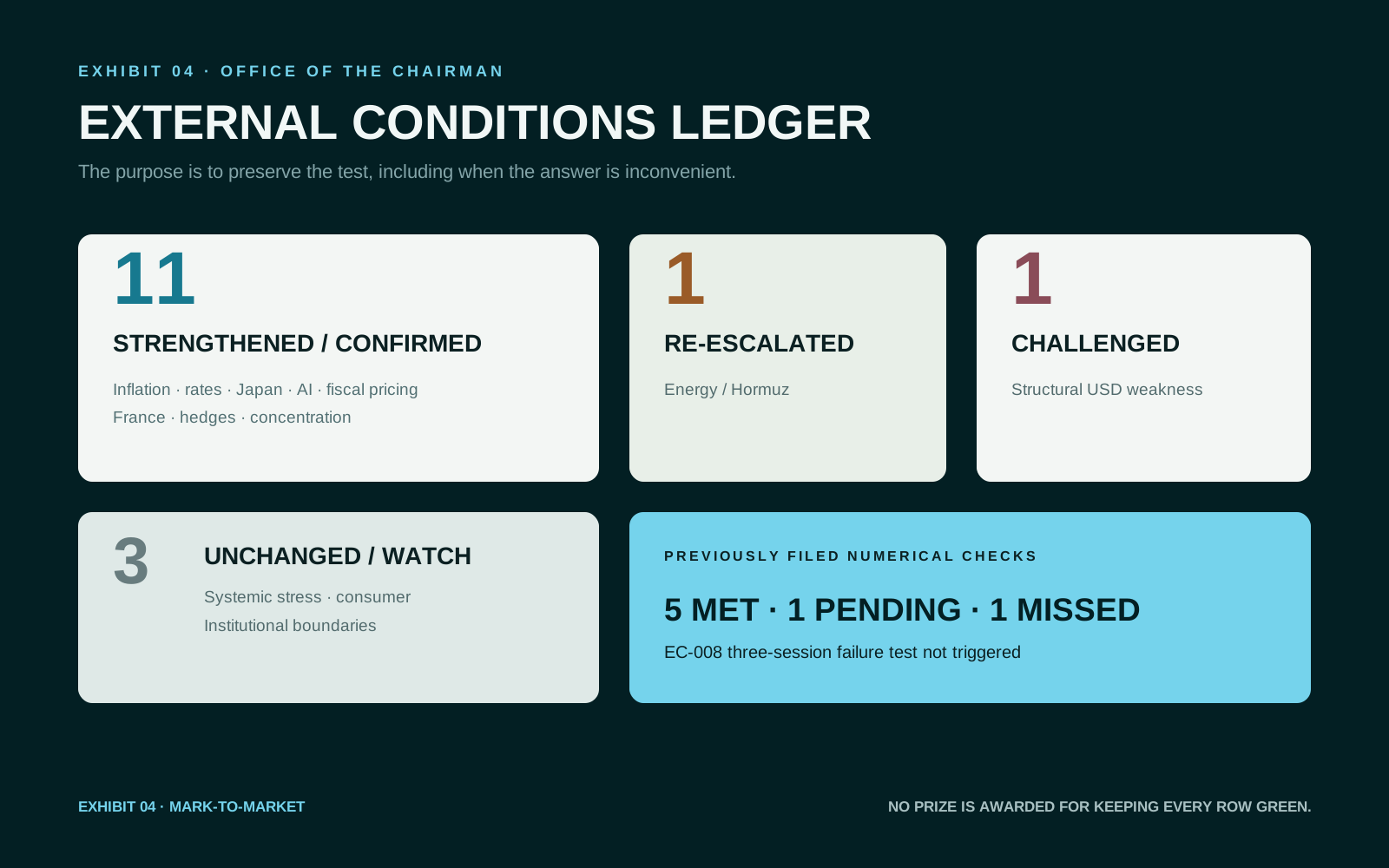
A research process that only records evidence supporting its existing views is advertising. Management has enough departments already.
The purpose of the ledger is not to prove management correct. It is to prevent management from forgetting what it previously believed.
Previously Filed Thresholds
The numerical tests below retain the levels filed in Chairman’s Letter #006. They have not been revised to improve this week’s result. Friday’s Treasury closes were 4.360% for the two-year, 4.728% for the ten-year and 5.213% for the thirty-year.
| Filed condition | Original threshold / failure test | Friday check | Result |
|---|---|---|---|
| EC-001 · Long bond demands additional margin | 30Y ≥ 5.00% | 5.213% | Met |
| EC-002 · Long end remains separated from ten-year | 30Y–10Y ≥ 40 bp | 48.5 bp | Met |
| EC-003 · Weak hiring coexists with expensive duration | 30Y–2Y ≥ 85 bp | 85.3 bp | Met, narrowly |
| EC-004 · France retains a premium to Germany | France–Germany 10Y ≥ 60 bp | Roughly 88 bp during August | Met |
| EC-005 · Labour-market weakening persists | Unemployment ≥ 4.0% | No new unemployment release; the filed 4.1% observation remains the latest official test | Pending new release |
| EC-006 · Long end prices more than the cycle | 10Y ≥ 4.50% | 4.728% | Met |
| EC-007 · August auction was a receipt, not a ceiling | 30Y ≥ 5.216% | 5.213% | Not met by 0.3 bp |
| EC-008 · Alternative stores of value share a macro bid | Failure requires gold and Bitcoin below their fixed filing marks—$4,602.99 and $77,055.15—while 30Y remains above 5.00%, for three overlapping sessions | Gold fell below its mark; Bitcoin ended Friday near $77,400; 30Y remained above 5.00%. No three-session overlap. | Failure test not triggered |
EC-008’s silver filing mark of $68.81 remains corroborating evidence only; it cannot trigger the test. A pending release is not a breach, and a threshold miss is recorded even when the margin is inconveniently small.
| Standing external condition | Status | Evidence this week | Evidence against / qualification |
|---|---|---|---|
| Inflation remains more persistent than markets expect | Strengthened | Warsh emphasized insufficient progress; energy re-escalated; French HICP rose to 2.7%. | Labor demand was revised slightly lower; Friday's oil move initially reflected improving Hormuz expectations. |
| Lower growth does not guarantee lower rates | Materially strengthened | Softer BLS benchmark estimate coincided with higher hike odds and a sharp two-year yield move. | The benchmark revision was only -0.1% and remains preliminary. |
| Fed easing cannot be assumed | Materially strengthened | September hike probability rose from about 35% to roughly 56-60%. | Monday yields partly retraced; the outcome still depends on incoming data. |
| Long-end rates remain an important constraint | Strengthened, not crisis | Ten-year ended Friday near 4.73%; thirty-year remained above 5.21%. | Friday's largest move was at the front end; long bonds did not sell off disorderly. |
| Japan / yen normalization | Structural global macro risk; domestic yields increasingly matter | Record ¥15.4T intervention; Japanese two- and ten-year yields at multi-decade highs. | Bessent called recent yen moves contained and not disorderly. |
| AI demand remains structurally strong | Strongly confirmed | Nvidia revenue +106% YoY; Data Center +117%; $108B next-quarter guide. | Exceptional supplier revenue does not establish returns for every buyer or project. |
| AI financing / ROI is an emerging vulnerability | Further strengthened | Compute-financing platforms, MediaTek convertible bonds and reported cloud credit-support structures make financing more visible. | Financing support may broaden access and be economically rational; it is not proof of weak demand or poor returns. |
| Fiscal policy is becoming a market-pricing variable | Strengthened | Treasury expanded long-end liquidity buybacks; sovereign term premia remain elevated. | Buybacks improved market functioning; U.S. markets remained orderly. |
| France is an early developed-market fiscal warning | Strengthened, not crisis | Wider OAT-Bund spread, flat Q2 growth and higher harmonized inflation. | French equities partly rebounded; market access remains intact. |
| Energy remains a nonlinear inflation risk | Re-escalated; active | Larak strikes, reported retaliation, lower visible transits, tanker incident and Brent above $90. | Oil still headed for a modest August decline; the strait is not verified as fully closed. |
| Gold / Bitcoin increasingly express fiscal-debasement concerns | Supported, explicitly rate-sensitive | Both remain prominent long-run monetary hedges. | Both fell sharply as the dollar and expected rates rose Friday. |
| Structural USD weakness | Challenged near term | None material this week. | DXY rose to 99.71 Friday and remained near 99.5 Monday. |
| Market concentration remains a vulnerability | Strengthened modestly | Rate-sensitive smaller caps underperformed; Nvidia continued to dominate index-level interpretation. | Major indexes remained resilient and finished the episode broadly functional. |
| Broad systemic market stress | Not confirmed | Cross-asset repricing and crypto liquidations showed tighter conditions. | No disorderly long-bond move, equity break or continuing Bitcoin cascade. |
| Consumer bifurcation | No material update | No new evidence strong enough to change the standing view. | No new evidence strong enough to weaken it either. |
| U.S. financial-policy credibility / institutional boundaries | Emerging watch item | Treasury buybacks, currency intervention cooperation and competing philosophies around the price of money merit monitoring. | Current actions remain within recognizable policy and market-functioning frameworks. |
What Would Make Management Change Its Mind?
This thesis would weaken if several of the following occurred:
- Long-term Treasury yields declined sustainably despite heavy sovereign issuance and private-sector capital demand.
- Inflation returned convincingly toward target and energy markets normalized for more than a few sessions.
- The Bank of Japan backed away from normalization and the yen stabilized without repeated intervention.
- AI infrastructure increasingly funded itself from internally generated customer cash flows rather than larger support and financing structures.
- France's fiscal premium faded without higher yields, material consolidation or weaker growth.
- Equity participation broadened and rate-sensitive assets improved despite high yields.
The portfolio does not receive additional returns because the Chairman successfully worried about something. The purpose of an invalidation list is to identify when worry has become stale inventory.
Everything Is Competing for Capital
Friday gave markets a compact demonstration. Short-term yields rose sharply. The dollar strengthened. Gold and Bitcoin fell. Leverage was liquidated. Smaller companies weakened more than the largest indexes.
And yet the broader market remained intact.
That may be the more important observation. The repricing of capital does not need to produce a crisis to matter. It needs to change the hurdle rate.
Artificial intelligence still has to earn its infrastructure. Governments still have to fund their deficits. Investors still have to justify duration. Leveraged traders still have to survive volatility. Energy systems, utilities, defense programs, households and private businesses still arrive at the same market looking for financing.
The strongest borrowers will continue to borrow. The strongest businesses will continue to invest. The most credible projects will continue to attract capital. The difference is that weaker claims will increasingly be asked to explain themselves.
Everything is competing for capital. And capital is beginning to set terms again.
Source notes
- 01NVIDIA, “NVIDIA Announces Financial Results for Second Quarter Fiscal 2027,” August 26, 2026. Revenue, Data Center revenue, growth rates, guidance and China assumption. ↗
- 02Reuters, “Nvidia invests $3.5 billion in MediaTek convertible bonds,” August 31, 2026. ↗
- 03*The Wall Street Journal*, “Nvidia Pauses Revenue-Sharing Deals With AI Cloud Companies,” August 27, 2026. Reported credit-support/revenue-sharing pause and stated antitrust concern. ↗
- 04U.S. Bureau of Labor Statistics, “Current Employment Statistics Preliminary Benchmark (National) — March 2026,” August 28, 2026. ↗
- 05Reuters, “Stocks fall while dollar, bond yields rise as Warsh prompts rate hike bets,” August 28, 2026. Friday rates, equities, dollar, gold, Bitcoin and Fed probability. ↗
- 06Reuters, “Barclays sees two more Fed rate hikes this year after Warsh speech,” August 31, 2026. Monday FedWatch probability. ↗
- 07Reuters, “US stock futures down as Middle East strikes fuel inflation fears,” August 31, 2026. Monday futures. ↗
- 08U.S. Treasury, “Treasury Announces Increased Sizes of Nominal Long-End Liquidity Support Buybacks Beginning September 9,” August 19, 2026. ↗
- 09Reuters, “Bessent pushes back on fears over US debt market strains,” August 31, 2026. Buyback rationale and orderly-market qualification. ↗
- 10Reuters, “Japan spent record $96.5 billion to support yen over past month, ministry data shows,” August 28, 2026. ↗
- 11Reuters, “Japan's 10-year yield hits three-decade peak on inflation worries,” August 18, 2026. ↗
- 12Reuters, “Bessent says yen moves ‘pretty contained’ and not disorderly,” August 30, 2026. ↗
- 13Reuters, “Record debt and election politics raise stakes for French budget,” August 27, 2026. ↗
- 14INSEE, “In August 2026, consumer prices should increase by 2.4% year on year,” August 28, 2026. CPI 2.4%; HICP 2.7%; both preliminary. ↗
- 15Reuters, “Flat French growth in the second quarter puts outlook at risk,” August 28, 2026. ↗
- 16Reuters, “Oil rises over 3% as US and Iran resume military attacks,” August 31, 2026. Larak strike, attributed Iranian retaliation, vessel traffic and Brent. ↗
- 17UK Maritime Trade Operations, Warning 122-26, issued August 30, 2026. Time-late tanker incident report; no casualties or environmental impact reported at issuance. ↗
- 18CoinGlass data reported by CoinPedia, August 28, 2026. Approximately $485.9 million total liquidations and $368 million long liquidations. Treat as third-party market data, not an audited figure. ↗
Market levels reflect the cited publication cutoff. Commentary only; not financial advice.